The first thing my mother did when I reached for the buttons of her coat was scream.
The second thing she did was grab my wrist with both hands and whisper:
“Please, Elena. Don’t let Julian know you saw.”
I froze.
My mother was seventy-eight years old.
She had spent most of her life afraid of almost nothing.
She had raised two children after my father died, managed a small accounting office until she was seventy, and once chased a burglar off her porch with nothing but a broom and language I had never heard her use before.
But now she was trembling because I wanted to help her take off a coat.
And it was nearly seventy-five degrees inside the house.
That was when I knew something was terribly wrong.
I had driven six hours to surprise Mom for her birthday.
Julian, my older brother, had moved into her house with his wife Chloe eight months earlier.
According to him, Mom had become forgetful.
Nothing serious, he insisted.
She misplaced keys.
Forgot appointments.
Repeated questions.
Julian told everyone he and Chloe had “put their lives on hold” to care for her.
I wanted to believe him.
Maybe I needed to believe him.
My career kept me away more than I liked. I worked long hours as an assistant attorney general, and although I called Mom regularly, I hadn’t visited in three months.
That guilt would eventually become the weapon Julian used against me.
When I arrived, Chloe opened the door.
She was wearing a gold necklace I recognized immediately.
It had belonged to my grandmother.
I almost asked why she was wearing it.
Instead, I smiled.
“Surprise.”
Chloe didn’t smile back.
“You should’ve called.”
“It wouldn’t be much of a surprise if I called.”
“Your mother gets confused when plans change.”
Something about the way she said your mother bothered me.
Then Mom appeared behind her.
My heart sank.
She looked twenty pounds lighter.
Her cheeks were hollow.
Her hair had become thin.
And despite the warmth inside the house, she wore a thick gray wool coat buttoned all the way to her neck.
“Mom?”
Her eyes filled with tears.
“Elena.”
She started toward me.
Then Chloe turned around.
Mom stopped.
That tiny hesitation told me more than any sentence could have.
I opened my arms.
Mom finally hugged me.
She felt frighteningly small.
At dinner, Julian gave me a performance.
He showed me grocery receipts.
Medication schedules.
Doctor appointments.
Bills.
He even showed me a power of attorney supposedly authorizing him to manage Mom’s finances.
“She can’t handle money anymore,” he explained.
Mom sat silently at the table.
“What happened to the investment accounts?” I asked.
Julian’s fork stopped for half a second.
Then he smiled.
“What investment accounts?”
“The two Dad left her.”
“They’re being managed.”
“By whom?”
“Me.”
I looked at Mom.
She lowered her eyes.
Chloe laughed.
“Elena, you haven’t been here. You have no idea how difficult things have become.”
“You’re right.”
That surprised them.
I smiled.
“I should help while I’m here.”
Julian relaxed.
“Exactly.”
But I wasn’t relaxing.
I was watching.
That evening, I offered to help Mom bathe.
The reaction was immediate.
“No!”
A drinking glass slipped from her fingers and shattered.
Julian shouted from downstairs.
“Everything okay?”
“Yes!” I called. “I dropped something.”
I looked at Mom.
She was crying.
“Please,” she whispered. “Don’t take off my coat.”
I locked the bathroom door.
Then I turned on the shower.
“What happened?”
Mom shook her head.
“Tell me.”
“They’ll hear.”
“The shower is running.”
“Elena…”
“I need to know.”
Slowly, I reached for her coat.
This time she let me remove it.
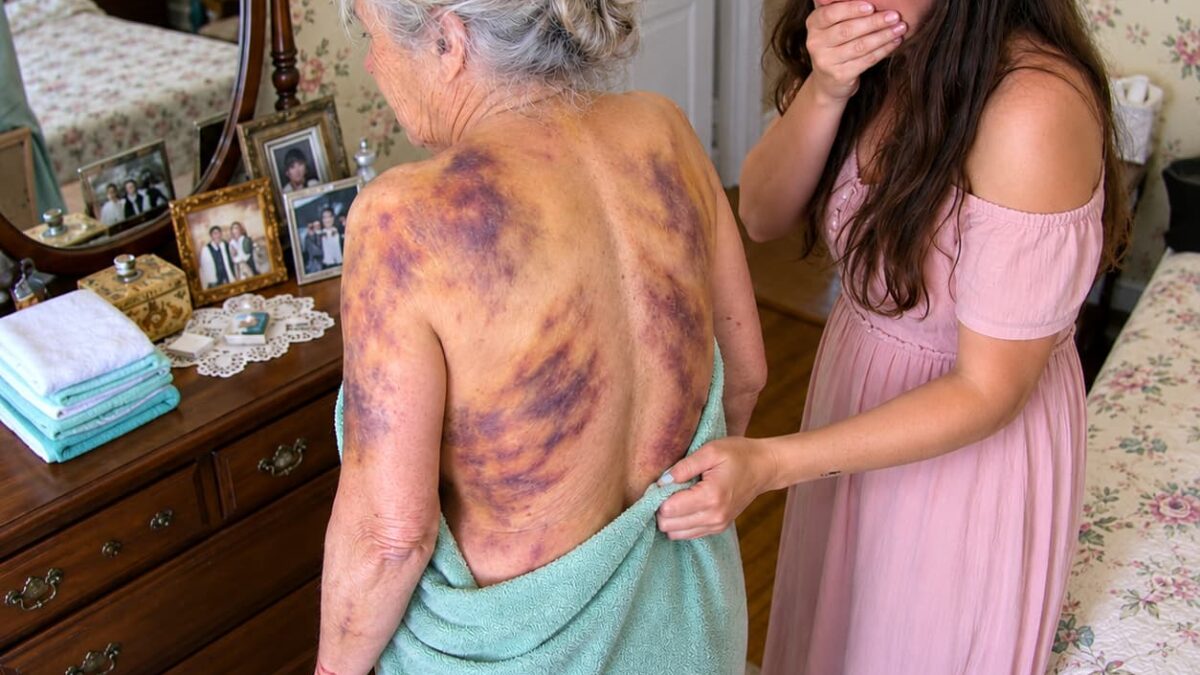
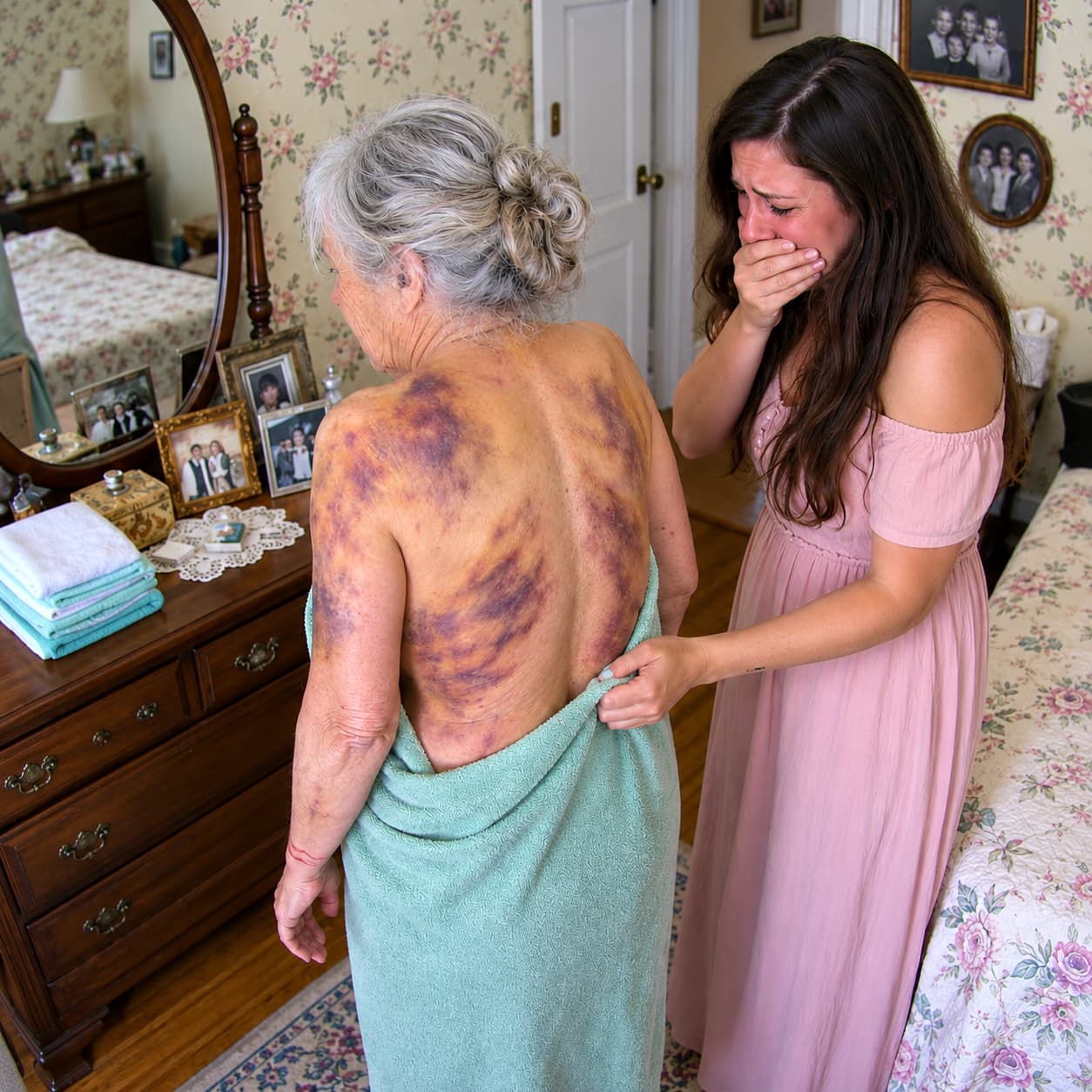
I will never forget what I saw.
Dark bruises covered her ribs.
Purple marks stretched across her shoulders.
Older yellow bruises disappeared beneath newer ones.
And around both wrists were deep red marks.
Restraint marks.
I had seen enough evidence photographs in my career to recognize them immediately.
My hands started shaking.
“Who did this?”
Mom began sobbing.
“Julian.”
My stomach turned.
“And Chloe.”
I closed my eyes.
For one dangerous moment, I wanted to go downstairs and confront them.
But anger is useful only when you control it.
So I asked questions.
“What happened?”
Mom told me everything.
Julian had gradually taken control of her finances.
First, he offered to pay bills.
Then he took her bank cards.
Then he changed passwords.
When she objected, he told relatives she was becoming confused.
Soon he was telling doctors the same thing.
He and Chloe sold her lake cabin.
They liquidated investments.
They pressured her to sign a new will.
When she refused, the intimidation became physical.
“They tie me to the bed sometimes,” Mom whispered.
I felt sick.
“Why?”
“When I won’t sign things.”
She looked at me.
“They tell me nobody will believe me because I’m old.”
“Did you try to call me?”
“Twice.”
“What happened?”
“Julian broke my phone.”
I swallowed hard.
“He told me you didn’t want to be bothered.”
That sentence nearly broke me.
But I couldn’t afford to break yet.
I photographed every visible injury.
Then, with Mom’s permission, I recorded her statement.
I asked dates.
Names.
Account information.
Property details.
Where documents were kept.
Who had witnessed what.
Then I called someone Julian never expected me to call.
“Judge Thorne,” I said quietly when he answered, “this is Elena Vance. I need guidance on obtaining emergency protection for an elderly adult tonight.”
His tone changed immediately.
“What happened?”
“I have reason to believe my mother is being abused and financially exploited.”
“Is she in immediate danger?”
“Yes.”
“Then don’t confront the suspected abusers. Call local law enforcement and adult protective services. Preserve everything you have.”
“I already started.”
“I assumed you would.”
Forty minutes later, Julian knocked on the bathroom door.
“Elena?”
I opened it only a few inches.
“What?”
“Why are you taking so long?”
“Mom isn’t feeling well.”
His eyes narrowed.
“Let me see her.”
“No.”
For the first time, his expression changed.
Not concern.
Fear.
“Elena, she’s my mother too.”
“Then give her some privacy.”
He stared at me.
Then he smiled.
It wasn’t a friendly smile.
“You always did enjoy acting important.”
I closed the door.
Behind me, Mom whispered:
“He knows.”
“That’s okay.”
“No, you don’t understand.”
Her voice shook.
“He gets worse when he thinks he’s losing control.”
I squeezed her hand.
“He’s already lost it.”
The doorbell rang twenty-five minutes later.
Julian answered.
I heard voices downstairs.
“What is this?”
Then another voice.
“Mr. Vance, we’re responding to a welfare concern involving Margaret Vance.”
Silence.
Then Julian shouted my name.
“Elena!”
I walked downstairs.
Two police officers stood near the entrance.
A representative from adult protective services was with them.
Chloe had gone pale.
Julian pointed at me.
“This is ridiculous. My sister is creating drama because she hasn’t been involved in our mother’s care.”
I said nothing.
The APS investigator asked:
“May we speak with your mother privately?”
Julian immediately replied:
“She gets confused.”
“I asked whether we could speak with her.”
“I manage her medical decisions.”
“Sir, please step aside.”
That was the first moment I saw Julian understand that the story was no longer his to control.
Mom was examined that night.
Her injuries were documented independently.
The next morning, an emergency protective order was issued while authorities investigated.
Julian and Chloe were prohibited from contacting her.
But that was only the beginning.
Because once investigators started following the money, the story became much worse.
The lake cabin had indeed been sold.
The proceeds had not gone toward Mom’s care.
They had moved through several accounts.
One belonged to Julian.
Another was connected to Chloe.
Investigators also found large purchases.
A luxury SUV.
Jewelry.
Vacations.
Credit-card payments.
Home renovations.
And then there was the new will.
The signature looked like Mom’s.
But the date created a problem.
According to medical records, Mom had been hospitalized that day.
She could not have signed the document at the location listed.
The notary information raised additional questions.
So did several other documents.
Julian had spent months constructing a paper fortress.
He thought paperwork made theft legitimate.
Instead, it created a trail.
Three weeks later, Julian called me from an unknown number.
I answered.
“You destroyed my life.”
I almost laughed.
“No.”
“You turned Mom against me.”
“No.”
“You brought police into our family.”
“No, Julian.”
I paused.
“You did all of this. I just stopped helping you hide it.”
He went silent.
Then he said:
“You weren’t there.”
That part was true.
I hadn’t been there enough.
And I would carry that regret for a long time.
But guilt and responsibility are not the same thing.
“You’re right,” I said. “I should have visited more.”
He seemed surprised.
“But my absence didn’t put bruises on her body.”
Silence.
“It didn’t tie her wrists.”
More silence.
“And it didn’t move her money.”
He hung up.
The legal process lasted more than a year.
There was no magical courtroom scene where everything was solved in ten minutes.
Financial records had to be reconstructed.
Witnesses were interviewed.
Medical evaluations were performed.
Documents were examined.
Some of Mom’s money was recovered.
Some was gone forever.
The cabin could not simply be returned as though nothing had happened.
The new will was challenged, and Mom worked with independent counsel to put her affairs back in order.
Julian and Chloe faced consequences based on the evidence authorities were able to establish.
But the most important victory wasn’t financial.
It happened three months after I found those bruises.
Mom was living with me temporarily.
One morning, I found her sitting on the back porch.
She wasn’t wearing a coat.
Just a pale blue cardigan.
Sunlight touched her arms.
For the first time in months, there was nothing she was trying to hide.
I sat beside her.
“Coffee?”
“Yes.”
I handed her a cup.
For a while, we said nothing.
Then she whispered:
“I thought you wouldn’t believe me.”
My chest tightened.
“Why?”
“Because Julian kept telling me you thought I was losing my mind.”
I put down my cup.
“Mom, look at me.”
She did.
“I believe you.”
She started crying.
So did I.
Recovery wasn’t simple.
Mom still startled when doors slammed.
She hated having anyone stand behind her.
For months, she slept with a lamp on.
We found her a therapist experienced in elder trauma.
She also underwent a full medical and cognitive evaluation.
Yes, she had some normal age-related memory difficulties.
But she was not the helpless, incompetent woman Julian had portrayed.
That lie had been convenient.
If everyone believed Mom couldn’t remember, then nobody had to listen when she spoke.
So we started listening.
Really listening.
She chose where she wanted to live.
She chose who handled her finances.
She chose her doctors.
She chose what happened to her property.
And, most importantly, she chose who was allowed into her life.
On her eightieth birthday, I drove her to a small restaurant overlooking the river.
There were no extravagant gifts.
Mom didn’t want them.
She wanted lemon cake.
She wanted flowers.
And she wanted the window table.
Halfway through dinner, she reached into her handbag and handed me an envelope.
“What is this?”
“A letter.”
“For what?”
“For later.”
“Later when?”
She smiled.
“When I’m not around to embarrass you anymore.”
“Mom.”
“Just read it someday.”
I put the envelope away.
But later that night, curiosity won.
I opened it.
There were only a few lines.
Elena,
For a while, I thought getting old meant becoming invisible.
Then you came home and looked at me.
Not at my age.
Not at the paperwork.
Not at what Julian said I was.
You looked at me.
Sometimes being saved begins with someone believing that your voice still matters.
Thank you for hearing mine.
I sat alone at my kitchen table and cried.
People sometimes ask why I didn’t confront Julian the moment I saw the bruises.
The answer is simple.
Because confrontation was what he expected.
He expected anger.
He expected shouting.
He expected a family argument he could later describe as an unstable sister overreacting.
Instead, I documented.
I listened.
I called people whose job was to protect vulnerable adults.
I let evidence speak where rage could not.
Julian believed his greatest protection was Mom’s age.
He thought forgetfulness made her powerless.
He thought fear made her silent.
He thought my career made me too busy to notice.
He was wrong about one thing.
I noticed.
And once I did, I refused to look away.
I’ll never forget the afternoon my seventy-eight-year-old mother begged me not to remove her coat.
At first, I thought she was ashamed of what was underneath.
Later, I understood.
She wasn’t ashamed.
She was terrified of what would happen if someone finally saw the truth.
So I made her a promise.
She would never have to hide beneath that coat again.
And she never did.