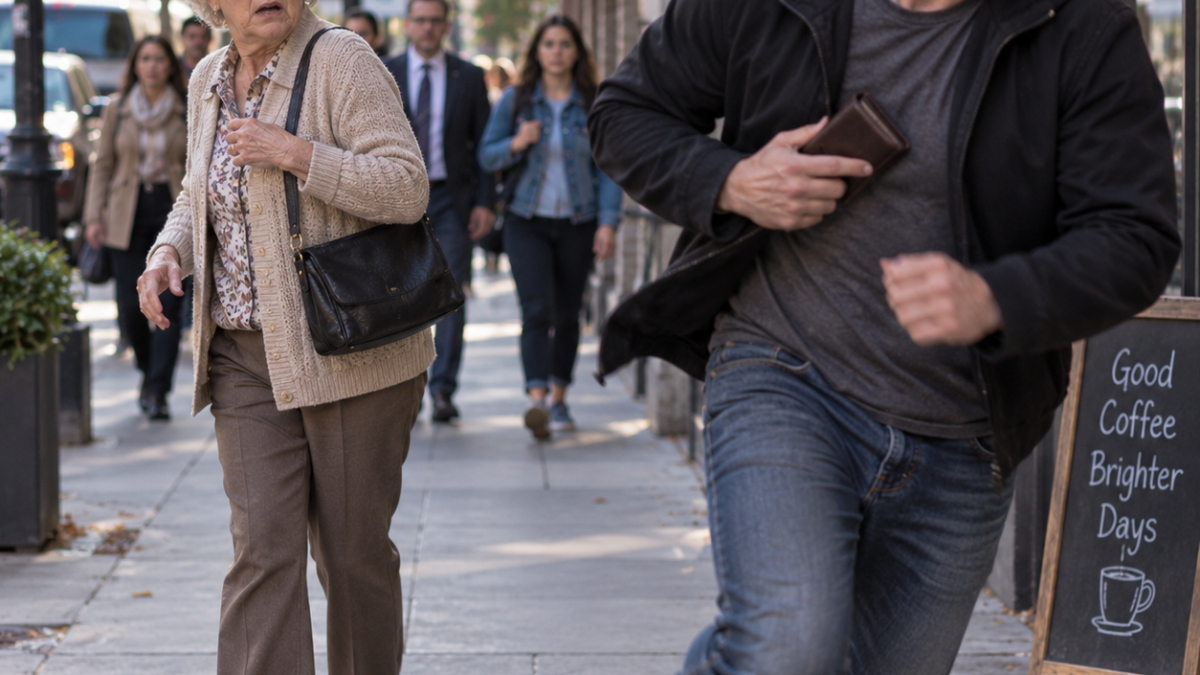
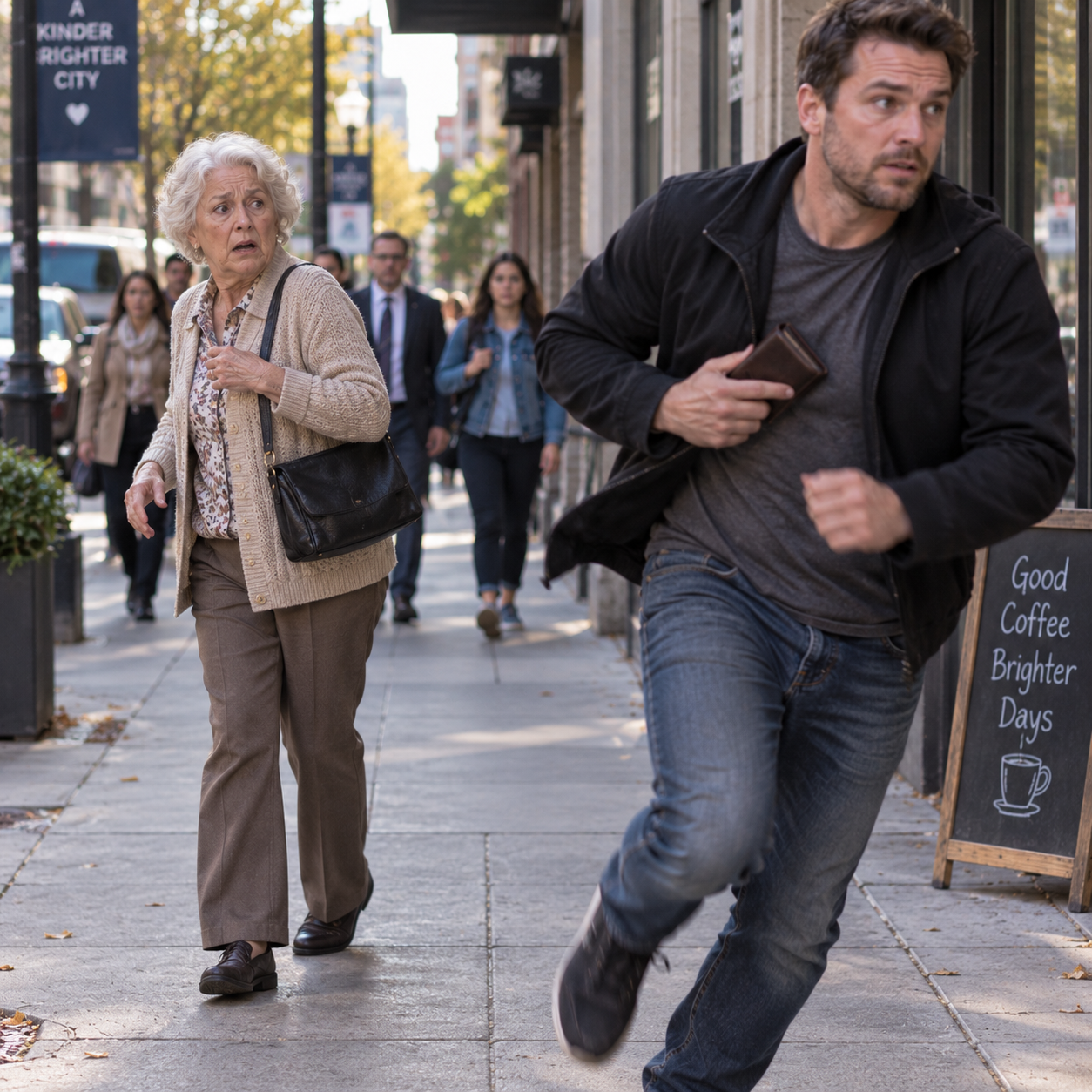
The wallet hit the sidewalk without Dorothy noticing.
Kevin did.
He was walking only ten feet behind her.
The street was crowded.
Cars passed.
People moved between stores.
A bus stopped at the corner.
Dorothy, seventy-five years old and wearing a simple gray coat, continued walking slowly toward the intersection.
Kevin looked down.
A brown leather wallet lay beside his shoe.
He looked at Dorothy.
Then at the wallet.
“Ma’am—”
The word almost left his mouth.
Then he stopped.
He picked it up.
It was thick.
Kevin squeezed it slightly.
There was definitely cash inside.
Dorothy kept walking.
Kevin glanced around.
Nobody seemed to be watching.
For three seconds, he stood completely still.
He could call her.
He could run forward.
Hand it back.
She would probably smile.
Maybe thank him.
Instead, Kevin slipped the wallet inside his jacket.
Then turned around.
And walked quickly in the opposite direction.
After twenty feet, he began running.
Dorothy reached the corner.
She put her hand into her coat pocket.
Nothing.
She stopped.
Checked the other pocket.
Then her handbag.
Her expression changed.
“No.”
She searched again.
“No, no, no…”
People walked around her.
Dorothy turned toward the street she’d just come from.
Her wallet was gone.
She began walking back.
Faster than before.
Looking at the pavement.
Under benches.
Beside trash cans.
Near the curb.
“Please…”
Her hands trembled.
She stopped a young woman.
“Excuse me. Did you see a brown wallet?”
The woman shook her head.
“Sorry.”
Dorothy continued searching.
Her eyes filled with tears.
But it wasn’t the cash she was thinking about.
It was the photograph.
Three blocks away, Kevin entered an alley beside a coffee shop.
He leaned against the wall.
His heart was pounding.
“What am I doing?”
He looked back.
Nobody had followed him.
Kevin pulled out the wallet.
He opened it.
Cash.
He counted quickly.
$287.
Kevin stared at it.
Two hundred eighty-seven dollars wasn’t a fortune.
But to him, right then, it felt enormous.
His rent was late.
His electricity bill was sitting unopened on his kitchen counter.
He had forty-three dollars in his checking account.
He had been laid off six weeks earlier.
He had spent that morning at a job interview that lasted eleven humiliating minutes.
The manager had promised:
We’ll call you.
Kevin already knew they wouldn’t.
He looked at the money.
Then whispered:
“She probably has more.”
He hated himself as soon as he said it.
But he removed the cash anyway.
Then he looked through the rest of the wallet.
Credit cards.
Driver’s license.
DOROTHY MILLER.
Age seventy-five.
An insurance card.
A pharmacy card.
Then Kevin found a folded piece of paper.
He opened it.
The handwriting was shaky.
If found, please call my daughter, Emily.
A phone number followed.
Underneath was another sentence.
My mother sometimes becomes confused. Please don’t leave her alone.
Kevin stopped.
He read it again.
Then noticed something behind the note.
A photograph.
He pulled it out.
It showed a young man in military uniform standing beside a much younger Dorothy.
On the back, someone had written:
Tom and Mom — 1989.
Kevin stared at it.
There was another photo.
A little girl sitting on Dorothy’s lap.
Then a hospital appointment card.
Kevin’s stomach tightened.
Printed across the top:
MEMORY & COGNITIVE CARE CENTER
Appointment:
TODAY — 2:30 P.M.
Kevin checked his phone.
2:14.
“Damn it.”
He looked toward the street.
Then back at the $287 in his hand.
For a moment, he considered putting the wallet in a mailbox.
Calling the daughter anonymously.
Leaving.
Anything that didn’t require facing Dorothy.
Then he heard a voice inside his head.
Not Dorothy’s.
His father’s.
A bad day doesn’t give you permission to become a bad man.
Kevin closed his eyes.
His father had said that years ago.
Kevin had forgotten it until now.
He shoved the money back into the wallet.
Then ran.
Dorothy was no longer where he’d found the wallet.
Kevin searched the block.
Nothing.
He reached the intersection.
“Dorothy!”
People looked at him.
“Dorothy Miller!”
No answer.
He ran toward the bus stop.
Empty.
Then he remembered the note.
Emily.
Kevin pulled out his phone.
His thumb hovered over the number.
What was he supposed to say?
Hi, I stole your mother’s wallet, but I’ve changed my mind?
He almost put the phone away.
Then called.
A woman answered immediately.
“Hello?”
“Is this Emily?”
“Yes.”
“My name is Kevin.”
He swallowed.
“I found your mother’s wallet.”
Silence.
Then:
“Where is she?”
“I don’t know.”
“What do you mean you don’t know?”
Kevin closed his eyes.
“She dropped it on Jefferson Street.”
“Is she alone?”
“Yes.”
“Oh my God.”
Emily’s voice changed.
“My mother has early memory problems. She was supposed to take a taxi directly to her appointment.”
Kevin felt sick.
“I saw the appointment card.”
“Where are you?”
“Jefferson and Fifth.”
“Find her.”
Kevin froze.
“What?”
“Please.”
Emily’s voice cracked.
“I’m forty minutes away.”
Kevin looked around.
“I’ll find her.”
He ended the call.
Then ran.
He checked three stores.
A pharmacy.
A bakery.
A bus shelter.
Nothing.
Finally, a flower vendor remembered seeing Dorothy.
“She was crying.”
“Which way?”
The woman pointed.
“Toward the park.”
Kevin ran.
He found Dorothy sitting on a bench near the fountain.
She was staring at her hands.
Kevin slowed down.
For the first time since picking up the wallet, he felt afraid.
Not of police.
Not of getting caught.
Of looking at her.
“Mrs. Miller?”
Dorothy looked up.
“Yes?”
Kevin approached.
“I think this belongs to you.”
He held out the wallet.
Dorothy’s face changed instantly.
“Oh!”
She grabbed it with both hands.
“Oh, thank God.”
She opened it.
Ignored the cash.
Ignored the cards.
Her fingers immediately searched the inner pocket.
She pulled out the photograph of the young soldier.
Then pressed it against her chest.
Kevin stared.
Dorothy closed her eyes.
“Thank God.”
Kevin sat beside her.
“Is that your son?”
She looked at the photograph.
“Yes.”
“Tom?”
Dorothy smiled.
“You saw the back.”
“Yes.”
“He died.”
Kevin’s chest tightened.
“I’m sorry.”
“Twenty-seven years ago.”
She touched the photograph.
“Car accident.”
Kevin looked away.
Dorothy continued:
“Some days I remember everything.”
“Other days…”
She paused.
“Faces get slippery.”
Kevin didn’t understand.
She smiled sadly.
“I know that’s a strange way to say it.”
“No.”
“Sometimes I look at photographs because I’m afraid one day I’ll know I love someone but won’t remember why.”
Kevin couldn’t speak.
Dorothy looked at Tom’s picture.
“This is the only copy I carry.”
Kevin thought about the alley.
The wallet in his hands.
How close he had come to throwing it away after taking the money.
Dorothy put the photograph back carefully.
Then checked the cash.
She counted it.
$287.
“All here.”
Kevin looked at the ground.
Dorothy smiled.
“Thank you.”
He said nothing.
“You’re a good man.”
Kevin’s face tightened.
“No.”
Dorothy frowned.
“What?”
“I’m not.”
He stood.
She looked confused.
Kevin rubbed his hands over his face.
“I need to tell you something.”
Dorothy waited.
“I saw you drop the wallet.”
“Yes?”
“I picked it up.”
She smiled.
“I know.”
“No.”
Kevin shook his head.
“I saw you walking away.”
Dorothy’s smile faded.
“And I didn’t call you.”
Silence.
“I put it inside my jacket.”
Dorothy stared at him.
“I ran.”
Her expression changed.
Kevin continued before he lost his nerve.
“I opened it three blocks away.”
“I took the money out.”
Dorothy gripped the wallet.
“I was going to keep it.”
Neither spoke.
Then Dorothy asked:
“What changed your mind?”
Kevin looked at her.
“The note from your daughter.”
He paused.
“And the photograph.”
Dorothy looked down.
Kevin continued:
“I put everything back.”
“I called Emily.”
“She told me to find you.”
Dorothy’s eyes narrowed.
“You called my daughter?”
“Yes.”
“She knows?”
“That I found the wallet.”
Kevin hesitated.
“Not everything.”
Dorothy stood slowly.
“Then call her.”
Kevin stared at her.
“What?”
“Call her again.”
“Why?”
“And tell her the truth.”
Kevin looked stunned.
“You want me to tell her I stole from you?”
“Yes.”
“But I brought it back.”
“Yes.”
“Everything’s here.”
“Yes.”
Kevin shook his head.
“I don’t understand.”
Dorothy looked directly at him.
“You want to feel like a good man again?”
Kevin froze.
“Don’t make me do the work for you.”
He called Emily.
And told her everything.
She was furious.
“You stole from a seventy-five-year-old woman?”
“I did.”
“Do you have any idea what could’ve happened?”
“I know.”
“No, you don’t.”
Kevin let her speak.
He didn’t defend himself.
Didn’t mention losing his job.
Didn’t mention rent.
Didn’t mention his bills.
Those things explained his desperation.
They didn’t excuse what he’d done.
When Emily finally stopped, Kevin said:
“I’m sorry.”
Then Dorothy took the phone.
“Emily?”
Her daughter immediately softened.
“Mom, are you okay?”
“I’m fine.”
“Stay there. I’m coming.”
“I have my appointment.”
“We can reschedule.”
“No.”
“Mom—”
“Kevin is taking me.”
Kevin’s head snapped toward her.
Emily apparently reacted the same way.
Dorothy smiled.
“Yes, the wallet thief.”
Kevin covered his face.
Dorothy continued.
“He brought it back.”
She listened.
“No, I haven’t lost my mind yet.”
Another pause.
“Yes, I’m sure.”
Then she handed Kevin the phone.
Emily said:
“If anything happens to my mother—”
“Nothing will.”
“I mean anything.”
“I understand.”
“And don’t ask her for money.”
Kevin almost laughed.
“I won’t.”
Dorothy called from beside him:
“He already knows where I keep it.”
Emily groaned.
“Mom!”
For the first time that afternoon, Dorothy laughed.
Kevin took her to the appointment.
They arrived seventeen minutes late.
Dorothy refused to let him leave.
“You’re already here.”
Kevin sat in the waiting room.
Forty minutes later, Emily arrived.
She walked straight toward him.
“You’re Kevin?”
He stood.
“Yes.”
Emily looked ready to slap him.
Instead, she said:
“Thank you for bringing her.”
Kevin nodded.
“I’m sorry.”
“I know.”
“I really am.”
Emily studied him.
“My mother thinks you deserve another chance.”
Kevin looked toward the treatment-room door.
“She doesn’t know me.”
Emily smiled faintly.
“That’s never stopped her before.”
The doctor confirmed Dorothy’s memory decline was progressing.
Not rapidly.
But enough that she should no longer travel alone to unfamiliar places.
Emily cried in the hallway.
Dorothy didn’t.
She simply asked practical questions.
Then she looked at Kevin.
“You still here?”
“Yes.”
“Good.”
She handed him the wallet.
Kevin recoiled.
“What are you doing?”
“Hold this.”
“No.”
Dorothy laughed.
“I’m not giving it to you.”
“Oh.”
“I’m tying my shoe.”
Kevin stared at her.
Then burst out laughing.
Emily did too.
For a moment, even Dorothy laughed so hard she had to sit down.
Kevin thought that would be the end.
It wasn’t.
Two weeks later, Emily called him.
He almost didn’t answer.
“Hello?”
“Kevin?”
“Yes.”
“My mother wants to hire you.”
He frowned.
“For what?”
“She needs someone three afternoons a week.”
“To do what?”
“Drive her to appointments. Grocery shopping. Help with errands.”
Kevin was silent.
Emily continued:
“I told her absolutely not.”
“That seems reasonable.”
“She told me I’m not in charge of her life yet.”
Kevin smiled.
“That sounds like her.”
“Are you interested?”
Kevin looked at the overdue bills on his kitchen table.
“Yes.”
Then he paused.
“But why me?”
Emily sighed.
“I asked her that.”
“What did she say?”
Emily was silent for a moment.
Then:
“She said, ‘Because he already had the chance to disappear with my money, and he came back.’”
Kevin closed his eyes.
“I don’t deserve that.”
“I agree.”
He almost laughed.
Emily continued:
“But Mom says trust isn’t always about finding people who’ve never done wrong.”
“Sometimes it’s seeing what they do after they know they have.”
Kevin took the job.
At first, Emily checked everything.
Every receipt.
Every purchase.
Every mile.
Kevin didn’t complain.
He understood.
Then weeks became months.
Dorothy’s memory slowly became less reliable.
Some afternoons she knew exactly who Kevin was.
Other days she’d stare at him.
“Are you the taxi?”
Kevin would smile.
“Something like that.”
Then one afternoon she looked at him and said:
“You’re the wallet man.”
Kevin laughed.
“Yes.”
“The one who stole it?”
His smile disappeared.
“Yes.”
Dorothy nodded.
“Good.”
“Good?”
“I remembered.”
He laughed so hard he almost cried.
A year later, Dorothy’s condition had progressed significantly.
One rainy afternoon, Kevin drove her home from an appointment.
She stared through the window.
Then suddenly asked:
“Do you have children?”
“No.”
“A wife?”
“No.”
“Parents?”
“My mother died when I was young.”
“And your father?”
Kevin looked ahead.
“Six years ago.”
“Were you close?”
“Very.”
Dorothy nodded.
“What did he teach you?”
Kevin smiled sadly.
“A bad day doesn’t give you permission to become a bad man.”
Dorothy turned toward him.
“Smart.”
“He was.”
Then she asked:
“Did you listen?”
Kevin laughed.
“Not always.”
Dorothy smiled.
“Nobody does.”
They drove another mile.
Then Dorothy reached into her handbag.
Kevin tensed instinctively.
She pulled out the brown wallet.
“Recognize this?”
Kevin laughed.
“I’ll never forget it.”
Dorothy opened it.
She removed the photograph of Tom.
Then handed it to Kevin.
He stared at her.
“What are you doing?”
“Keep it.”
“No.”
“Yes.”
“Dorothy, that’s your son’s photograph.”
“I know.”
“You told me it’s the only one you carry.”
“It is.”
“Then I can’t take it.”
Dorothy looked at him.
“Kevin.”
He stopped.
“One day I may not remember the story behind that picture.”
Her voice remained calm.
“But you will.”
Kevin’s eyes filled.
Dorothy continued:
“So when I can’t remember Tom…”
She pressed the photograph into his hand.
“You remember him for me.”
Kevin began crying.
He couldn’t stop.
Dorothy watched him.
Then smiled.
“You cry a lot for a wallet thief.”
Kevin laughed through his tears.
After Dorothy eventually moved into assisted living, Kevin kept visiting.
Even when she no longer needed rides.
Even when she stopped remembering his name.
Sometimes he’d show her Tom’s photograph.
“This is your son.”
Dorothy would stare at it.
“He’s handsome.”
“He was.”
“You knew him?”
Kevin would smile.
“Not really.”
Then he’d tell her everything she had once told him.
About Tom.
About Emily.
About her life.
Sometimes Dorothy listened.
Sometimes she fell asleep.
Kevin always came back.
Years earlier, on a crowded sidewalk, Kevin had watched an elderly woman drop her wallet.
He had one easy decision to make.
Call her back.
Instead, he chose badly.
He picked it up.
Hid it.
And ran.
There was no noble reason for that choice.
He needed money.
He was frightened.
He was desperate.
But desperation hadn’t put the wallet inside his jacket.
Kevin had.
What changed his life wasn’t pretending that first decision never happened.
It was making a different decision afterward.
Then another.
And another.
Until the man who once ran away carrying Dorothy’s wallet became the man who kept returning after Dorothy could no longer remember why.
The $287 was eventually spent.
The credit cards expired.
The wallet itself became worn and was replaced.
But Kevin kept one thing from inside it.
Tom’s photograph.
And on the back, beneath the old words—
Tom and Mom — 1989
Kevin eventually added one more line:
She was afraid she might forget you. So I promised I wouldn’t.
Because sometimes redemption doesn’t begin when someone proves they were innocent.
Sometimes they weren’t.
Sometimes it begins with something much harder:
Turning around.
Going back.
Admitting what you did.
And choosing to become the person you should have been—
before you picked up the wallet.