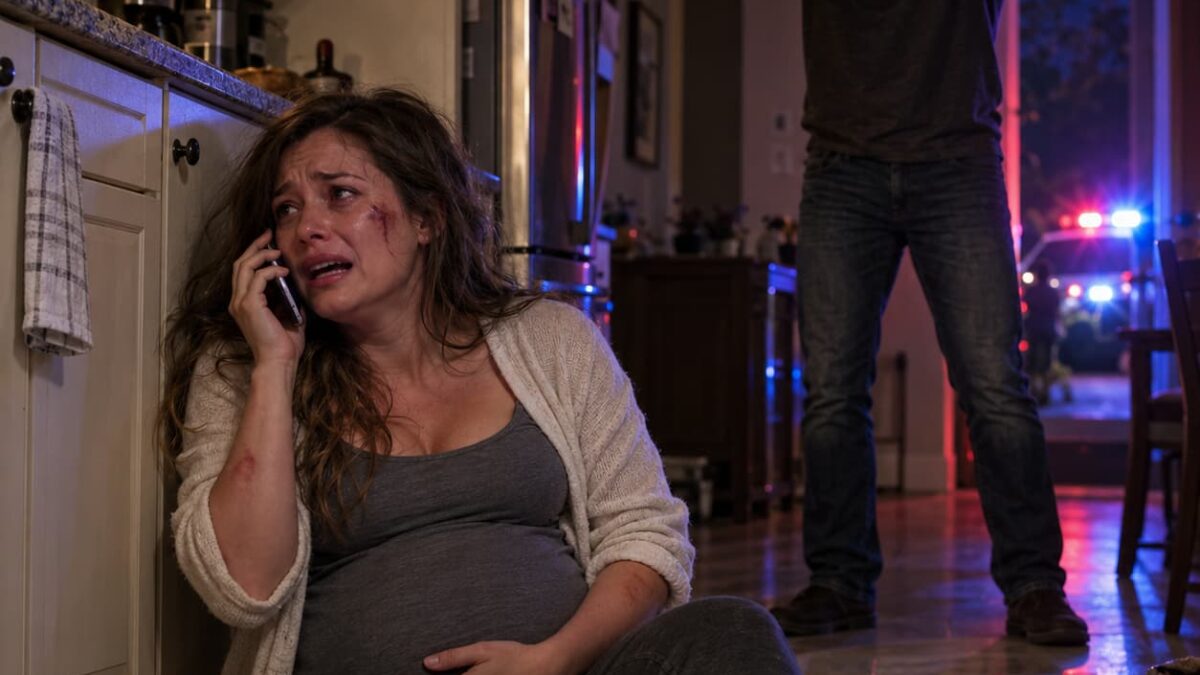
The first kick didn’t sound the way I thought violence would sound.
There was no dramatic crash.
Just a dull, ugly thud against my body, the scrape of Mark’s work boot across the kitchen tile, and the sudden copper taste of blood in my mouth.
The second kick made the room tilt.
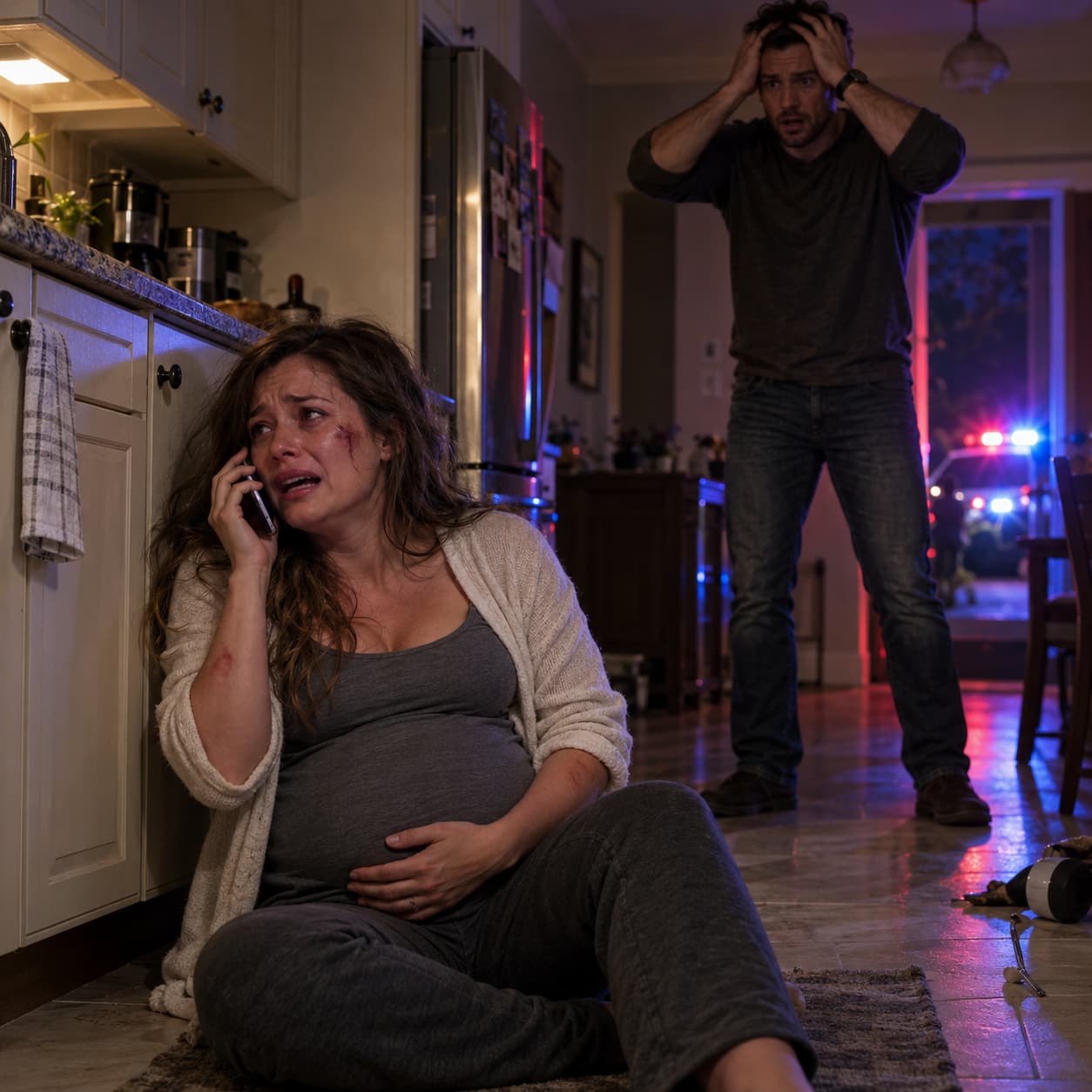
I collapsed beside the stove, one hand instinctively wrapping around my seven-month pregnant belly.
“Lose it,” Mark hissed.
He stood over me with his jaw clenched and his eyes frighteningly empty.
“Then I’ll marry her.”
Her name was Lena.
At 6:18 that evening, I’d seen her name appear on his phone.
Can’t keep pretending. Tell her tonight.
Six minutes later, I was on the kitchen floor.
At 6:25, my baby moved.
Barely.
But she moved.
That tiny movement gave me enough strength to crawl toward my phone.
“Who are you calling?” Mark demanded.
His voice had changed.
For the first time, he sounded nervous.
Two months earlier, a nurse at my prenatal appointment had noticed bruises around my wrist. Before I left, she’d quietly slipped a card into my paperwork and asked me a question.
“Do you feel safe at home?”
I’d lied.
That evening, I stopped lying.
I dialed.
When someone answered, I whispered:
“I’m pregnant. My husband kicked me. I need help.”
Mark froze.
Then the dispatcher asked for my address.
His face went white.
“No,” he whispered.
“No… not them.”
Sirens began rising somewhere down the street.
“You’re ruining my life,” Mark said.
I pressed my hand over my stomach.
“No, Mark.”
I looked directly at him.
“You did that yourself.”
Then someone pounded on the front door.
“Police!”
And for the first time in our marriage, Mark looked afraid.
Not because he’d hurt me.
Because someone else finally knew.
My name is Claire Donovan
I was twenty-nine years old when my marriage ended on my kitchen floor.
I say ended because although the divorce papers came months later, the marriage itself died at 6:24 p.m. that Tuesday.
Until then, I’d spent four years making excuses for Mark.
He wasn’t always cruel.
That was part of what made everything so confusing.
When we first met, he could be funny, attentive, even gentle. He brought coffee to my office. He remembered how I liked my eggs. When my father had surgery, Mark drove three hours to sit beside me at the hospital.
But after we married, kindness slowly became something I had to earn.
If dinner was ready when he wanted it, he was affectionate.
If the house was clean, he was pleasant.
If I agreed with him, we had a good evening.
If I disagreed?
I was “difficult.”
When his hours were cut at work, I covered the rent twice.
When he needed another vehicle, I signed the financing paperwork because my credit was better.
When he wanted access to my bank account “so we could budget as a team,” I gave it to him.
Then somehow, our money became his money.
And my money became something I needed permission to spend.
Pregnancy made everything worse.
He called me lazy when morning sickness left me exhausted.
He complained about medical appointments.
He accused me of using the baby to get attention.
Then the bruises started.
Never my face.
Not initially.
My wrist.
My upper arm.
Once, my shoulder after he shoved me into a doorframe.
Every time, Mark apologized just enough to make me question myself.
“I didn’t mean to grab you that hard.”
“You know how stressed I’ve been.”
“Why do you keep pushing me?”
Eventually, I started believing that if I could just become easier to live with, he would become the man I’d married again.
He never did.
The nurse who saw what I was hiding
Her name was Nora Ellis.
She was the nurse who noticed my wrist during a prenatal appointment.
Mark had grabbed me two nights earlier because I’d ordered a crib without asking him.
I wore long sleeves to the appointment.
When the blood-pressure cuff went around my arm, my sleeve moved.
Nora saw the bruising.
She didn’t accuse me of anything.
She didn’t demand an explanation.
She simply waited until Mark stepped out, then asked:
“Are you safe at home?”
“Yes.”
The lie came automatically.
She looked at me for several seconds.
Then nodded.
“All right.”
Before I left, she tucked information about local support services and emergency resources into my discharge papers.
“No pressure,” she said. “Keep this somewhere safe.”
I almost threw it away.
Instead, I memorized the number.
Then I hid the card inside an old sewing box.
Two months later, lying beside my stove, I finally understood why.
The police entered my kitchen
One officer went directly to Mark.
Another came to me.
“Ma’am, don’t try to stand.”
“My baby.”
Those were the only words I could manage.
“My baby isn’t moving enough.”
That changed everything.
Emergency medical responders arrived.
Someone asked where Mark had kicked me.
I pointed.
Another person asked how many times.
“Twice.”
Mark immediately interrupted.
“I didn’t kick her. She fell.”
I turned my head toward him.
He wouldn’t look at me.
“There was sauce on the floor,” he continued. “She slipped.”
One officer looked around the kitchen.
Then he asked Mark:
“If she slipped, why did she call and report that you kicked her?”
Mark’s mouth opened.
Nothing came out.
I remembered something.
“His phone.”
Everyone looked at me.
“Lena.”
Mark’s expression hardened.
“That has nothing to do with this.”
Maybe it didn’t legally prove the assault.
But it explained the argument.
More importantly, there were other things that did matter.
My injuries.
My statement.
The condition of the kitchen.
The emergency call.
And something neither Mark nor I had thought about.
Our doorbell camera.
The ambulance doors closed between us
I was taken to the hospital.
I remember staring at the ceiling inside the ambulance and repeating the same sentence.
“Please save my baby.”
A paramedic kept talking to me.
I barely heard him.
At the hospital, everything happened quickly.
Monitors.
Questions.
An ultrasound.
Blood tests.
Hands moving across my abdomen.
Then a doctor named Dr. Priya Shah came into the room.
“We have a heartbeat.”
I started crying.
“Is she okay?”
“We’re monitoring her closely.”
“Is she going to die?”
“We’re going to do everything we can to keep both of you safe.”
That was the first honest answer anyone could give me.
Not a miracle.
Not a promise.
Just medical care and uncertainty.
I stayed under observation.
There were concerns because of the abdominal trauma and contractions that began afterward, but the medical team did not rush to tell me everything was fine simply because there was a heartbeat.
For several hours, I watched the monitor as though staring hard enough could keep my daughter alive.
At 2:11 in the morning, Nora walked into my room.
The same prenatal nurse.
I stared at her.
She stared at me.
Then she pulled a chair beside my bed.
“You remembered the number.”
I nodded.
She took my hand.
That was when I finally broke.
“I should have called sooner.”
“No.”
“I knew.”
“You were scared.”
“I let him—”
Nora stopped me.
“Claire, he made his choices. You made the call tonight.”
I cried until I couldn’t anymore.
Mark had made one enormous mistake
Our doorbell camera didn’t show what happened inside the kitchen.
But it recorded sound surprisingly well.
The kitchen window had been partially open because I’d burned the garlic.
Investigators later preserved footage from around the time of the incident.
The audio wasn’t perfect.
But parts were clear.
My voice asking:
“Who is Lena?”
Mark shouting.
Something crashing.
Me crying out.
And then Mark’s voice.
Not every word was usable.
But enough of the timeline could be corroborated alongside the emergency call and physical evidence.
Mark’s story changed.
First, I slipped.
Then he said I had attacked him.
Then he claimed he’d pushed me away.
Later, through counsel, he disputed portions of my account.
I learned something important during those months:
Evidence doesn’t always arrive as one perfect recording that answers every question.
Sometimes it is a collection of smaller things that fit together.
Medical documentation.
Photographs.
Messages.
Emergency-call records.
Witness observations.
Financial records.
Prior disclosures.
And a timeline.
Mark had spent years depending on my silence.
Once I stopped being silent, he discovered how much a pattern could leave behind.
Then Lena contacted me
Three days after the assault, I received a message from an unfamiliar number.
Claire, my name is Lena. I think we need to talk.
My first reaction was rage.
Then curiosity.
My attorney advised me to preserve communications and avoid turning the situation into a confrontation.
So I didn’t call her.
I asked her to write what she needed to say.
The messages arrived slowly.
Lena said Mark had told her we were separated.
He said I remained in the house because I was pregnant and financially dependent on him.
He told her the baby might not even be his.
I stared at that sentence for a long time.
Then came something worse.
According to Lena, Mark had been telling her that after the baby was born, he would “deal with the marriage” and start over.
She had never known about the violence.
She had believed his lies about our relationship.
Then she sent screenshots.
I gave them to my attorney.
One message from Mark haunted me:
Once the situation with Claire is handled, we can finally have our life.
It wasn’t a confession to violence.
It didn’t prove what he intended.
But seeing myself described as a “situation” clarified something for me.
I had spent years treating Mark like a husband who needed help.
He had started treating me like an obstacle.
My daughter stayed inside me
Every day after the assault felt borrowed.
I moved in with my older cousin, Joanna, after leaving the hospital.
The first night, she made up the guest room with three blankets even though it was warm outside.
“You don’t need all these,” I told her.
“I know.”
“Then why?”
“Because I don’t know what else to do.”
I laughed.
Then cried.
She cried too.
For the first time in years, I slept somewhere without listening for Mark’s footsteps.
My daughter remained under close medical follow-up.
The trauma had frightened everyone, but week after week, she stayed where she needed to be.
At thirty-eight weeks, I went into labor.
Joanna drove me to the hospital.
Nora was working that day.
When she heard I had arrived, she came to see me.
“You made it,” she whispered.
“No.”
I placed my hand on my belly.
“We made it.”
Eleven hours later, my daughter was born.
I named her Hope Elise Donovan.
Hope because I needed the word.
Elise because it was my grandmother’s name.
She weighed six pounds, eleven ounces.
When they placed her against my chest, I counted every finger.
Every toe.
Then I touched the tiny heel that had kicked inside me on the kitchen floor.
“You told me you were still there,” I whispered.
I cried so hard the nurse had to hand me tissues.
Mark wanted access to us
The birth didn’t magically resolve the legal situation.
Mark was Hope’s father, and family-law questions had to be handled through appropriate court procedures rather than by my anger or his demands.
I had counsel.
The court considered evidence, safety concerns, applicable evaluations, and the child’s interests.
Temporary protections and structured arrangements were put in place while matters were reviewed.
I won’t pretend the process was easy.
It was exhausting.
There were hearings.
Statements.
Requests.
Financial disclosures.
Mark accused me of trying to punish him.
At one point he said:
“She’s using the baby against me.”
I wanted to scream.
Instead, my attorney answered through the process.
I learned that protecting yourself legally can feel painfully slow when your body remembers danger instantly.
But slow did not mean nothing was happening.
The affair was not the worst betrayal
For months, friends asked whether I hated Lena.
I didn’t.
Not eventually.
She had made choices I wouldn’t have made.
But she wasn’t the person who kicked me.
She hadn’t promised to protect me.
Mark had.
And when she learned what had happened, she didn’t stay with him.
She sent one final message six months later.
I’m sorry I believed him. I hope you and your daughter are safe.
I replied:
We are.
Nothing else was necessary.
Mark finally had to face himself
The criminal case related to the assault moved separately from the divorce and parenting proceedings.
There were negotiations, evidence reviews, and legal consequences determined through the applicable process.
I won’t dress it up as cinematic justice.
No judge slammed a gavel and delivered a speech written for television.
No courtroom applauded.
No one asked me to stand dramatically and tell Mark exactly what I thought of him.
Real consequences are usually quieter.
Orders.
Conditions.
Records.
Required programs.
Restrictions.
Financial consequences.
A divorce decree.
A house no longer shared.
A wife who no longer answers when he says jump.
Most importantly, there was documentation that what happened had happened.
Mark could tell himself whatever story he wanted.
I no longer had to live inside it.
I discovered how much money I had been losing
Once I separated my finances properly with professional help, I realized how much of my paycheck had been disappearing into Mark’s version of our marriage.
Vehicle payments.
Subscriptions.
Credit balances.
Purchases I hadn’t made.
Money transferred into accounts he controlled.
Not all of it could simply be reclaimed.
Some debts were handled during the divorce.
Some accounts had to be disputed or closed through proper procedures.
But for the first time since our wedding, I knew where my money was going.
The first thing I bought entirely for myself was ridiculous.
A yellow armchair.
$219.
Joanna stared at it.
“That’s hideous.”
“I love it.”
“Then it’s perfect.”
I put it beside the window of my new apartment.
It became the chair where I fed Hope at two in the morning.
The chair where I read books.
The chair where I learned that silence could mean peace instead of danger.
Two years later
Hope turned two on a Saturday.
We had cupcakes in the park.
Nora came.
Joanna came.
A few friends from work came.
Hope spent most of the party trying to put leaves into everyone’s drinks.
At one point, she stumbled toward me holding half a cupcake.
“Mommy!”
I crouched.
She threw herself into my arms.
I held her against my chest.
And suddenly I remembered the kitchen.
The tile against my cheek.
Blood in my mouth.
Mark standing above me.
Lose it.
For a moment, I couldn’t breathe.
Then Hope smeared frosting across my face.
Everyone laughed.
So did I.
The memory passed.
Not disappeared.
Passed.
That difference mattered.
Five years after the kitchen floor
I’m thirty-four now.
Hope starts kindergarten next month.
She loves dinosaurs, strawberries, and asking questions at exactly the moment adults wish she wouldn’t.
We live in a small two-bedroom house.
Nothing luxurious.
There is a vegetable garden out back that I am terrible at maintaining.
The yellow chair is still beside the living-room window.
I kept it even though Joanna still calls it a crime against furniture.
Mark is no longer my husband.
Our interactions, where necessary, follow the boundaries and arrangements established through the appropriate legal processes.
I don’t spend my days thinking about him anymore.
That surprised me.
For a while, I believed healing would mean reaching a point where I could think about Mark without anger.
I was wrong.
Healing meant reaching a point where I didn’t need to think about him at all.
Last year, I went back to the clinic where Nora first gave me that card.
I brought flowers.
She laughed when she saw me.
“You don’t owe me flowers.”
“I know.”
“Then why?”
“Because you asked me a question before I was ready to answer it.”
Her expression softened.
I told her something I had wanted to say for years.
“I lied to you that day.”
“I knew.”
That surprised me.
“You knew?”
“I suspected.”
“Why didn’t you force me to tell you?”
“Because you needed to know the door existed. You had to decide when you were ready to walk through it.”
I thought about that all the way home.
People sometimes ask me what saved me that night.
The police?
The nurse?
The phone?
The baby moving?
All of them mattered.
But I think the real answer began two months earlier.
Someone looked at a bruise on my wrist and gave me information without judging me for not using it immediately.
Someone created a door.
And eventually, I walked through it.
Mark thought I was powerless because I had stayed.
He mistook fear for permission.
He mistook silence for weakness.
And when I finally reached for that phone, he thought I was ruining his life.
I wasn’t.
I was saving mine.
And my daughter’s.
I still remember the exact moment his face turned white after he realized help was coming.
For years, I had been the one afraid of footsteps approaching a door.
That night, Mark heard footsteps coming for him.
But that isn’t the memory I choose to keep.
I choose the tiny movement beneath my palm at 6:25 p.m.
My unborn daughter, alive inside me.
One small kick after two terrible ones.
A reminder that I still had something worth fighting for.
Mark told me to lose my baby so he could begin another life.
Instead, I lost him.
And that was the moment mine finally began.