My name is Dale Pruitt, and for most of my sixty-eight years, I’ve believed that the best solutions are usually the quiet ones.
That’s probably why I became a mechanical engineer.
Machines don’t care who has the louder voice. Steel doesn’t respond to intimidation. Numbers don’t join committees or spread rumors.
Force goes somewhere.
Structures either hold or fail.
And eventually, consequences show up in the data.
My neighbor, Brenda Hollister, was about to learn that lesson the hard way.
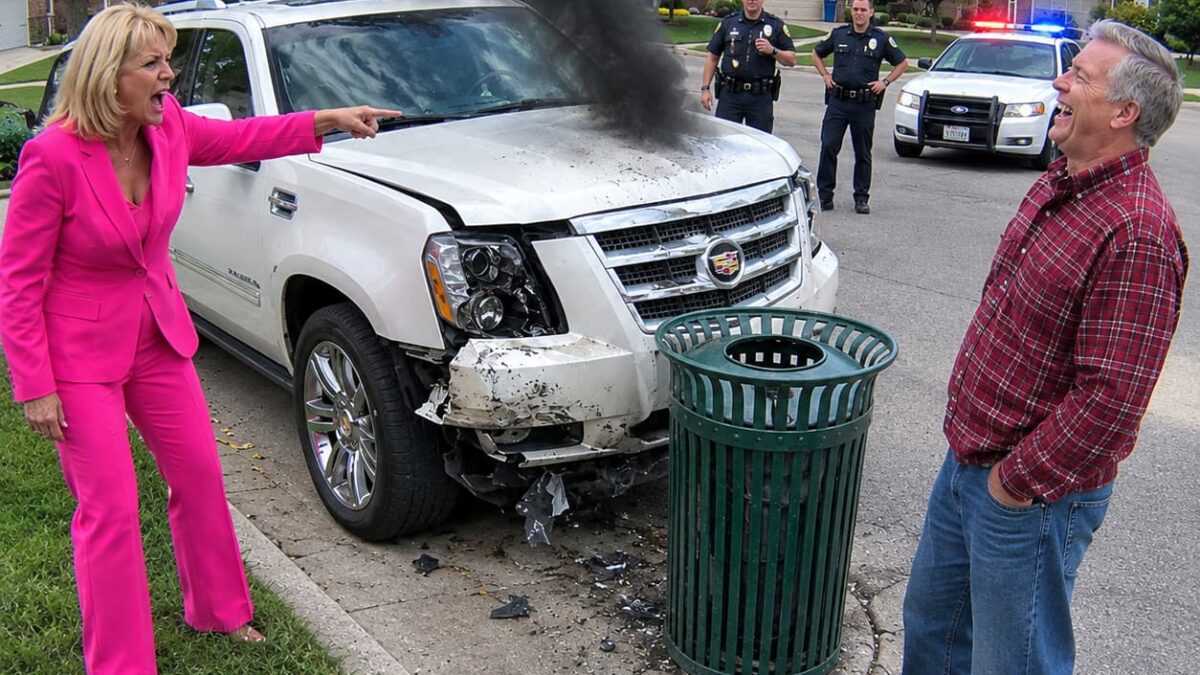
At 6:42 on a Wednesday morning, I stood behind the curtains of my living room with a mug of coffee in my hand and watched her white Cadillac Escalade reverse out of her driveway.
She was moving faster than anyone needed to move on a residential cul-de-sac.
Same as every Wednesday.
She turned the wheel.
The rear corner of the Escalade swung toward my curb.
And then—
BANG.
The sound was magnificent.
Not because I enjoyed seeing someone’s vehicle damaged.
But because for fourteen weeks, Brenda had hit my trash container, scattered my garbage across Sycamore Falls, blamed me for the mess, and then used her position as HOA president to fine me.
This time, however, my trash can didn’t fly across the street.
It didn’t even tip.
Brenda’s Cadillac stopped with a crunch of plastic, metal, and one extremely expensive-looking taillight.
My trash container remained exactly where I’d installed it.
Brenda climbed out.
She stared at her bumper.
Then she stared at the bin.
Then she kicked it.
That hurt her more than it hurt the trash can.
I almost smiled.
Instead, I took a sip of coffee.
My phone vibrated.
The accelerometer hidden inside the container had transmitted the impact data.
I looked at the numbers.
Then I looked at Brenda.
For thirty-one years, I’d designed things meant to survive collisions.
She had just provided my retirement project with its first field test.
Ten minutes later, she was pounding on my front door.
I opened it.
“What did you do?”
“Good morning, Brenda.”
She pointed toward the street.
“You destroyed my car!”
I looked past her.
The Escalade was still running.
“I don’t believe my trash can drove into your driveway.”
“You put that thing there deliberately!”
“Yes.”
“To damage my vehicle!”
“No. I put a trash container at the curb so the sanitation company could collect my trash.”
“You knew I would hit it.”
That sentence was a gift.
I didn’t react.
“Why would I know that?”
Her mouth opened.
Nothing came out.
Because there was only one honest answer:
Because she had hit the previous ones repeatedly.
Instead she said, “That thing is illegal.”
“Which rule?”
“I don’t need to explain HOA regulations to you.”
“Then send me the applicable rule in writing.”
Her face tightened.
“You’re going to pay for my Cadillac.”
“I suggest you contact your insurer.”
“You’re going to regret this, Dale.”
She marched back across my lawn.
I called after her.
“Please use the sidewalk.”
She turned around as if I had insulted her ancestors.
Then she left.
By Friday, I received a certified letter.
NOTICE OF HAZARDOUS AND NONCONFORMING STRUCTURE.
My trash container, according to the letter, constituted an unauthorized permanent structure and a danger to vehicles, pedestrians, sanitation workers, and “the aesthetic integrity of Sycamore Falls.”
That last one was my favorite.
Brenda demanded removal within seventy-two hours.
She also assessed a $500 fine.
I read the letter twice.
Then I pulled out the HOA declaration, architectural guidelines, amendments, meeting minutes, and enforcement procedures.
Retirement gives a man time.
Engineering gives him patience.
Widowhood, I had discovered, gives him a surprisingly low tolerance for nonsense.
There was no rule prohibiting a reinforced trash enclosure.
There were setback requirements.
Mine complied.
There were requirements about placement.
Mine complied.
There were visibility requirements.
Mine complied.
There were restrictions on permanent structures near sidewalks.
Mine sat entirely within my property boundary and did not obstruct pedestrian access.
Most importantly, the rule Brenda cited had nothing to do with trash containers.
It concerned decorative masonry near community intersections.
I emailed the HOA management company requesting an appeal.
I attached photographs, measurements, a property survey and the relevant sections of the governing documents.
Then I attached something else.
Fourteen violation notices.
Every one Brenda had issued after hitting my old bins.
I requested that all fourteen be reviewed.
That evening, my doorbell rang.
It was Martin Keller, who lived across the cul-de-sac.
Martin was seventy-three and had the permanent expression of a man who had spent his entire career arguing with printers.
He held an HOA letter.
“You too?” he asked.
“Depends.”
He handed it to me.
His violation was for leaving a garden hose visible from the street.
Fine: $100.
“It was out for forty minutes,” he said. “I was washing pollen off my porch.”
“When?”
“Tuesday.”
I remembered seeing Brenda’s Escalade pass his house Tuesday morning.
Martin looked toward her property.
“You know what she’s doing, don’t you?”
“Driving around looking for violations?”
“No.”
He lowered his voice.
“Picking people.”
That interested me.
“What do you mean?”
He told me to talk to Priya Shah, three houses over.
Priya had been fined for leaving her daughter’s bicycle near the garage.
Then Tom Alvarez had been cited over a mailbox Brenda claimed was the wrong shade of black.
Another neighbor had received repeated landscaping violations after questioning an HOA expenditure.
A retired teacher had been fined because her Christmas wreath remained up until January 8.
One complaint was annoying.
Two could be coincidence.
By Sunday afternoon, I had spoken to eleven households.
I stopped thinking about my trash can.
Brenda had turned HOA enforcement into a personal weapon.
Not necessarily a criminal conspiracy.
Not some cinematic fraud scheme.
Something simpler.
She had power.
People disliked confrontation.
So she kept pushing.
Residents paid small fines because fighting them cost more time than paying them.
And because nobody had compared notes, each person assumed they were the only one being targeted.
I created a spreadsheet.
Date.
Household.
Alleged violation.
Fine.
Evidence provided.
Appeal requested.
Appeal granted or denied.
Board member involved.
I didn’t post accusations online.
I didn’t call Brenda corrupt.
I collected facts.
By Monday, I had twenty-seven questionable citations from eleven households.
Then Priya noticed something.
“Dale, look at the dates.”
I did.
A surprising number of citations had been issued before the required review or notice period described in our enforcement policy.
Some residents said they’d never received the warning the HOA rules appeared to require before certain fines.
Others had appealed directly to Brenda and been told there was “nothing to discuss.”
That was a governance problem.
And governance problems have one weakness.
Minutes.
I requested the HOA board minutes.
Brenda refused.
The management company was more careful.
After several written requests, I received what records I was entitled to inspect under the governing process applicable to the association.
They didn’t prove Brenda had stolen money.
They didn’t prove some grand criminal enterprise.
What they did show was enough.
Several enforcement decisions Brenda had presented as “board decisions” did not appear in the minutes as having been voted on by the board.
At least two directors later told residents they hadn’t even known about some of the fines.
That changed the mood in Sycamore Falls.
People who had been irritated became interested.
People who had been afraid became angry.
And Brenda noticed.
Then she made her biggest mistake.
I was at the hardware store on Tuesday afternoon when my trail camera sent an alert.
Three men were standing beside my trash container.
A white pickup truck was parked nearby.
Brenda was with them.
I watched the live feed.
One worker examined the base.
Another returned to the truck and brought out tools.
Brenda pointed at my container.
The men began trying to remove it.
I called the police.
Then I drove home.
I did not race.
I did not confront anyone.
By the time I arrived, an officer was already speaking with Brenda.
She waved an HOA document in his face.
“We have authority to remove violations!”
The officer looked toward me.
“Mr. Pruitt?”
“Yes.”
“Is this your property?”
“Yes.”
I showed him my survey and the location of the container.
I also showed him the notice I had received.
There was no court order.
No agreement from me authorizing entry.
No emergency.
The officer told the workers to stop while the property dispute was sorted out through the proper channels.
Brenda exploded.
“This man built a weapon!”
I looked at the officer.
“It’s a trash container.”
“He designed it so I’d crash!”
The officer looked at Brenda.
“Why were you driving into it?”
Silence.
I wish I could tell you everyone burst into applause.
Nobody did.
Real life is rarely that well timed.
But Martin Keller coughed suspiciously into his fist.
Brenda’s lawyer sent me a demand letter two days later.
It alleged that I had created a dangerous roadside obstruction intended to damage Brenda’s vehicle.
My attorney, Rachel Kim, read it in her office.
Then she looked at me.
“You built this yourself?”
“Yes.”
“How much does it weigh?”
“Do you want the short answer?”
“Very much.”
“Heavy.”
She closed her eyes.
“Dale.”
“It meets the dimensions.”
“That isn’t what I asked.”
I handed her the engineering drawings.
Then the survey.
Then photographs showing the placement of every previous bin.
Then the HOA guidelines.
Then the fourteen fines.
Then the trail-camera footage.
Finally, I gave her the impact data.
Rachel stared at the stack.
“You’ve been waiting your entire life for someone to ask you for documentation, haven’t you?”
“Thirty-one years in engineering.”
“I can tell.”
Then she became serious.
“The fact that Brenda repeatedly hit your previous containers helps explain foreseeability, but we still need to be careful. You don’t get to create an unreasonable hazard merely because someone has behaved badly.”
“I understand.”
“So we get an independent professional to evaluate the installation, visibility, placement and compliance. And we let the insurer and attorneys deal with the collision.”
“Good.”
I liked Rachel immediately.
She had the same rule I did.
Facts first.
The insurance investigation was where Brenda’s story began falling apart.
She initially claimed my container had been placed unusually close to her normal backing path.
My photographs showed the placement was materially the same curbside location I’d used before.
She claimed she hadn’t previously struck my bins.
I had video.
She claimed the collision happened because the steel container was difficult to see.
It had reflective markings.
The morning was clear.
And her own vehicle’s camera systems became relevant to the insurer’s investigation.
Then came my trail-camera recording.
It showed her backing directly into the container.
The footage did not prove what she was thinking.
It didn’t need to.
It showed what happened.
The accelerometer supplied additional technical information about the impact, though I left it to qualified professionals to determine what conclusions could properly be drawn from the data.
I wasn’t going to play accident reconstructionist simply because I had an engineering degree.
The most important fact was much simpler.
The trash can hadn’t hit Brenda.
Brenda had hit the trash can.
Then the neighborhood meeting happened.
Eighty-four people showed up.
Our normal HOA meetings attracted twelve if someone brought cookies.
Brenda sat at the front beside two board members and the property manager.
I sat in the third row.
She began with my trash container.
“This individual deliberately installed an industrial-grade obstruction after developing a personal grievance against me.”
I raised my hand.
She ignored me.
“This has created significant liability for our community.”
A voice behind me said:
“What about the fines?”
Brenda stopped.
Priya stood.
“My bicycle fine.”
Then Martin stood.
“My garden hose.”
Tom raised his hand.
“My mailbox.”
Another woman:
“My wreath.”
Then another:
“My grass.”
Within seconds, half the room was talking.
The property manager repeatedly asked everyone to sit down.
Eventually, one board member named Elaine Porter took the microphone.
“Please. One person at a time.”
I waited.
Then I stood.
“I have documents I’d like the board to review.”
Brenda laughed.
“Of course you do.”
I handed Elaine a binder.
Not a speech.
A binder.
Inside were copies of the disputed fines residents had voluntarily shared, relevant HOA procedures, meeting records, photographs and a timeline.
Then I handed over the footage of Brenda hitting my old trash container.
The room became very quiet.
We watched her Escalade reverse.
Strike the bin.
Scatter garbage.
Drive away.
Then I displayed the timestamp of the HOA violation notice Brenda sent twenty-two minutes later concerning the resulting debris.
Nobody spoke for several seconds.
Finally Martin said:
“So she created the mess and fined him for it?”
Brenda stood.
“This is being taken completely out of context.”
“What context?” Priya asked.
Brenda turned toward me.
“This is harassment.”
I didn’t raise my voice.
“Then let’s have an independent review.”
That sentence changed the meeting.
Because I wasn’t asking the neighborhood to believe me.
I was asking them to check.
The board voted that evening to refer the disputed enforcement actions for independent review and to pause collection on the challenged fines while their validity was examined.
Brenda objected.
Loudly.
Then Elaine asked her a question.
“Did the board authorize the workers to enter Mr. Pruitt’s property and remove the container?”
Brenda hesitated.
“I acted under my authority as president.”
“That wasn’t my question.”
Another board member leaned toward his microphone.
“I didn’t authorize it.”
Neither had Elaine.
The property manager said their company had not directed the workers either.
That was the moment Brenda stopped looking powerful.
She looked alone.
The next several weeks were less dramatic than people expected.
There was no FBI raid.
No handcuffs at an HOA meeting.
No judge declaring my trash can a monument to freedom.
There were audits.
Records reviews.
Insurance correspondence.
Attorney letters.
Board meetings.
Exactly the boring mechanisms that usually matter most.
A number of fines were rescinded because the required process had not been followed or because the supporting evidence was inadequate.
Mine were among them.
Residents who had already paid certain invalidated fines were given credits or reimbursements according to the association’s review.
The board adopted clearer enforcement procedures.
No single officer would again be allowed to handle complaints, determinations and appeals with so little oversight.
And Brenda?
The board removed her from certain enforcement responsibilities while the review continued.
Soon afterward, following the association’s governing procedures and a furious community response, she was no longer HOA president.
She remained my neighbor.
That was awkward.
The dispute over my reinforced trash container ended less triumphantly.
And probably more sensibly.
The independent evaluation concluded that while the placement did not excuse Brenda driving into it, a permanently anchored rigid container near a vehicle travel area raised legitimate safety and compliance questions.
So I modified it.
Yes.
After all that, I modified the indestructible trash can.
Rachel laughed for almost a full minute when I told her.
“What happened to the bunker?”
“Engineering revision.”
“You lost?”
“Engineers don’t lose. We discover additional design requirements.”
She laughed harder.
The permanent anchoring was removed, and I replaced the setup with a compliant reinforced enclosure that could safely accommodate normal service requirements without functioning like a concrete-rooted fortress beside the curb.
I kept the damaged original shell in my workshop.
It had a small white streak from Brenda’s Cadillac.
I considered polishing it off.
I didn’t.
Brenda’s insurance handled her vehicle damage according to its investigation and policy terms.
I didn’t get some enormous settlement.
I didn’t want one.
My attorney fees weren’t magically paid by karma.
Neighborhood disputes are expensive even when you’re right about important parts of them.
But Brenda never successfully made me pay for the damage caused when her vehicle struck the container.
More importantly, the collision exposed something bigger than a dented Cadillac.
It exposed how much authority the neighborhood had quietly surrendered to one person simply because confronting her was inconvenient.
About three months later, I was sitting on my porch when Brenda walked past.
She didn’t patrol in the Escalade much anymore.
The repaired Cadillac stayed in her driveway most mornings.
She stopped.
I expected an argument.
Instead she looked at the oak tree.
“Camera still up there?”
“Yes.”
She nodded.
“I figured.”
Then she looked at me.
“You turned everyone against me.”
I put down my coffee.
“No.”
She laughed bitterly.
“Of course you’d say that.”
“I showed people what happened.”
“You humiliated me.”
“Brenda, you hit my trash cans repeatedly.”
Her jaw tightened.
“You could have talked to me.”
“I did.”
She looked away.
“You denied it.”
Silence.
“Then you fined me for the garbage your car scattered.”
More silence.
“You sent workers onto my property.”
She finally looked at me again.
“You built that thing because of me.”
That was true.
“Yes.”
For some reason, hearing me admit it seemed to calm her.
“Were you trying to destroy my Cadillac?”
“No.”
“Then why steel?”
I looked toward my garage.
“Because plastic wasn’t surviving.”
She almost smiled.
Almost.
Then she walked home.
It was the closest thing to an apology I ever received.
Sycamore Falls changed afterward.
Not dramatically.
The hedges remained trimmed.
People still complained about parking.
Somebody still left Christmas decorations up too long.
The HOA still existed.
Rules still existed.
And honestly, most of them were useful.
But people started attending meetings.
Board votes were documented more carefully.
Residents asked questions.
Appeals actually went through an appeal process.
The HOA wasn’t destroyed.
It became boring again.
Which, as Caroline would have understood, was exactly what I wanted.
The following spring, I replaced the two rocking chairs on my porch.
One had belonged to Caroline.
For years, I couldn’t bring myself to sit in hers.
One Sunday morning, I finally did.
I drank coffee and watched sunlight move through the oak leaves.
Martin walked past.
“Morning, Dale.”
“Morning.”
He pointed toward the curb.
“When are you building the indestructible mailbox?”
“Don’t tempt me.”
He laughed all the way down the street.
I smiled.
Then I looked at the empty chair beside me and thought about Caroline.
She hated conflict.
She would have hated every minute of the HOA drama.
But she also used to tell me something whenever I became frustrated with a design problem:
“If something keeps breaking, Dale, maybe you’re fixing the wrong part.”
For fourteen weeks, I thought the problem was my trash can.
So I built one that wouldn’t break.
But the trash can had never really been the problem.
The problem was that one person had discovered she could behave badly because everyone around her found resistance more exhausting than surrender.
The steel container didn’t fix that.
The camera didn’t fix it.
The accelerometer didn’t fix it.
What fixed it was evidence—
and a neighborhood finally willing to look at that evidence together.
Brenda’s Cadillac made an unforgettable sound when it hit my new trash can.
A crunch of plastic.
A snap of a taillight.
Metal protesting against metal.
But that wasn’t the sound that changed Sycamore Falls.
The sound that changed the neighborhood came later.
It was eighty-four residents in one room, one after another, finally saying:
“That happened to me too.”