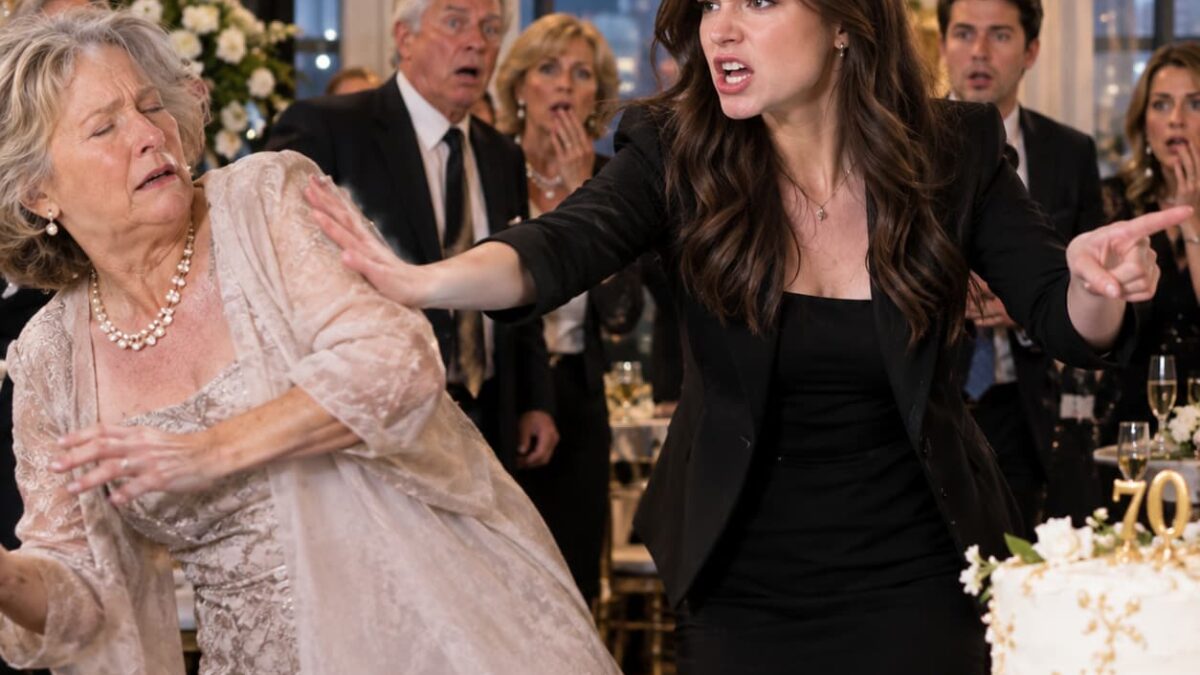
The first person I called was not the police.
It was my attorney.
“Margaret?”
Lawrence Beckett sounded half asleep. It was almost eleven-thirty at night.
“I’m sorry to call this late.”
“You’ve been my client for thirty-one years. You have never called me after ten. What happened?”
I looked at my reflection in the dark window of my study.
My lower lip was swollen and split. A faint red mark had begun to spread across my cheek. My broken glasses sat beside my daughter’s photograph.
“Valerie hit me.”
There was silence.
“Your granddaughter?”
“At my birthday dinner.”
Another pause.
“Are you safe?”
“Yes.”
“Have you been medically evaluated?”
“No.”
“Then that’s first.”
“I need to talk about the company.”
“Margaret—”
“She announced tonight that she’s becoming CEO on Monday.”
This time, Lawrence’s silence felt different.
Then he asked, “On whose authority?”
“Apparently hers.”
I heard papers moving.
“Did you sign anything?”
“No.”
“Did the board vote?”
“No.”
“Did you transfer your controlling shares?”
“No.”
“Then Valerie is not becoming CEO on Monday.”
I closed my eyes.
“I know.”
And for the first time that night, I felt something other than pain.
I felt awake.
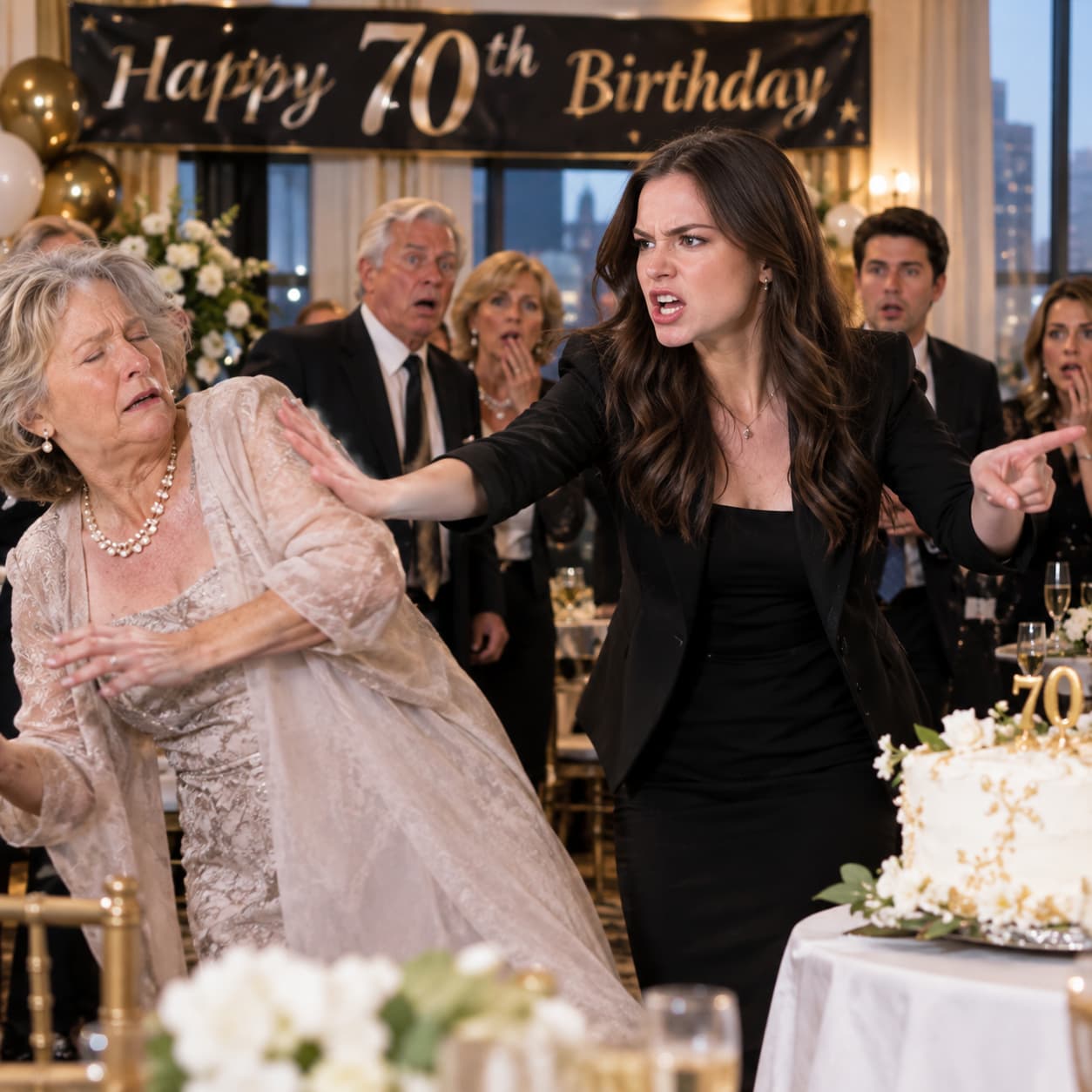
The urgent-care physician documented the split lip and bruising.
I told the truth about how it happened.
I did not exaggerate.
I did not need to.
There had been twenty-three witnesses.
There were also cameras covering the main entrance and portions of the dining room because the brownstone doubled as a venue for company dinners and author receptions.
The assault would be dealt with separately.
What mattered to me that night was understanding how I had allowed Valerie to become so certain that everything I owned was already hers.
At 8:00 the next morning, Lawrence arrived at my house with another attorney from his firm and my longtime accountant, Celeste Rowan.
We met in the study.
Lawrence placed five folders on my desk.
“Before we do anything,” he said, “I want to separate what you can legally change from what you cannot.”
“Good.”
“Anything you gave Valerie outright is hers. We don’t pretend otherwise.”
I nodded.
The diamond bracelet?
Hers.
The tuition I’d paid?
Gone, obviously.
The wedding gifts?
Hers.
Money transferred as unconditional gifts?
Hers.
I wasn’t interested in rewriting history because I was angry.
Then Lawrence touched the second folder.
“But the agency fund was not structured as an unrestricted personal gift.”
I looked up.
Years earlier, when Valerie wanted to establish Sullivan Literary Group, I’d provided substantial funding through an investment entity.
At Valerie’s insistence, she’d called it “Grandma’s investment” whenever she needed reassurance.
Later, she began calling it “my company.”
Legally, those were very different things.
Whitmore Holdings still owned a substantial interest.
The agreement included governance rights and restrictions on major transactions.
“I can pull the investment?”
“Not simply because you’re angry,” Lawrence said. “And we aren’t going to manufacture a default.”
Exactly the answer I wanted.
“But if she’s violated the agreement?”
“Then we review the actual facts and enforce the actual terms.”
Celeste opened another folder.
“There may be facts worth reviewing.”
She slid several reports toward me.
My stomach tightened.
“What am I looking at?”
“Expenses.”
For six months, Celeste’s team had questioned several charges connected to Valerie’s division at Whitmore Publishing.
Nothing had yet established criminal conduct.
Some could have legitimate explanations.
But there were expensive meals categorized as author development.
Luxury hotel stays during trips where no corresponding author meetings appeared on the calendar.
Car services.
Consulting payments to a firm associated with one of Richard’s business acquaintances.
And several invoices that deserved closer review.
“Why didn’t I know?”
Celeste looked uncomfortable.
“You received summaries.”
I remembered them.
I had skimmed them.
Then sent them back with the same instruction.
If Valerie approved it, I’m comfortable.
I stared at those words in my own email.
That hurt.
Not because Valerie had fooled me.
Because I had made myself easy to fool.
I had confused trust with the absence of oversight.
Lawrence opened the third folder.
Whitmore Publishing’s ownership structure.
I held the largest voting block personally and through a family trust established years earlier.
Valerie owned shares.
Real shares.
I couldn’t erase them because she had slapped me.
But her shares did not give her unilateral control.
More importantly, being vice president did not make her my automatic successor.
CEO appointments were governed by the board.
I was still chair.
The succession plan she had announced at my birthday dinner existed only in her imagination.
“Can I fire her?”
Lawrence leaned back.
“From employment? Possibly, subject to her agreement, company policy, board procedures and whatever findings come from the review.”
“Then review everything.”
He nodded.
“That’s the right first step.”
The fourth folder concerned the Greenwich house.
I had given Valerie and Richard the down payment.
That money had been a gift.
The house was theirs.
I couldn’t take it back.
Strangely, that made me feel better.
I didn’t want revenge disguised as law.
I wanted clarity.
Then Lawrence reached for the fifth folder.
“This is the one you were remembering last night.”
The trust.
I had established it after Lucy died.
At first, it existed primarily to protect Valerie if anything happened to me before she became an adult.
Over the years, it grew.
Investment accounts.
Interests in commercial property.
Future distributions from some publishing assets.
Certain family holdings.
Valerie was a beneficiary.
But she did not own the trust assets.
And years earlier, when I began discussing succession, Lawrence had insisted that I retain certain powers and that an independent trustee control discretionary distributions under defined standards.
At the time, I’d complained.
“She’s my granddaughter, not a hostile takeover.”
Lawrence had answered:
“Then she’ll never know the difference.”
Now I understood.
Some future gifts Valerie had been casually describing as “my inheritance” were not hers.
Not yet.
Possibly not ever in the form she expected.
My estate plan was still mine to revise where the law and governing documents permitted.
My voting control was still mine.
My personal assets were still mine.
And several properties Valerie spoke about as if she already owned them were held by entities she did not control.
I looked at Lawrence.
“So I can take everything away.”
He shook his head.
“No.”
That answer surprised me.
“You can stop giving away things you still own. You can revise your estate plan. You can exercise your voting rights. You can enforce contracts. You can change beneficiaries where legally permitted.”
He tapped the folder.
“But don’t call that taking her property.”
I looked toward Lucy’s photograph.
“No.”
I understood.
“It’s taking back my assumption that she was entitled to my future.”
Lawrence nodded.
“That’s much closer.”
Valerie called at 9:17 that morning.
I let it ring.
Again at 9:19.
Then 9:22.
At 9:26, Richard called.
At 9:31, Valerie sent:
We need to discuss what happened last night before people exaggerate it.
At 9:34:
You embarrassed me too.
At 9:41:
I shouldn’t have hit you, but you deliberately provoked me.
There it was.
The apology that wasn’t an apology.
I forwarded the messages to Lawrence.
At 10:03, another arrived.
Monday’s announcement still needs to happen. We can’t let a personal disagreement interfere with the company’s future.
Celeste actually removed her glasses.
“She still thinks she’s becoming CEO?”
“Yes.”
Lawrence closed the trust folder.
“Then perhaps Monday will be educational.”
We did not wait until Monday to act irresponsibly.
That distinction mattered.
No bank accounts were mysteriously emptied overnight.
No employees were fired by text.
No mansion was seized.
No police convoy appeared at Valerie’s house.
Instead, we did what I had spent forty years teaching younger executives to do.
We documented.
We reviewed.
We followed governance.
An emergency board meeting was scheduled.
Independent counsel was brought in.
The questionable expenses were referred for a formal internal review.
Valerie’s access to certain discretionary company spending was restricted pending that review, consistent with company procedures.
And I notified the board that I had not resigned as CEO or chair and had authorized no succession announcement.
Then I changed my estate plan.
Not in rage.
Not that morning.
I waited three weeks.
I met separately with Lawrence.
Then another estate attorney.
Then the independent trustee.
I wanted nobody, including Valerie, to argue someday that an injured seventy-year-old woman had made impulsive decisions while emotionally distressed.
When I finally signed the revised documents, my lip had healed.
My decision hadn’t changed.
Monday morning arrived.
Valerie entered Whitmore Publishing at 8:12 wearing a cream-colored suit.
She had brought Richard.
She had also brought a photographer.
That detail told me almost everything.
She expected a coronation.
The photographer did not make it past reception.
Richard was directed to wait outside the boardroom because he had no role in company governance.
Valerie entered alone.
I was already sitting at the head of the table.
My place had not been moved this time.
Lawrence sat to my right.
Independent counsel sat farther down.
Six directors were present in person or by video.
Valerie stopped.
“What is this?”
“A board meeting.”
She looked at my face.
The bruise was still faintly visible.
Her eyes shifted away.
“I thought we were announcing the transition.”
“There is no transition.”
Her mouth opened.
Then closed.
“Grandma—”
“Here, I’m Margaret.”
That irritated her.
I saw it immediately.
“Fine. Margaret. We discussed this.”
“No. You announced it at my birthday.”
“The company needs younger leadership.”
“That is something the board may discuss through an appropriate succession process.”
She looked around the table.
Nobody rescued her.
Then independent counsel began explaining the review.
Valerie’s face changed.
“What review?”
“The review of expenses and related transactions under your authority.”
She turned toward me.
“You’re investigating me?”
“The company is reviewing company money.”
“Because I slapped you?”
“No.”
I folded my hands.
“The assault is a separate matter.”
Her cheeks flushed.
“You’re doing this to punish me.”
“No, Valerie. I’m doing something I should have done years ago.”
“What?”
“Separating being your grandmother from being responsible for this company.”
The review took nearly four months.
Some expenses were legitimate.
Some were poorly documented.
Some violated company policy.
A smaller group involved conflicts that should have been disclosed and payments that required further explanation.
The findings were serious enough for employment and governance consequences, but I refused to turn uncertainty into melodrama.
Where outside legal or accounting review was appropriate, we used it.
Where reimbursement was required, it was pursued.
Where controls were weak, we fixed them.
Valerie did not become CEO.
Eventually, she left her executive position under an agreement negotiated through counsel.
She retained whatever shares she legally owned.
I did not steal them.
I did not erase her from corporate history.
But she lost the authority she had confused with ownership.
Her literary agency was harder.
Whitmore Holdings had invested heavily in it, but Valerie owned part of it too.
We couldn’t simply walk in and take the company.
So we didn’t.
The financial review found that the agency had grown too dependent on my publishing company.
Contracts were renegotiated at arm’s length.
Preferential arrangements ended.
Company resources that had been casually shared were separated.
Valerie suddenly had to operate the agency as an actual business rather than as an extension of her grandmother’s generosity.
It survived.
Barely at first.
Then, surprisingly, it improved.
That would matter later.
The assault had consequences too.
I gave a statement.
So did several guests.
Valerie’s lawyers urged resolution.
I did not demand that the justice system destroy her life.
I demanded that nobody call what happened “a family misunderstanding.”
It was physical violence.
It had witnesses.
It had caused injury.
Whatever legal resolution followed had to acknowledge that reality.
More important to me personally was the protective boundary afterward.
For months, Valerie was not welcome in my home.
Communication went through attorneys when necessary.
She didn’t have access to my office.
She didn’t have keys.
She didn’t get to arrive crying and turn my sympathy into another shortcut around accountability.
Then came the estate plan.
That was the part she cared about most.
I learned this because Richard called Lawrence.
Not me.
Lawrence later told me Valerie wanted to know whether she was “still the primary heir.”
I laughed.
Not because it was funny.
Because my granddaughter had struck me in the face at seventy and apparently believed the important unresolved question was whether she would eventually receive my assets.
The revised plan did not leave her penniless.
Lucy would not have wanted that.
And despite everything, I still loved Valerie.
But love was no longer going to be confused with unrestricted control.
A significant portion of my estate was redirected toward a charitable foundation supporting literacy programs, independent bookstores and scholarships for young editors from working-class families.
Certain assets remained in trust.
Distributions were governed rather than automatic.
Company voting control after my death would pass according to a professional succession structure rather than dropping into Valerie’s hands because we shared blood.
I also created a scholarship in Lucy’s name.
The Lucy Whitmore Fellowship.
That was the inheritance that gave me the most peace.
Valerie discovered the changes six months after my birthday.
She came to Lawrence’s office with her own attorney.
I agreed to attend.
She looked different.
Thinner.
Tired.
Angry.
She sat across from me.
“You changed everything.”
“I changed some things.”
“You gave away my inheritance.”
I looked at her.
“No.”
Her eyes hardened.
“That money was always supposed to come to me.”
“It was never yours.”
“I’m your only granddaughter.”
“Yes.”
“I’m Lucy’s daughter.”
That hurt.
She knew it would.
“Don’t use your mother as a weapon.”
Her face crumpled for half a second.
Then the anger returned.
“She would have wanted me protected.”
“She would have wanted both of us protected.”
“You don’t know that.”
I reached into my bag.
I pulled out an old photograph.
Lucy holding eight-year-old Valerie at Cape Cod.
My daughter was laughing.
Valerie had missing front teeth.
“I spent twenty-two years trying to make sure you never felt the absence of your mother.”
My voice shook.
“I paid for schools. Travel. Degrees. A wedding. A home. A business. A career.”
Valerie looked down.
“And somewhere along the way, I taught you the wrong lesson.”
She looked at me again.
“What lesson?”
“That because I would give you anything, you had the right to take everything.”
Neither attorney spoke.
Valerie’s eyes filled with tears.
Then she whispered:
“You chose the company over me.”
“No.”
I shook my head.
“I chose to stop sacrificing myself to prove I loved you.”
We did not reconcile that day.
Or that year.
That’s another lie families like ours tell.
That one apology repairs decades of entitlement.
It doesn’t.
Valerie spent almost two years blaming me.
Her marriage to Richard became strained when the lifestyle they had planned around future wealth became less certain.
They did not lose their house.
They were not ruined.
They simply discovered that assets belonging to other people could no longer be included in their personal financial forecasts.
Eventually, Valerie’s agency stabilized.
Without Whitmore Publishing quietly supporting every weakness, she had to become better.
She cut unnecessary expenses.
Hired an experienced finance director.
Stopped using company accounts like extensions of her social life.
Signed several talented writers.
For the first time, she built something that wasn’t simply handed to her.
I watched from a distance.
I was proud of her.
I didn’t tell her.
Not yet.
Three years after my seventieth birthday, Valerie called.
I almost didn’t answer.
“Grandma?”
I hadn’t heard her call me that in a long time.
“Yes?”
“Can I see you?”
“Why?”
“I found something.”
That frightened me more than it should have.
“What?”
“Mom’s rabbit.”
I stopped breathing for a moment.
The stuffed rabbit.
Valerie had carried it everywhere after Lucy died.
“I thought it was gone.”
“So did I.”
She had found it in a box while moving offices.
We met at a café in Boston.
No attorneys.
No husbands.
No board members.
Just us.
Valerie placed the worn rabbit on the table.
One ear was still bent.
I touched it and started crying.
So did she.
Then Valerie said:
“I remember you sleeping on the floor beside my bed after Mom died.”
I said nothing.
“I remember waking up and asking if you were going to die too.”
My throat closed.
“You told me you weren’t going anywhere.”
“I remember.”
Valerie wiped her face.
“I think somewhere along the way, I started believing that meant you existed for me.”
There it was.
Not an excuse.
An understanding.
She looked directly at me.
“What I did to you was disgusting.”
I waited.
“I hit you.”
“Yes.”
“I humiliated you in your own home.”
“Yes.”
“I announced I was taking your company like you were already dead.”
“Yes.”
She cried harder.
“And then when you changed the estate plan, I was angrier about the money than about what I’d done.”
I didn’t rescue her from that sentence.
She needed to sit inside it.
Finally, she said:
“I’m sorry.”
No “but.”
No explanation.
No request.
Just:
“I’m sorry.”
I believed her.
Forgiveness came slowly.
Access came even slower.
Valerie never became CEO of Whitmore Publishing.
Neither did I remain CEO forever.
At seventy-three, I stepped down voluntarily.
The board selected an experienced executive named Helen Ward, who had worked in publishing for almost thirty years.
I remained chair for another two years.
Then I stepped away from that too.
Because there is a difference between being pushed aside and choosing when to leave.
That difference mattered to me.
On my seventy-fifth birthday, I had dinner at the same Beacon Hill house.
There were only nine people.
No business partners.
No photographers.
No speeches about succession.
Valerie came early.
She brought flowers.
Then she walked into the dining room and stopped beside the head of the table.
For a second, neither of us spoke.
She pulled the chair out.
“For you.”
I sat down.
She took the chair beside me.
Not mine.
Hers.
During dessert, she handed me a small box.
Inside was a new pair of glasses.
I laughed.
“They’re not prescription.”
“I know.”
“So what am I supposed to do with them?”
“Keep them.”
She smiled through tears.
“To remind me that I broke the last pair.”
“That is an extremely strange birthday gift.”
“I know.”
I started laughing.
Then she did too.
For the first time in years, the laughter didn’t hurt.
I’m seventy-seven now.
Whitmore Publishing is still independent.
The Lucy Whitmore Fellowship has funded more than forty young people entering publishing.
Valerie’s agency is profitable.
She and Richard are still married, though much quieter about money than they used to be.
We have dinner twice a month.
Sometimes more.
She still isn’t the primary controller of my estate.
She knows that.
She no longer asks.
The trust documents remain in place.
The charitable commitments remain.
The professional succession structure remains.
Forgiveness did not require me to undo the boundaries that accountability taught me to create.
That’s important.
People sometimes think reconciliation means restoring everything to the way it was.
I disagree.
If everything returns to exactly what it was, then nothing was learned.
I still have the blouse I wore on my seventieth birthday.
The bloodstain never completely came out.
I considered throwing it away.
Instead, I keep it folded in a box beside Lucy’s photograph.
Not because I enjoy remembering the slap.
Because I want to remember what happened afterward.
That night, Valerie believed she had power because she was young and I was old.
She believed my company was already hers.
My properties were already hers.
My investments were already hers.
My future was already hers.
She thought she was simply waiting for me to die so ownership could catch up with entitlement.
But she had misunderstood something fundamental.
Love can give generously without surrendering ownership.
Inheritance is not a debt the living owe the people waiting behind them.
And being seventy did not mean I was already gone.
Valerie once screamed:
“While you’re still alive, I’ll never be anyone.”
Years later, I realized the tragedy inside that sentence.
She thought becoming someone required me to disappear.
It didn’t.
In fact, she only truly became someone after she stopped waiting for my life to become hers.
And I learned something too.
I had spent years believing that protecting Valerie meant making sure she never experienced consequences.
I was wrong.
Sometimes love pays the tuition.
Sometimes love provides a home.
Sometimes love sits beside a frightened eight-year-old until she falls asleep.
And sometimes—
love locks the file drawer, calls the attorney, and finally says:
This is mine.
You are loved.
But you are not entitled to everything I have.