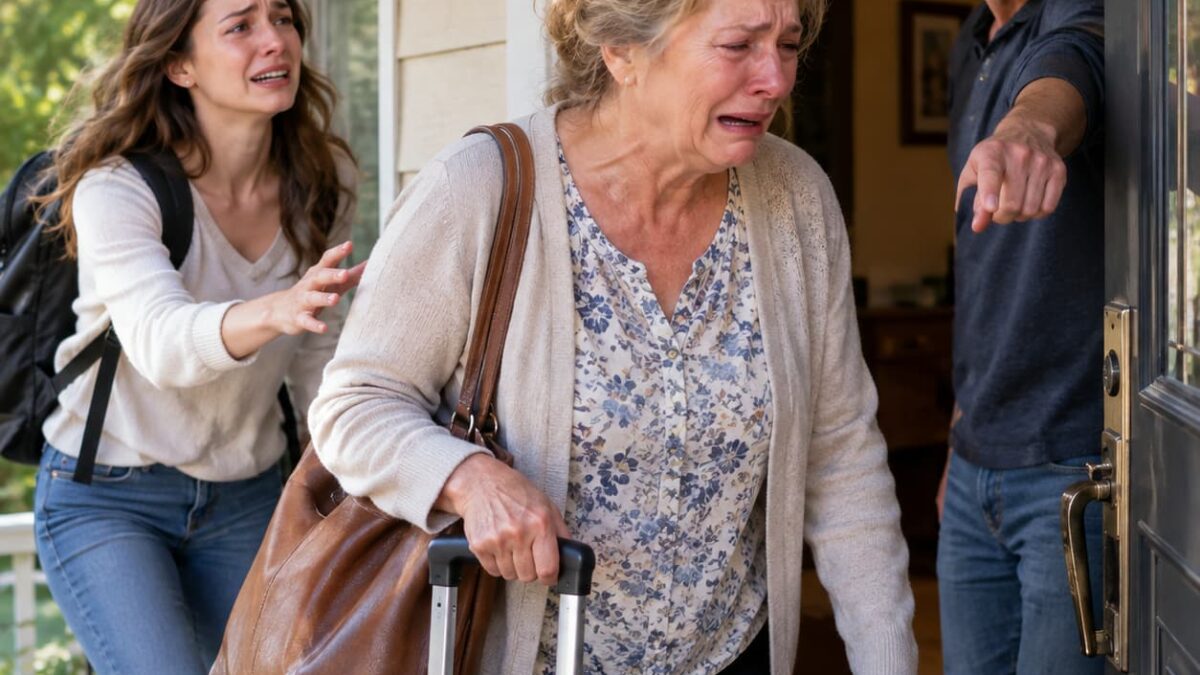
Clare stood in the doorway of the little storage room they called my bedroom, her face pale.
My hand was still wrapped around the handle of my suitcase.
Down the hall, I could hear Michael and Jessica whispering furiously in the dining room.
“Grandma,” Clare said again, “before you leave, you need to know what they’re planning.”
I looked at my granddaughter.
“What did you hear?”
She glanced over her shoulder and stepped inside, quietly closing the door behind her.
“Dad and Jessica were talking Tuesday night. They thought I was upstairs.”
My stomach tightened.
“About me?”
She nodded.
“About your money.”
For a moment, I didn’t say anything.
Then I sat on the edge of the narrow bed.
“Tell me.”
Clare swallowed.
“They were talking about the money from your house.”
Everything inside me went still.
Three months earlier, I’d sold the little house near Hudson where I’d lived with my husband for twenty-seven years.
After closing costs and paying off the small remaining mortgage, the proceeds had gone into an account in my name.
Michael knew that.
I’d never hidden it.
What I hadn’t told him was exactly how much remained.
“What did they say?”
Clare twisted the sleeve of her sweater.
“Dad said they needed to convince you to help with the home-equity loan.”
I frowned.
“This isn’t my house. I can’t help them borrow against it.”
“I know. That’s what Jessica said.”
Clare’s voice dropped.
“Then Dad said maybe you could give them enough money to pay down their credit cards first, so they could qualify.”
I stared at her.
“How much?”
“I don’t know. But Jessica said something about forty thousand.”
Forty thousand dollars.
I almost laughed.
Three months of free childcare.
Groceries.
Cooking.
Laundry.
Utility bills.
And apparently the next stage of my usefulness was forty thousand dollars.
But Clare wasn’t finished.
“She said if you wouldn’t give them the money, Dad should ask you to add him to your bank account so he could ‘help manage things.’”
My chest tightened.
“Did Michael agree?”
Clare nodded.
“He said you were getting older anyway.”
I was sixty-three.
Not ninety-three.
Not that ninety-three would have made my money his.
“He said once you got comfortable here, you’d realize you didn’t need all that money because you didn’t have a house anymore.”
There it was.
The sentence that changed everything.
I hadn’t moved into my son’s house because I was helpless.
I had moved in because he told me he needed me.
Somewhere along the way, he had rewritten the arrangement in his own mind.
I wasn’t his mother helping temporarily.
I was an aging widow with money, no property, and nowhere else to go.
At least, that’s what he thought.
I stood.
“Thank you for telling me.”
Clare’s eyes filled with tears.
“Are you mad at me?”
“At you?”
“For listening.”
I put my good hand against her cheek.
“No, sweetheart.”
She looked toward the suitcase.
“Where are you going?”
“A hotel tonight.”
“And after that?”
“I’ll figure it out.”
Her expression changed.
There was something else.
“Grandma…”
“Yes?”
“I want to go with you.”
I stared at her.
“No.”
Her face fell.
“Not because I don’t want you,” I said quickly. “Because you’re sixteen, and I can’t simply take you away from your parents because we’re angry.”
“I’m not angry.”
Her voice cracked.
“I’m scared.”
That changed the room.
I put the suitcase down.
“What are you scared of?”
Clare looked at the closed door.
Then she whispered:
“Dad.”
I had spent three months noticing what Michael did to me.
I had not spent enough time noticing what he did to his daughter.
That realization still makes me ashamed.
Clare told me her father had become increasingly controlling during the previous year.
He checked her phone.
Read messages.
Tracked her location.
Took the money she’d earned babysitting because, according to him, teenagers didn’t need savings.
None of those things alone told me the whole story.
Then she pulled up the sleeve of her sweater.
There was a fading bruise around her upper arm.
My heart dropped.
“What happened?”
“Dad grabbed me Thursday.”
“Why?”
“I told him I didn’t want to cancel debate practice to watch the twins.”
The same twins I was supposedly there to watch.
“Did he hit you?”
“No. He grabbed me and pushed me into the wall.”
“Did Jessica see?”
Clare nodded.
“What did she do?”
“She told me to stop provoking him.”
For a few seconds, I couldn’t speak.
I had heard almost those exact words in different forms for months.
Don’t make this difficult.
Don’t be selfish.
Don’t overreact.
Help the family.
Apparently Michael had learned the language of entitlement so well that he’d begun speaking it to his own daughter.
I reached for my phone.
Clare panicked.
“Don’t call Dad.”
“I’m not.”
“Then who?”
“Someone who can help us make the next decision correctly.”
I wasn’t going to sneak a sixteen-year-old out of the house and create a custody nightmare.
I wasn’t going to confront Michael while Clare was frightened.
And I wasn’t going to leave her alone after she’d told me that.
So I called for help.
That night did not end with some dramatic escape.
Real life is slower than that.
There were conversations.
Questions.
Documentation.
A call to an appropriate child-protection resource.
Clare spoke privately to professionals without Michael standing over her.
Her bruise was photographed.
Her account was documented.
I learned that my granddaughter had been keeping notes on her phone for months.
Dates.
Arguments.
Money taken from her.
Screenshots.
Things she’d been afraid she’d forget if everyone later told her they hadn’t happened.
She was sixteen years old and already doing what I had waited until sixty-three to learn:
keeping evidence of the things people expected silence to erase.
Michael was furious.
He accused me of turning his daughter against him.
I didn’t argue.
Jessica accused Clare of exaggerating.
I didn’t argue with her either.
The immediate decisions about where Clare could safely stay were handled through the proper channels and with the involvement of adults who actually had authority to make them.
Clare did not simply disappear with me.
But she also wasn’t forced to pretend nothing had happened.
That mattered.
As for me, I left that night.
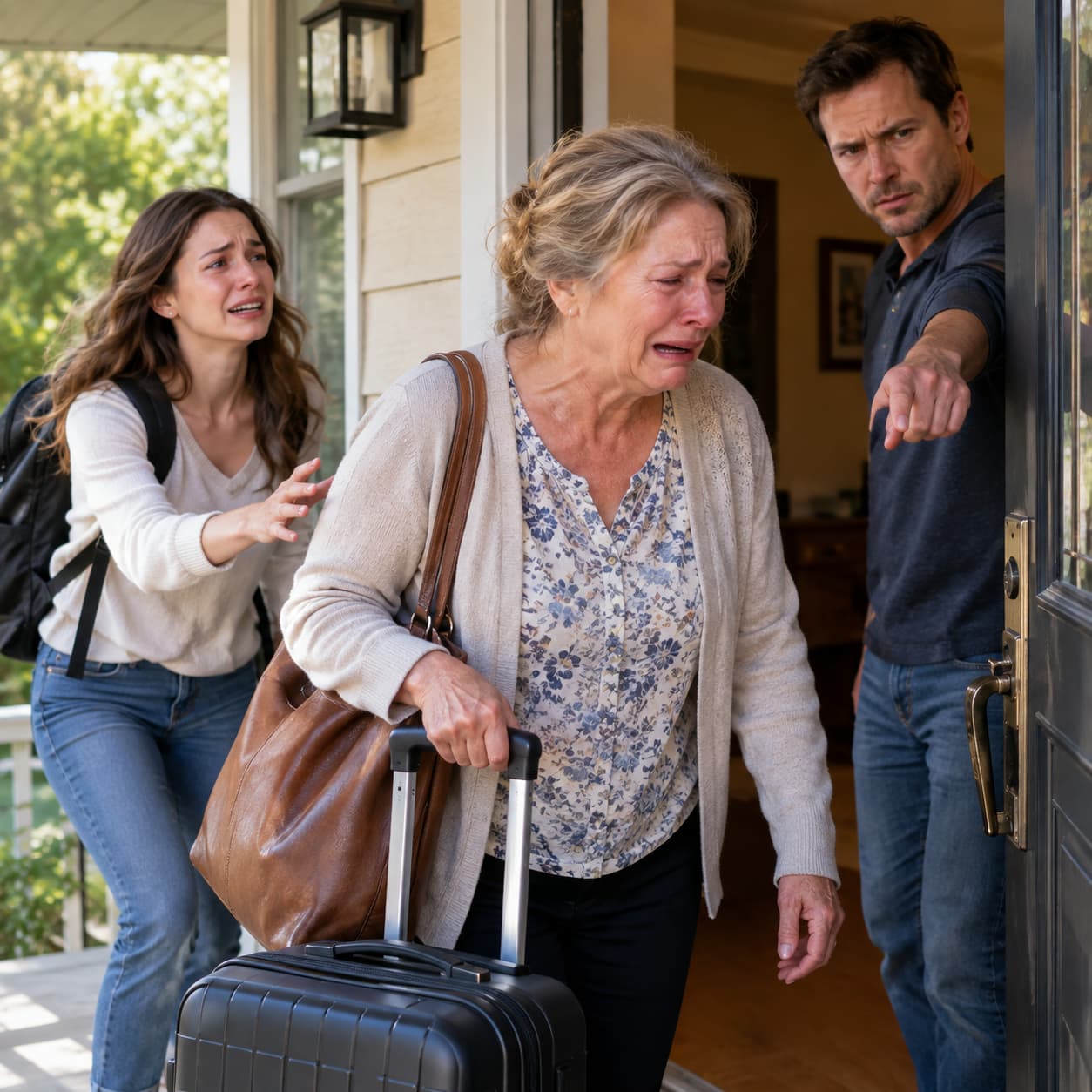
Michael followed me into the hallway as I rolled my suitcase toward the front door.
“Mom, what the hell are you doing?”
I kept walking.
“You told me where the door was.”
“That was an argument.”
“No. It was clarification.”
Jessica came down the stairs.
“You can’t just leave us without childcare.”
I turned.
“I can.”
“We both work!”
“Yes.”
“Who’s going to take care of the twins?”
“Their parents.”
Her mouth opened.
Nothing came out.
Michael stepped closer.
“What about Monday? I have a client meeting.”
“Then you should arrange childcare.”
“You know what daycare costs?”
I almost smiled.
“Yes, Michael. That’s why what I was doing had value.”
He stared at me.
Then his face changed.
“The utility bill is due Tuesday.”
“I know.”
“You usually pay it.”
“I used to.”
“Mom.”
“And the groceries are your responsibility now too.”
His eyes widened.
For the first time, he seemed to understand that when I said I was leaving, I wasn’t merely taking my body out of the house.
I was taking my labor.
My money.
My cooking.
My cleaning.
My childcare.
My emergency availability.
Everything they had stopped noticing because it arrived without an invoice.
“You’re seriously going to punish your grandchildren?”
That almost worked.
Almost.
Then I remembered Clare’s bruised arm.
“No,” I said. “I’m going to stop rescuing their parents from the cost of their own choices.”
I opened the door.
Behind me, Michael said:
“You’ll be back.”
I looked over my shoulder.
“No, sweetheart.”
It was the first time I’d called my son that in months.
“I won’t.”
Then I left.
The next morning, Michael learned the second part.
I wasn’t the only one leaving.
After the appropriate authorities and family arrangements became involved, Clare was permitted to stay temporarily with her maternal aunt while the situation was assessed.
Not with me.
I was disappointed for exactly five seconds.
Then I realized that was the right decision.
This wasn’t about winning Clare.
It was about making sure she was safe.
Michael called me at 7:12 a.m.
“What did you do?”
I was sitting in a hotel robe drinking coffee.
“For the first time in months? Very little.”
“Clare is gone.”
“I know.”
“You called people on your own son?”
“I responded when your daughter told me she was afraid of you.”
“I grabbed her arm!”
“Yes.”
“I didn’t beat her!”
I closed my eyes.
The fact that he believed this was a defense told me how much work lay ahead.
“Michael, I’m not discussing this with you while you’re angry.”
“You destroyed this family.”
“No.”
I looked out the hotel window.
“You told me my job was to serve your family for free, and you told me where the door was.”
I paused.
“I’m simply the first person who used it.”
Then I hung up.
The next few weeks exposed something else.
Michael and Jessica were in far worse financial condition than they’d admitted.
Not ruined.
Not secretly bankrupt.
Just living beyond what their income comfortably supported.
Trips.
Restaurant meals.
Two expensive vehicles.
Subscriptions.
Credit cards.
A kitchen renovation they’d financed.
They had built a lifestyle that worked partly because I had quietly removed several costs from their budget.
Childcare was the biggest.
But not the only one.
During my three months there, I had paid for groceries more often than I realized.
Gas.
School supplies.
Household items.
A utility bill here.
A repair there.
I went through my statements.
The total was a little over $8,000.
That didn’t include the value of my time.
Then I looked at the proceeds from selling my home.
And I finally understood why Clare’s warning had frightened me so much.
That money wasn’t extra.
It was my housing.
My retirement.
My security.
My future medical needs.
It was the financial form of the little house I had given up because my son said:
Mom, I need you.
I contacted a financial adviser and an estate-planning attorney.
I changed passwords.
Updated account security.
Reviewed beneficiaries.
Made sure nobody had authority over my finances that I no longer wanted them to have.
Michael was not on my bank account, so there was nothing dramatic to “take away.”
That was important.
But I made sure it stayed that way.
Then I began looking for a home.
I couldn’t buy back my old house.
Another couple owned it now.
For several weeks, that broke my heart.
I drove past once.
The basil was gone.
There was a bicycle on the porch.
A blue planter sat where my wooden coffee chair used to be.
I cried in my car.
Then I realized something.
I wasn’t grieving wood and siding.
I was grieving the woman who had believed selling her home was the price of being needed.
So I stopped looking backward.
Two months later, I found a small townhouse fifteen minutes outside Hudson.
Two bedrooms.
A narrow kitchen.
A little patch of ground behind it.
And a front window that caught the morning sun.
I could afford it without touching the money I needed for long-term security.
The day I closed, I bought a basil plant.
Then I bought another wooden chair.
Michael and Jessica’s situation became uncomfortable quickly.
They had to arrange actual childcare.
They reduced trips.
Jessica took on more household responsibility.
Michael eventually sold one of the vehicles and refinanced some debt through legitimate channels.
No magical collapse occurred.
They weren’t homeless.
They simply had to start paying for the life they’d chosen.
That was apparently shocking enough.
Clare’s situation took longer.
Professionals became involved.
There were family meetings.
Counseling.
Rules.
Michael initially treated every boundary as an accusation.
Eventually, though, something shifted.
Not quickly.
Not cleanly.
He began attending counseling consistently.
He admitted taking Clare’s babysitting money had been wrong.
He returned what could be documented.
He stopped demanding access to every private conversation she had.
Most importantly, he eventually said something to her without adding a justification afterward:
“I scared you. I shouldn’t have.”
Clare didn’t forgive him immediately.
I was proud of her for that.
She didn’t owe anyone a performance of healing.
Jessica apologized to me almost nine months after I left.
We met in a coffee shop.
She looked exhausted.
I noticed it immediately.
For months, I’d secretly wanted her to understand what my life in that house had been like.
Now she did.
But seeing her exhausted didn’t make me happy.
It just made me sad that she’d needed to experience the weight before she could recognize that I’d been carrying it.
“I didn’t realize how much you were doing,” she said.
“You did.”
She looked surprised.
“You knew I cooked. You knew I cleaned. You knew I watched the twins.”
She lowered her eyes.
“You’re right.”
“You didn’t realize what it cost me because you didn’t have to.”
She nodded.
Then she cried.
This time, I didn’t rush to comfort her.
I wasn’t cruel.
I simply let the apology belong to the person making it.
Michael took longer.
Almost a year.
He came to my townhouse alone.
He knocked.
That mattered.
He didn’t use a key.
He didn’t walk in.
He knocked.
I opened the door but didn’t immediately invite him inside.
He looked past me at the small living room.
My wooden chair sat near the window.
A photograph of my late husband was on the shelf.
Basil grew in a pot in the kitchen.
“You bought another place.”
“I did.”
He nodded.
“I thought you’d come back.”
“I know.”
He looked down.
“I thought you needed us.”
That sentence explained almost everything.
I leaned against the doorway.
“I wanted you.”
He looked up.
“There’s a difference.”
His eyes filled.
“I messed up.”
“Yes.”
“I thought because you sold your house, you didn’t have anywhere else to go.”
“I know.”
“I thought the money was just sitting there.”
“It was my retirement.”
“I know that now.”
Then he said the sentence I’d waited almost a year to hear.
“I treated your security like it was available to me because I’m your son.”
I said nothing.
“And I treated your time like it was free because you’re my mother.”
Still, I waited.
“And when you complained, I acted like you were failing us.”
His voice cracked.
“I’m sorry.”
I believed him.
But belief wasn’t the same thing as returning to the old arrangement.
So when he asked whether we could rebuild our relationship, I said yes.
When he asked whether I could start watching the twins every weekday again, I said no.
He almost laughed.
So did I.
That was how I knew something had actually changed.
It’s been three years.
Clare is nineteen now.
She’s in college.
She still calls me at least twice a week.
Sometimes she visits on Sundays.
The twins come too.
I love watching them.
For a few hours.
By choice.
Then their parents pick them up.
Michael and Jessica are still married.
Their marriage survived the financial stress and the family intervention, though not without work.
Michael and Clare are rebuilding something too.
Slowly.
Carefully.
Not perfectly.
That’s what real repair looks like.
Nobody wakes up transformed.
They make different choices long enough for those choices to become trustworthy.
Last Christmas, the whole family came to my townhouse for dinner.
Not because I was required to host.
Because I invited them.
Michael brought dessert.
Jessica made two side dishes.
Clare set the table.
The twins cleared the plates.
After dinner, Michael found me alone in the kitchen.
He looked toward the dining room.
“You remember that Sunday?”
“Yes.”
“I still hear myself saying it.”
So did I.
Your job is to watch my kids while I enjoy my life with my wife.
If you have a problem with it, the door is right there.
“I wish I could take it back,” he said.
I dried my hands.
“I don’t.”
He looked surprised.
“Why?”
“Because I needed to hear it.”
He frowned.
I smiled.
“I had spent months telling myself you didn’t mean to take advantage of me. That I should be patient. That family helps family. That things would get better.”
I folded the kitchen towel.
“You finally said out loud what the arrangement had become.”
Michael looked down.
“And then you left.”
“Yes.”
“And Clare left.”
“For a while.”
He nodded.
“And everything fell apart.”
“No.”
I touched his arm.
“Everything stopped being held together by one exhausted person.”
He looked at me for a long time.
Then he nodded.
That was enough.
After everyone went home that night, I made tea and sat in my wooden chair by the window.
The house was quiet.
My house.
Not the one I had lost.
Not a replacement.
Something new.
For most of my life, I believed being needed was the same thing as being loved.
After my husband died, that belief became dangerous.
When Michael said, “Mom, I need you,” I heard:
You still matter.
So I sold a home.
Packed my life into boxes.
Moved into a storage room.
Cooked.
Cleaned.
Paid.
Babysat.
And slowly disappeared.
Until one Sunday evening, my son pointed toward the door.
He meant it as a threat.
Instead, it became a gift.
Because I finally understood that a door works in two directions.
It can be used to throw someone out.
Or it can be used by someone who has finally decided to leave.
I picked up my suitcase and walked through it.
And by the next morning, Michael discovered something he should have understood from the beginning:
A mother is not free childcare.
A widow’s savings are not family property.
And love does not require one person to disappear so everyone else can live comfortably.
The door was right there.
He was correct about that.
I just don’t think he ever expected me to use it.