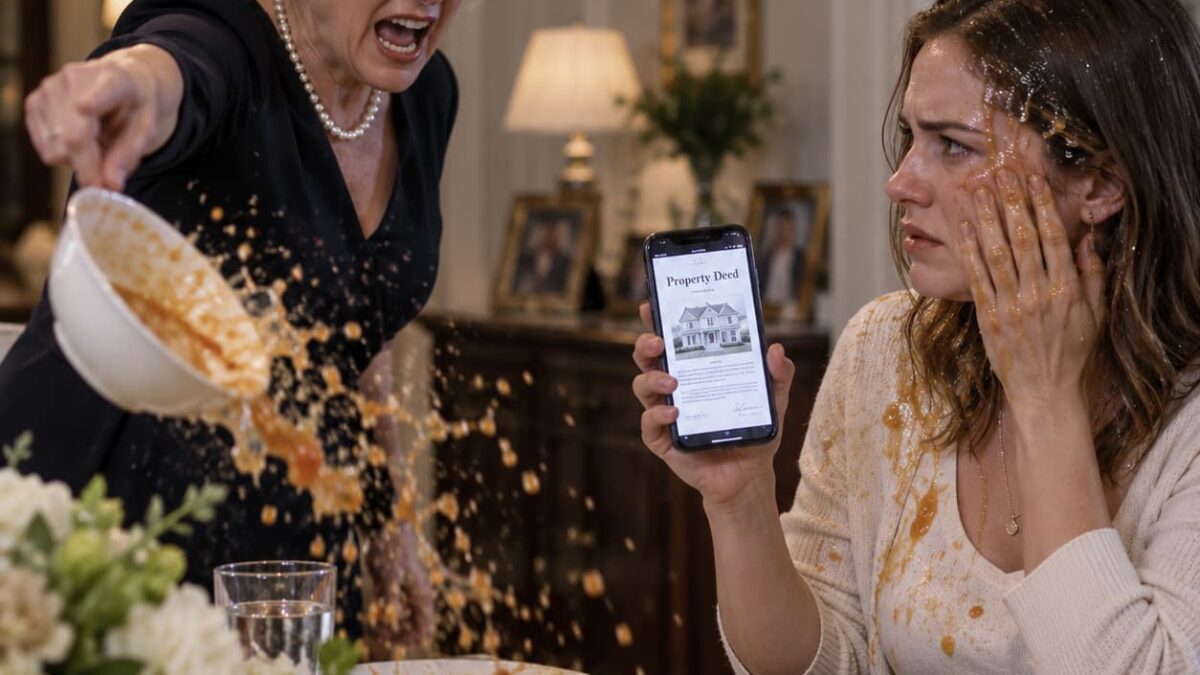
Marcus Hale opened the leather folder on the small hotel table and turned the first document toward me.
It was the deed to my house.
My name appeared exactly where it had appeared since my father died four years earlier.
Nora Bennett. Sole owner.
Marcus tapped the page.
“Your mother has no ownership interest in the property?”
“No.”
“Life estate?”
“No.”
“Lease?”
“No.”
“Written agreement giving her permanent occupancy?”
“No.”
He nodded.
“Good. Then we’re going to do this properly.”
I looked at him.
“What does properly mean?”
“It means we don’t retaliate. We document.”
That wasn’t the dramatic answer part of me wanted.
My face still burned beneath the bandage. Violet had spent the previous night drinking my wine and wearing my clothes in a house she didn’t own.
I wanted them gone.
Immediately.
Marcus seemed to read my expression.
“I know what you’re thinking.”
“Do you?”
“You’re thinking it’s your house, so you should be able to change the locks while they’re buying groceries.”
I didn’t answer.
He smiled slightly.
“That would make my job more interesting.”
“Not in a good way?”
“Rarely.”
Then he pulled out another document.
“Your mother has been living there long enough that we need to follow the applicable process for removing an occupant. We are not going to hand her an argument that you illegally locked her out.”
I leaned back.
“So I can’t empty the house.”
“Oh, the house can become very empty.”
That got my attention.
Marcus opened the folder wider.
“We just have to distinguish between your property and their right to occupy the premises while proper notice is handled.”
For the first time since the soup hit my face, I smiled.
My father, Thomas Bennett, had been obsessive about paperwork.
As a child, I thought it was annoying.
Receipts went into envelopes.
Contracts went into labeled folders.
Every appliance manual had a place.
Every insurance policy had a duplicate.
When I was twelve, Dad taught me how to read the fine print on a cell-phone contract.
“People who understand paper don’t get erased,” he told me.
I didn’t understand why he cared so much.
Then he got cancer.
And suddenly paper mattered.
His will mattered.
The deed mattered.
The beneficiary forms mattered.
Dad left me the house because I’d helped him build the small consulting company that eventually paid off its mortgage.
My mother received other assets and insurance proceeds.
It wasn’t a punishment.
It wasn’t some secret act of revenge.
Dad simply knew I had invested years of my life and a significant amount of my own money into maintaining the property.
Mom had never liked that arrangement.
After he died, she began referring to the house as hers anyway.
I let her.
That was my mistake.
Not because saying “my house” changed the deed.
Because every time I remained silent, she became more convinced that my silence was permission.
Then she married Violet’s father, Raymond, eighteen months later.
That marriage lasted less than two years.
Raymond left.
Violet stayed.
Somehow, so did all of Violet’s problems.
She lost an apartment.
She lost two jobs.
She borrowed money.
She needed a car.
She needed a better phone.
She needed help paying a credit card.
Every emergency had the same solution.
Me.
And every time I hesitated, Mom used the same sentence.
“She’s family.”
Apparently, I was family only when something needed to be taken from me.

Marcus and I spent the next two days documenting everything.
The security company preserved the kitchen footage.
The recording was brutal.
There was no ambiguity.
Violet asked for my car.
Then my laptop.
Then Dad’s necklace.
I refused.
Mom shouted.
Then she picked up the bowl.
The camera captured her throwing the soup directly into my face.
It also captured what happened afterward.
No one rushed to help me.
Violet smiled.
Mom told me to leave.
Then they demanded my belongings.
My medical report documented the burn.
Photographs documented the progression.
The messages documented what happened after I left.
And Violet, apparently believing social media was a private diary, had documented herself using my property.
Marcus looked through the evidence.
“People used to make lawyers work harder.”
“What do you mean?”
“They didn’t used to upload exhibits themselves.”
I laughed.
It hurt my cheek.
“Don’t make me laugh.”
“Sorry.”
He wasn’t.
There was another problem.
My belongings.
The house was furnished almost entirely with things I owned.
The dining table had been purchased by me.
The living-room furniture was mine.
The televisions were mine.
The artwork was mine.
The washer and dryer were mine.
Most of the kitchen equipment was mine.
The bed in my room was mine.
So were the rugs, lamps, office furniture and nearly everything in the garage except a few boxes belonging to Mom.
I had receipts for much of it.
For the rest, I had bank statements, photographs and purchase histories.
Marcus arranged for a bonded moving company to retrieve my personal belongings with documentation and appropriate notice.
I didn’t go.
I couldn’t.
Instead, a representative handled the inventory.
The security cameras recorded the process.
Mom called me forty-three times.
Violet called eighteen.
I answered neither.
They sent messages instead.
YOU ARE STEALING OUR FURNITURE.
I replied once.
Please direct questions concerning the property to my attorney.
Violet responded:
You’re insane.
I saved it.
By the end of that day, the house looked almost empty.
Not literally empty.
We didn’t touch their beds, clothing, toiletries, personal electronics or anything that belonged to them.
But almost everything that had made the house look warm and finished was gone.
My sofa.
My dining set.
My television.
My office furniture.
My paintings.
My kitchen equipment.
Even the expensive espresso machine Violet loved photographing for Instagram.
Gone.
The house hadn’t been stripped out of spite.
I had simply removed what belonged to me.
The difference mattered.
Especially legally.
Mom and Violet returned that evening.
The security camera caught their reactions.
Violet entered first.
She stopped.
“Where’s the couch?”
Mom walked in behind her.
Then she saw the dining room.
“Where is everything?”
Violet ran toward the kitchen.
“My coffee machine!”
I almost wished I’d been there.
Almost.
Then they noticed the man standing beside the kitchen island.
Marcus Hale.
Dark suit.
Leather folder.
Perfectly calm.
“Mrs. Bennett?”
My mother stared at him.
“Who are you?”
“Marcus Hale. I represent Nora.”
Violet immediately reached for her phone.
“You can’t be here.”
Marcus didn’t argue.
He simply handed my mother an envelope.
“This contains formal notice concerning the property and instructions for communication through my office.”
Mom didn’t take it.
“This is my house.”
Marcus glanced down at the folder.
“No, ma’am.”
That was all.
Two words.
No speech.
No dramatic reveal.
Just reality.
Mom finally took the envelope.
Violet snatched it from her.
I watched the security footage later.
I watched her read the first page.
Then the second.
Her face changed.
She looked at Mom.
“You said the house was yours.”
Mom didn’t answer.
“Mom?”
Still nothing.
Marcus said calmly, “The recorded deed identifies Nora Bennett as the owner.”
Violet looked around the nearly empty room.
“You’re lying.”
Marcus didn’t react.
“The county records are public.”
That silenced her.
Then she asked the question I knew was coming.
“So she can just throw us onto the street?”
“No.”
Marcus’s answer surprised her.
“Nora is following the required process. You will receive whatever notice and procedural rights apply. You should obtain your own legal advice if you have questions.”
He wasn’t there to humiliate them.
That made the moment stronger.
He was there because facts didn’t need theatrics.
Then Mom noticed something else.
The wedding photograph.
Hers and Dad’s.
It was still hanging beside the pantry.
She looked at Marcus.
“Why didn’t she take that?”
“Because she said it belongs to you.”
For the first time, Mom’s expression cracked.
Not anger.
Something closer to shame.
I had taken the furniture.
I had taken my electronics.
I had taken my kitchenware.
I had taken my father’s necklace.
But I hadn’t taken her memories.
Because this wasn’t revenge.
It was a boundary.
She had simply never encountered one from me before.
The police investigation into the soup incident moved separately.
I gave a statement.
So did Mom.
Violet tried to describe it as an “argument that got out of hand.”
The video made that explanation difficult.
There was no physical fight before the soup was thrown.
I hadn’t threatened anyone.
I hadn’t touched anyone.
I’d said no.
That was it.
The authorities handled the assault based on the evidence and local law.
I also followed my attorney’s advice regarding protective measures and communication.
For several weeks, Mom communicated with me only through lawyers.
That was the quietest our relationship had ever been.
And strangely, it was also the clearest.
Then Marcus discovered something I hadn’t expected.
Mom had tried to borrow against the house.
Not successfully.
That distinction mattered.
She hadn’t secretly mortgaged my property.
She couldn’t simply do that because she lived there.
But she’d spoken to a loan representative months earlier about accessing equity.
She had described the property as “the family home” and apparently assumed there would be some way to make it work.
Nothing had been completed.
No valid lien had been placed against my title through her inquiry.
But hearing about it still chilled me.
“Why would she need that much money?”
Marcus didn’t know.
So I asked Mom.
Through counsel.
Her answer arrived three days later.
Violet.
Of course.
Violet had nearly $46,000 in debt.
Credit cards.
A personal loan.
An old auto deficiency.
And other expenses she’d never told me about.
Mom had been trying to find money to “help her start over.”
Again.
When she couldn’t access the house equity, she apparently decided my possessions were the next available solution.
The car would help Violet get to work.
The laptop would help her “build a career.”
Dad’s necklace?
That one had no practical explanation.
Violet simply wanted it.
And Mom had become so accustomed to treating my belongings as family resources that she no longer understood why I believed ownership mattered.
I didn’t immediately sell the house.
People expected me to.
Marcus even asked whether I wanted to.
But I wasn’t ready.
Dad had built the back deck himself.
His pencil marks were still inside the pantry door.
The maple tree we’d planted when I was nine had finally grown taller than the roof.
I wasn’t going to let one violent afternoon decide what happened to every good memory I’d ever had there.
But I also wasn’t moving back while Mom and Violet remained.
So I waited.
The proper process took time.
There were notices.
Deadlines.
Lawyers.
Arguments.
Mom hired counsel.
That was fine.
I wanted everything done correctly.
Eventually, Mom and Violet moved out.
Not onto the street.
Mom had enough money for a modest apartment.
Violet, despite claiming she had nowhere to go, moved in with a friend for several months.
I didn’t pay their moving expenses.
I didn’t provide a security deposit.
I didn’t give Violet my car.
That last part caused another explosion.
She sent:
You don’t even need it every day.
I stared at the message for a long time.
Then blocked her.
I returned to the house for the first time almost four months after the soup incident.
Marcus came with me.
When I opened the door, the rooms echoed.
The walls had lighter rectangles where paintings used to hang.
The kitchen looked enormous without the table.
I walked to the place where I’d been sitting when Mom threw the soup.
For a moment, I could smell it again.
Chicken.
Onion.
Pepper.
Then my skin seemed to remember the heat.
I touched my cheek.
The burn had healed well.
There was still slight discoloration near my jaw.
The doctor said it might fade further.
Maybe it would.
Maybe it wouldn’t.
I no longer cared as much.
Marcus stood in the doorway.
“You okay?”
“Yes.”
It was the first time I’d said that and meant it.
I renovated slowly.
Not because the house needed it.
Because I did.
I painted the kitchen.
Changed the brass lights.
Moved Dad’s portrait from the living room into my office.
I bought a smaller dining table.
A softer sofa.
Nothing Violet had ever chosen.
Nothing Mom had ever insisted matched.
For the first time, the house began to look like mine.
Not legally.
It had always been mine legally.
Emotionally.
That took longer.
Mom contacted me seven months later.
She asked to meet.
I chose a public café.
When she arrived, she looked smaller.
Not physically.
Just less certain.
She sat across from me.
For several minutes, neither of us spoke.
Then she said:
“I was angry.”
I waited.
“I shouldn’t have thrown the soup.”
“No.”
“I felt like you were rejecting Violet.”
“I rejected her demand.”
Mom looked down.
“She was struggling.”
“She was always struggling.”
“She needed help.”
“And you decided my things were the solution.”
Mom’s eyes filled.
“I thought you had more.”
There it was.
The sentence underneath everything.
Because I had more, I was expected to give more.
Because I was stable, my stability was treated like a family emergency fund.
Because I didn’t have children, my future apparently counted less.
I leaned forward.
“Mom, having more than Violet did not make my things hers.”
“I know that now.”
“Do you?”
She looked at my cheek.
Then away.
“I do.”
I believed she was beginning to.
That wasn’t the same as forgiveness.
Violet’s apology took another year.
It came by email.
No excuses at first.
That surprised me.
She admitted she’d spent years resenting me because I seemed to have everything together.
She thought Dad had favored me by leaving me the house.
She convinced herself that taking from me was balancing something unfair.
Then she wrote:
When Mom threw the soup, I smiled. That’s the part I can’t excuse. I was happy because for once I thought someone was choosing me over you.
I stopped reading for a while.
That sentence hurt more than the insults.
Eventually, I finished.
I didn’t invite Violet back into my life immediately.
Trust isn’t restored because someone finally describes the damage accurately.
But I answered.
Four words:
I received your message.
That was all I could offer then.
It was enough.
Three years have passed.
Mom and I speak occasionally.
She has never had a key to my house again.
Violet and I have limited contact.
She found steady work eventually.
She bought her own used car.
She has her own laptop.
Apparently both work perfectly well despite not belonging to me.
Dad’s necklace is still around my neck.
I wear it almost every day.
And the house?
I kept it.
Last spring, I replaced the kitchen window with French doors opening onto Dad’s deck.
Sometimes I sit outside with coffee beneath the maple tree and think about the afternoon Mom told me:
“Give her all your things—or get out.”
For years, I thought being peaceful meant tolerating things quietly.
I was wrong.
Silence can be patience.
But it can also become permission.
The day I left wasn’t the day my mother took my home from me.
It was the day I finally stopped pretending that allowing someone to live in my house gave them ownership over my life.
Mom believed the house belonged to her because I had never corrected her.
Violet believed my belongings were available because I had shared before.
Both mistook generosity for surrender.
And I had helped teach them that mistake by saying yes long after I wanted to say no.
That ended with one bowl of soup.
I still remember standing beside my car with my cheek bandaged, looking through the windshield at the house my father left me.
I thought I was walking away from everything.
I wasn’t.
I was walking away from the people who believed loving them required me to give everything away.
They told me to leave.
So I did.
Quietly.
But when I returned, I came back to something I had almost forgotten belonged to me.
Not the house.
Not the car.
Not the furniture.
My right to say no—and remain the owner of my own life.