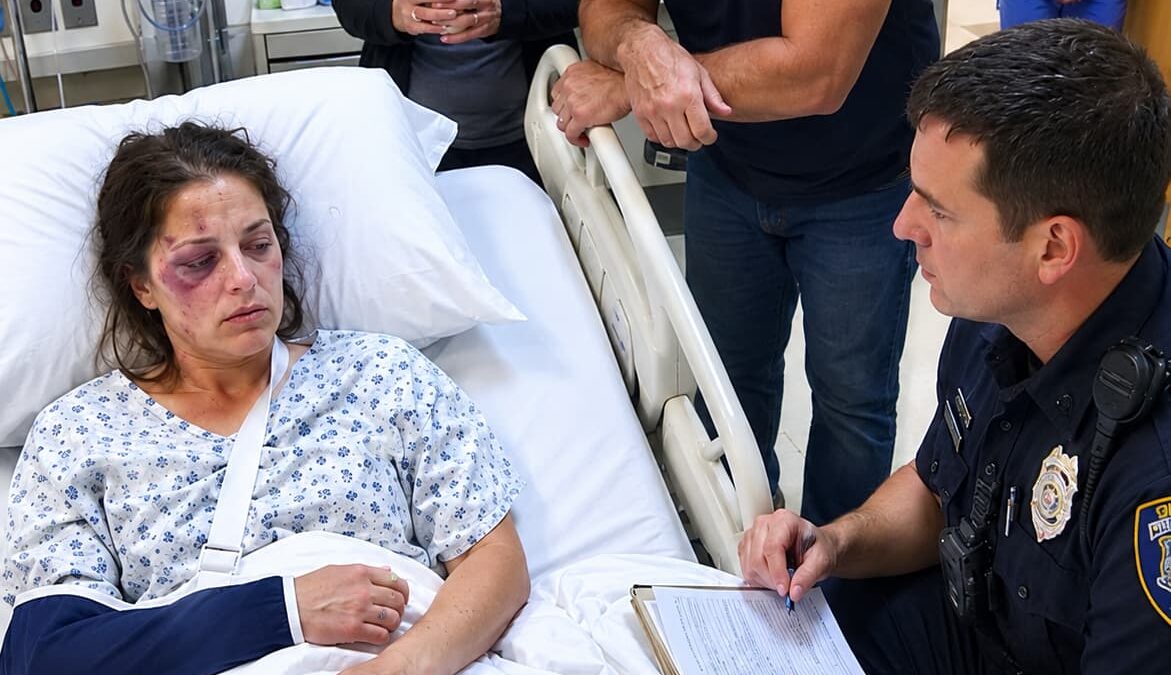
Officer Delgado’s hand remained on the radio.
I watched her face change as she spoke to someone on the other end.
“Secure the garage,” she said. “There may be financial documents connected to the assault. Don’t let anyone remove or alter anything.”
My mother stopped crying.
My father stared at the floor.
And I understood immediately that they were afraid of what the police might find.
Not because they knew everything.
Because they knew enough.
Officer Delgado lowered the radio.
“Holly, I need you to tell me exactly what you saw.”
“My name was already typed into the mortgage application.”
“Anything else?”
“My address. The last four digits of my Social Security number. There was a lender portal timestamp from two days ago.”
“Did you authorize your sister or brother-in-law to apply for credit using your information?”
“No.”
“Did you electronically sign anything?”
“No.”
“Did you give them access to your financial records?”
“No.”
She nodded.
“Then don’t speculate about what happened. We’ll document what you know and preserve what we can.”
That sentence mattered.
Because I wanted to call Vanessa a thief.
I wanted to say she’d stolen my identity.
I wanted to tell everyone exactly what she’d done.
But at that moment, I didn’t know.
I only knew what I had seen.
And what Ethan had done when I refused to sign.
So I told the truth.
Nothing more.
Nothing less.
The police found the mortgage packet exactly where I’d last seen it.
Under Vanessa’s purse.
There was blood on one corner.
Mine.
The uncapped black pen was still beside it.
But the most important thing wasn’t the blank signature line Ethan had tried to force me to sign.
It was another page underneath.
A preliminary borrower information sheet.
My name was listed as a co-borrower.
My income was wrong.
Not wildly wrong.
Strategically wrong.
It was about $18,000 higher than what I’d actually earned the previous year.
My monthly housing expense was listed lower than my actual rent.
And beside “liquid assets” was an amount that looked suspiciously close to the balance of my savings account.
I hadn’t given Vanessa that number.
At least, I didn’t remember doing so.
Then Officer Delgado asked a question I hadn’t considered.
“Who does your taxes?”
I looked at my father.
His head came up.
For years, Dad had prepared everyone’s taxes using consumer tax software.
Mine too.
I’d send him my W-2 and bank forms because that was what our family did.
He had copies of almost everything.
“Dad?”
His face went pale.
“I never gave Vanessa your tax return.”
“Did she have access to your computer?”
Silence.
Mom answered for him.
“She uses the office sometimes.”
I closed my eyes.
Of course she did.
In our family, Vanessa had access to everything because nobody ever wanted to make her feel excluded.
The next morning, a hospital social worker helped me make calls.
I froze my credit.
Changed passwords.
Contacted the lender’s fraud department.
Requested copies of any application materials associated with my identity.
My shoulder had been put back into place, but every movement still sent pain through my arm.
My face looked worse than it felt.
Purple bruising spread beneath my eye.
My lip was split.
Two ribs were badly bruised but, thankfully, not broken.
The doctor told me recovery would take time.
I remember thinking:
Which part?
My shoulder?
My face?
Or the realization that my sister had watched her husband hurt me and told me I was selfish?
Vanessa called eleven times that morning.
I didn’t answer.
Then the texts started.
You are ruining everything.
Ethan lost control because you provoked him.
We can fix this if you stop talking to the police.
Then:
Mom and Dad don’t need this stress.
That one almost made me laugh.
I took screenshots and sent them to Officer Delgado.
Twenty minutes later, Vanessa deleted several messages.
It didn’t matter.
I had them.
For once, I had learned faster than my family expected me to.
Ethan was arrested in connection with the assault.
The financial side took longer.
Much longer.
The lender did not simply declare that Vanessa had committed mortgage fraud because I said so.
Records had to be reviewed.
Portal activity had to be traced.
Documents had to be compared.
The lender’s compliance team preserved the application history.
And slowly, the story emerged.
Vanessa and Ethan had been trying to buy a four-bedroom house in a new development for months.
They’d already been rejected once.
Their debt-to-income ratio was too high.
Ethan had a truck payment.
Vanessa had substantial credit-card balances.
They had less cash available for closing than they’d told our parents.
The house wasn’t impossible for them forever.
It was simply beyond what the lender was willing to approve for them then.
Vanessa hated that answer.
So she started looking for another borrower.
Me.
At first, she told the mortgage broker I had “agreed in principle.”
That was false.
Then she provided basic identifying information.
Some of it came from family records.
Some came from documents stored on Dad’s computer.
Investigators later determined that an online application profile had been created containing my information before I ever entered that garage.
But the process wasn’t complete.
The lender still required additional verification and authorization.
That was why they needed my signature.
That was why the papers were waiting.
And that was why Vanessa had looked afraid when I noticed the timestamp.
She wasn’t afraid I would refuse.
She already knew I might refuse.
She was afraid I would realize how far she’d gone before asking me.
There was one more discovery.
A document in the packet contained initials that resembled mine.
I stared at them when my attorney showed me a copy.
“Those aren’t mine.”
“I believe you,” she said. “But what matters is what can be established.”
Her name was Camille Foster, and she had the useful habit of refusing to turn anger into conclusions.
The document was examined as part of the investigation.
Electronic records became more important than handwriting alone.
The submission history showed activity associated with information provided from Vanessa and Ethan’s side of the application process.
That didn’t magically answer every question.
But combined with messages, portal records and the physical packet recovered from the garage, it became difficult for Vanessa to maintain that I’d been participating voluntarily.
Especially after police recovered messages between her and Ethan.
One from Vanessa read:
She’ll say no if we ask normally. Mom needs to get her here.
Another from Ethan:
Once she’s sitting there, she’ll sign.
And Vanessa:
She always folds when Dad gets quiet.
I read that sentence three times.
Not because it was the worst thing she’d written.
Because it was the most accurate.
She knew our family system.
She knew Dad’s silence.
Mom’s guilt.
My exhaustion.
She knew exactly which buttons everyone had spent years installing in me.
She just hadn’t expected me to stop responding to them.
My parents were not charged with attacking me.
There was no evidence they’d planned for Ethan to become violent.
But that did not make them innocent in my eyes.
They had knowingly invited me to a meeting designed to pressure me into signing financial documents after I’d already said no.
Dad admitted that.
Mom admitted it too.
Their excuse was painfully familiar.
“We thought once everyone sat down, you could work something out.”
There was nothing to work out.
I had already answered.
No.
The family meeting existed because they believed my no was the beginning of negotiations.
Dad came to see me four days after I left the hospital.
By then I was staying with a friend because I didn’t want Vanessa knowing exactly where I was while everything was unfolding.
Dad sat across from me with his hands between his knees.
“I should’ve stopped him.”
“Yes.”
“I froze.”
“Yes.”
“I keep seeing it.”
“So do I.”
His eyes filled.
“I didn’t know Ethan was capable of that.”
I looked at him.
“You saw him move toward me.”
Dad nodded.
“You saw him hit me.”
His face crumpled.
“Yes.”
“And after the first time, you still didn’t get between us.”
“I know.”
I wasn’t interested in comforting him.
Not then.
He needed to sit with that truth.
Finally, he whispered:
“I’m sorry.”
I believed him.
But believing an apology doesn’t obligate you to erase what caused it.
“I love you,” I said. “But I don’t trust you right now.”
He cried.
So did I.
And nothing was magically fixed.
Mom’s apology took longer.
She spent weeks trying to make the situation about family unity.
She asked whether charges were “really necessary.”
She reminded me Vanessa was my sister.
She reminded me Ethan was the father of her grandchildren.
Finally, during one phone call, I asked:
“And what am I?”
She went silent.
“Your daughter,” I continued. “What does that mean when Vanessa wants something?”
“Holly—”
“No. Tell me.”
“You know I love you.”
“Love that never protects me from anything isn’t enough anymore.”
She started crying.
Usually that would have ended the conversation.
This time I let her cry.
Then I said goodbye.
Vanessa blamed Ethan at first.
She said he’d acted independently.
Then the recovered messages became part of the evidence.
Her story changed.
She said she only wanted to pressure me into reconsidering.
She said she believed I would eventually agree.
She said entering my information into preliminary paperwork was just “getting things ready.”
What she could no longer credibly say was that I had enthusiastically volunteered.
The electronic trail didn’t support that.
Neither did her own messages.
The financial matter was eventually resolved through the legal process based on what investigators and prosecutors believed the evidence could establish.
I won’t pretend every ugly act resulted in the most dramatic possible charge.
Real cases aren’t television.
Some conduct was handled through criminal proceedings.
Some through the lender’s fraud and compliance processes.
Some through civil remedies and identity-protection measures.
The lender canceled the application.
The house went to another buyer.
My credit reports were corrected where necessary.
I spent months checking them anyway.
Ethan’s assault case was simpler.
There were witnesses.
There were photographs.
There were medical records.
There was blood in the garage.
There was the neighbor’s 911 call.
And eventually there was something I hadn’t known existed.
Dad had a security camera mounted above the garage door.
He installed it years earlier after tools disappeared from the neighborhood.
It captured video.
Not perfect audio.
But enough.
Enough to show Ethan striking me.
Enough to show me falling.
Enough to show Vanessa remaining beside the table.
Enough to show Ethan kicking the papers toward me.
And enough to destroy the claim that I had attacked him first.
When my attorney showed me a still image, I couldn’t look at it for long.
I didn’t need to.
I remembered.
Vanessa and Ethan’s marriage collapsed during the following year.
I didn’t celebrate.
Vanessa eventually admitted that their finances had been much worse than she’d told anyone.
They had credit-card debt, tax obligations and expenses they’d been moving around for months.
The house had become symbolic.
If they could buy it, she believed it would prove they were successful.
She needed that illusion badly enough to put my financial future underneath it.
Ethan needed control badly enough to use violence when I refused.
Those were their choices.
Not mine.
My shoulder took almost five months to feel normal.
My family took longer.
Dad changed first.
He stopped preparing everyone’s taxes.
He deleted stored copies of documents he didn’t need.
He apologized without adding “but.”
He never again asked me to reconcile with Vanessa.
Mom struggled.
For nearly a year, every conversation seemed to circle back to the same sentence:
“But she’s still your sister.”
Eventually I answered:
“And I’m still her sister. She watched her husband beat me because I wouldn’t take responsibility for her mortgage.”
Mom never used that sentence again.
Vanessa contacted me fourteen months after the attack.
Not by phone.
Through a letter.
It was six pages.
The first two were excuses.
The next two were explanations.
On page five, she finally wrote something that sounded like accountability.
I knew you didn’t want to sign. I thought if we got you into the room with Mom and Dad, you would give in like you always did. When Ethan hit you, I was more afraid of losing the house than I was afraid for you. I don’t know how to live with knowing that about myself.
I stopped reading.
Not because I was angry.
Because for the first time, she had said exactly what happened.
I didn’t forgive her that day.
I didn’t call.
I didn’t tear up the letter either.
I put it in a drawer.
Some apologies are beginnings.
They are not automatic endings.
Three years have passed.
I never co-signed anyone’s mortgage.
My credit survived.
So did I.
I eventually bought a place of my own.
Nothing glamorous.
A two-bedroom townhouse with a narrow kitchen, a tiny patio and a mortgage that was approved using exactly one person’s income and credit.
Mine.
On closing day, the loan officer slid the documents across the table.
There were a lot of them.
I read every page.
Every number.
Every box.
The loan officer smiled.
“Take your time.”
So I did.
When I reached the signature line, my hand stopped.
For one second, I was back in Dad’s garage.
The concrete.
The oil smell.
The black pen.
Vanessa saying:
Just sign it.
Then I looked around.
Nobody was standing over me.
Nobody was angry.
Nobody was demanding anything.
My attorney had reviewed the documents.
The numbers were mine.
The debt was mine.
The decision was mine.
So I signed.
I still have limited contact with Vanessa.
She has done counseling.
She has rebuilt parts of her life.
I hope she continues.
But I don’t lend her money.
She doesn’t have access to my financial information.
And she has never been inside my new home.
Maybe that will change someday.
Maybe it won’t.
Forgiveness and access are not the same thing.
That was another lesson my family had never taught me.
My parents visit.
Dad always knocks.
Mom does too.
Sometimes I see her looking around my little townhouse with an expression I can’t quite name.
Pride, perhaps.
Or regret.
Probably both.
One afternoon, she said:
“You really did all this yourself.”
I looked at her.
“No.”
She seemed confused.
I touched my shoulder, where the injury sometimes still aches when the weather changes.
“I had doctors. Police. Friends. An attorney. People who helped me when I needed it.”
Then I smiled slightly.
“What I did by myself was finally say no.”
For years, my family had taught me that generosity meant making myself available.
My money.
My time.
My credit.
My patience.
My future.
And when I finally protected one thing that belonged only to me, they called me selfish.
Ethan believed violence could turn my no into a signature.
Vanessa believed guilt could do the same thing.
My parents believed silence would eventually make me surrender.
All of them were wrong.
Because the most important document in that garage wasn’t the mortgage application.
It wasn’t the borrower certification.
It wasn’t even the page containing information I had never authorized them to use.
It was the empty signature line.
They had filled in my name.
They had gathered my information.
They had prepared the paperwork.
They had surrounded me with people who expected me to surrender.
But one thing was still missing.
My consent.
And no matter how many people stood around that table telling me otherwise, my consent was never theirs to take.
That blank line cost me a dislocated shoulder, months of recovery, and the family I thought I had.
But it also taught me the sentence that changed the rest of my life:
“No” is not the beginning of a negotiation.
It is a complete answer.