The thirty-first phone call ended my marriage.
The divorce papers wouldn’t exist for another four months, but by then they were only paperwork.
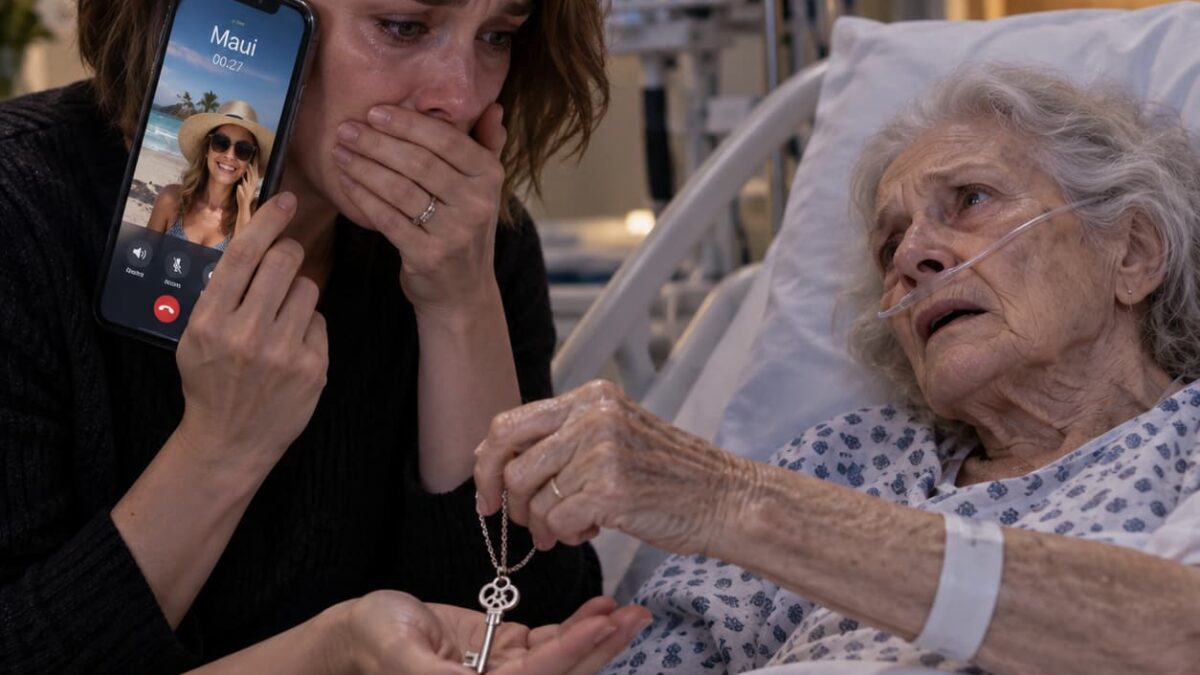
My marriage ended at 6:42 on a rainy Thursday evening, beside my mother-in-law’s hospital bed, when another woman answered my husband’s phone.
“He’s in the shower,” she said.
Behind her, I could hear music and waves.
I tightened my grip on the phone.
“Who is this?”
She laughed.
Not nervously.
Confidently.
Like I was the intruder.
“We’re in Maui. We’re celebrating. Stop acting like the desperate wife. It’s embarrassing.”
Then she hung up.
I stood frozen beside Eleanor’s bed.
My husband, Julian, had told me he was in Seattle for critical meetings with investors.
His mother was dying.
And he was in Hawaii with another woman.
The cruelest part was that Eleanor had heard every word.
Her eyes were open.
She couldn’t speak anymore, but she understood.
I knew she did.
For twenty years, Eleanor Mercer had been more than my mother-in-law.
After her first stroke, I organized her medications.
After the second, I drove her to physical therapy.
When swallowing became difficult, I learned which foods she could tolerate.
When Julian said he was too busy, I sat beside her.
When he forgot her birthday, I bought flowers and put both our names on the card.
I had protected him from his own failures for years.
And apparently, so had she.
I tried calling Julian again.
Voicemail.
I leaned toward Eleanor.
“I’m sorry,” I whispered. “I couldn’t bring him home.”
Her fingers suddenly closed around mine.
Hard.
I looked down in shock.
She hadn’t had that kind of strength in weeks.
Then she reached beneath her gown.
A thin chain appeared.
At the end hung a tiny silver key.
I’d seen it before.
Eleanor had worn it for years, always hidden beneath her clothes.
Whenever Julian entered the room, she tucked it away.
Now she pulled the chain until the clasp broke.
Then she pressed the key into my palm.
Her eyes locked onto mine.
Her lips moved behind the oxygen mask.
No sound came.
But I understood the emotion.
Fear.
Anger.
Urgency.
Then the monitor changed.
One long tone filled the room.
Nurses rushed in.
A doctor moved me aside.
And at 6:51 p.m., Eleanor was gone.
I stood in the hallway with that silver key cutting into my palm.
I didn’t know what it opened.
But I knew one thing.
Eleanor had waited until her son wasn’t there to give it to me.
Julian returned from “Seattle” two days later.
He came into the house wearing an expensive navy coat and carrying a leather suitcase.
I was sitting at the kitchen table.
He stopped when he saw me.
“How’s Mom?”
I stared at him.
There are moments when anger becomes so complete that it feels almost peaceful.
“She died Thursday.”
His suitcase slipped from his hand.
“What?”
“6:51.”
“No.”
He shook his head.
“No, no. Why didn’t you call me?”
I almost laughed.
“I called you thirty-one times.”
He pulled out his phone.
“I was in meetings.”
“In Maui?”
His face changed.
Just slightly.
Enough.
“Who told you that?”
“The woman who answered your phone.”
Silence.
I watched him decide which lie to choose.
Finally he sat across from me.
“Her name is Sabrina.”
I said nothing.
“It isn’t what you think.”
That time I did laugh.
“Your mother was dying while your mistress answered your phone from Maui. Which part am I misunderstanding?”
“We were there for business too.”
“Of course.”
“I was going to tell you.”
“When?”
He looked away.
I reached into my pocket.
Not for the key.
I wasn’t ready to show him that.
Instead, I placed Eleanor’s hospital bracelet on the table.
“Your mother heard her.”
Julian looked at the bracelet.
“What?”
“She heard Sabrina call me the desperate wife.”
His face collapsed.
For a second, I saw genuine grief.
Then he asked a strange question.
“Did Mom say anything before she died?”
I went still.
“No.”
“Nothing?”
“She couldn’t speak.”
He nodded.
But relief flickered across his face.
Relief.
At his mother’s deathbed.
That was when I knew the key was about more than an affair.
Eleanor’s funeral was held the following Tuesday.
Julian performed grief beautifully.
He cried during the eulogy.
He talked about sacrifice.
He described his mother as the moral center of the family.
He never mentioned that while she was taking her final breaths, he had been drinking champagne in Hawaii.
I stood beside him because I wasn’t ready to reveal anything.
Not yet.
After the burial, Eleanor’s longtime attorney approached me.
Her name was Celia Hart.
She was in her seventies, small and sharp-eyed.
“Can we speak privately?”
We walked toward the edge of the cemetery.
Celia looked toward Julian.
Then at me.
“Did Eleanor give you anything?”
My heart began pounding.
“What kind of thing?”
Celia held my gaze.
“A key.”
I said nothing.
That was answer enough.
She exhaled.
“Good.”
“What does it open?”
“Not here.”
“Celia—”
“Tomorrow. Ten o’clock. My office.”
Then she walked away.
The next morning, I sat across from Celia in a conference room.
I placed the silver key on the table.
She stared at it for several seconds.
“Eleanor was afraid she wouldn’t have time.”
“To do what?”
“To make sure this reached you.”
She handed me a card.
It contained the address of a private vault facility in downtown Chicago.
“What’s there?”
“I don’t know everything.”
“You were her attorney.”
“Estate attorney. Eleanor deliberately separated certain matters.”
That sounded exactly like her.
We drove there together.
The key opened a private storage box registered through a small family holding company Eleanor had controlled independently.
Inside were three things.
A sealed letter with my name on it.
A black ledger.
And an encrypted external drive.
The letter began:
My dear Claire,
I had to stop reading.
Celia waited.
I tried again.
If you are reading this, then I was either unable to tell you the truth myself, or I lost my courage again. For both, I am sorry.
I looked at Celia.
“What truth?”
“Keep reading.”
So I did.
Eleanor wrote that seven years earlier, after her first stroke, she had begun reviewing the family’s finances.
Julian ran Mercer Development Group, a regional real-estate company founded by his father.
Everyone—including me—believed Julian effectively owned it.
He didn’t.
Not completely.
Eleanor still controlled a substantial block of voting shares through a family trust established after her husband’s death.
Julian managed the company.
But management and ownership were not the same thing.
According to Eleanor’s letter, she had become concerned about transactions Julian was authorizing.
Payments to consulting companies she didn’t recognize.
Loans involving family entities.
Personal expenses classified as business development.
And transfers connected to properties Eleanor believed were supposed to remain protected.
She confronted him.
Julian told her she was confused after her stroke.
That sentence made my stomach turn.
Because I had heard him say similar things.
“Mom doesn’t understand numbers anymore.”
“Mom gets confused.”
“Don’t upset her with paperwork.”
I’d believed him.
Eleanor hadn’t.
So she started keeping records.
The black ledger contained dates, amounts, company names and questions.
It wasn’t proof by itself.
But the drive contained copies of documents she had preserved.
Emails.
Statements.
Board materials.
Property records.
And correspondence with an accountant Julian had later fired.
Then I reached the final paragraph of her letter.
Do not destroy my son, Claire.
I stopped.
That wasn’t what I had expected.
I read on.
I know my anger may have made you believe that is what I wanted. I do not. I want you to stop protecting him. There is a difference.
My eyes filled with tears.
Give these records to people qualified to determine what is true. If Julian has done nothing wrong, then the records cannot hurt him. If he has, do not save him from the consequences simply because you once loved him. I made that mistake too many times.
I covered my mouth.
All that fury I had read in Eleanor’s final expression suddenly made sense.
She wasn’t asking me for revenge.
She was asking me to do what neither of us had done before.
Stop covering for Julian.
Celia arranged for a forensic accountant and corporate attorney to review the records.
I didn’t touch the drive myself.
I didn’t confront Julian.
And I didn’t make dramatic accusations.
For nearly three weeks, I said almost nothing.
Julian mistook my silence for weakness.
One evening he came home and said:
“We need to discuss Mom’s estate.”
I looked up from my tea.
“Okay.”
“She made some changes while she was sick.”
“What changes?”
“Nothing important.”
That phrase immediately interested me.
He placed papers on the table.
“There are some administrative issues. If you sign this, I can streamline everything.”
I didn’t touch them.
“What am I signing?”
“Just acknowledgments.”
“I’ll have Celia review them.”
His expression hardened.
“You don’t need Celia.”
“I think I do.”
“Claire.”
“No.”
It was such a small word.
But Julian looked at me as if I had slapped him.
For twenty years, I had made his life easier.
I had handled his mother.
Smoothed over family arguments.
Covered forgotten birthdays.
Made excuses for his absences.
Apparently, he had mistaken service for obedience.
“Since when do you distrust me?” he asked.
I looked directly at him.
“Since Maui.”
He walked out.
The financial review took months.
And the truth was more complicated than the revenge fantasy I had initially imagined.
Julian had not secretly stolen every dollar his mother owned.
Some transactions Eleanor questioned were legitimate business expenses.
Some were poorly documented but explainable.
Others were not.
The review identified substantial company funds used for personal travel, gifts and expenses unrelated to business.
That included multiple trips involving Sabrina.
Maui was not their first.
It was their fifth.
There were also questionable transfers involving an entity partly controlled by one of Julian’s longtime associates.
Several transactions required board scrutiny.
A loan had been presented internally in a way that omitted material information.
And there were emails showing Julian repeatedly pressuring Eleanor to surrender voting control after her stroke.
One message made me physically sick.
Once Mom signs, we won’t have to keep pretending she still understands any of this.
Eleanor had seen it.
She had printed it.
And saved it.
But there was something else.
Something involving me.
My name appeared on a personal guarantee attached to financing for one of Julian’s projects.
I had never signed it.
My attorney immediately told me not to jump to conclusions.
A digital signature can appear on a document for different reasons, and determining whether authorization was improper required a proper investigation.
So that’s what we did.
Records were requested.
Metadata reviewed.
Emails recovered.
Eventually, the evidence showed that an electronic approval associated with me had been submitted without my informed consent.
Julian claimed he believed I had authorized him generally to handle financial paperwork.
My attorney disagreed.
That dispute became part of the divorce and separate financial proceedings.
For the first time in our marriage, Julian couldn’t solve a problem by telling everyone I was overreacting.
There were records.
Dates.
Emails.
Numbers.
Evidence does not care who is more charming.
Then came Eleanor’s will.
Everyone expected Julian to inherit everything.
He didn’t.
Eleanor did not disinherit him entirely.
She was too careful for theatrical revenge.
Instead, her estate plan separated her personal assets from her company interests.
Certain charitable gifts were funded.
Some assets went into trusts for grandchildren.
And her controlling voting interest in Mercer Development did not pass directly to Julian.
It went into a trust managed by independent trustees with strict governance provisions.
Julian still had an economic interest.
But he did not receive unrestricted control.
When Celia read that section, Julian’s face turned white.
“This is insane.”
Celia remained calm.
“Your mother executed these documents while her capacity was independently evaluated.”
“She was sick.”
“She was.”
“She had strokes.”
“She did.”
“She didn’t understand what she was signing.”
Celia opened another folder.
“Your mother anticipated you might say that.”
Inside were evaluations from two independent physicians and a recorded meeting with her estate counsel confirming her understanding of the plan.
Julian stared at the table.
His mother had protected herself from the argument he had used against her for years.
My divorce took fifteen months.
I wish I could say I felt powerful every day.
I didn’t.
Some mornings I could barely get out of bed.
Twenty years is a long time to discover you were loving someone whose private life had become unrecognizable.
Sabrina disappeared from Julian’s life three months after the financial review became serious.
Apparently Maui romance was less exciting when it involved attorneys, accountants and board meetings.
She later provided information through counsel concerning some expenses and trips.
I never met her.
I didn’t need to.
My marriage had vows.
She hadn’t made them to me.
Julian had.
The company investigation resulted in governance changes.
Julian lost significant operational authority.
Some personal expenses were repaid.
Certain transactions were unwound or restructured where legally appropriate.
Other matters were resolved through civil agreements.
Not every suspicion became a crime.
Not every ugly decision was illegal.
That distinction mattered.
I didn’t need Julian imprisoned to feel vindicated.
I needed the truth documented.
I needed my finances protected.
I needed Eleanor’s wishes respected.
And I needed to stop sacrificing myself to protect the reputation of a man who had spent years treating both his mother and wife as obstacles to manage.
Six months after our divorce became final, Julian asked to meet me.
I almost refused.
Eventually, I agreed to twenty minutes at a coffee shop.
He looked older.
Not ruined.
Not homeless.
Not destroyed.
Just smaller somehow.
He stirred his coffee for nearly a minute.
“Did Mom hate me?”
The question surprised me.
“No.”
His eyes lifted.
“She changed everything.”
“Because she loved you.”
He laughed bitterly.
“That’s a strange way of showing it.”
“No. What she did before was the strange way.”
“What does that mean?”
“She protected you from consequences.”
He stared at me.
“So did I.”
He said nothing.
I reached into my bag.
I had brought a copy of Eleanor’s letter.
Not the financial records.
Just one page.
I slid it toward him.
He read the paragraph:
Do not destroy my son. I want you to stop protecting him. There is a difference.
His face broke.
For the first time since I’d known him, Julian cried without trying to hide it.
“She wrote that?”
“Yes.”
He covered his eyes.
“I should’ve been there.”
“Yes.”
“I knew she was getting worse.”
I waited.
He swallowed.
“I went to Maui anyway.”
“Yes.”
“I kept telling myself I’d come back if it became serious.”
“She was already dying, Julian.”
“I know.”
There was nothing I could say that would make that easier.
Some regrets should hurt.
Not forever.
But long enough to change you.
Before I left, he asked:
“Do you hate me?”
I thought carefully.
“No.”
“Why?”
“Because hating you would still make too much of my life about you.”
Then I walked away.
Three years have passed.
I live in a smaller house now.
There is a garden Eleanor would have criticized because I planted the tomatoes too close together.
On my desk sits the silver key.
Not around my neck.
Not hidden.
Just resting inside a small wooden frame beside a photograph of Eleanor laughing at her seventieth birthday.
For a long time, I thought the key represented revenge.
It didn’t.
It represented permission.
Permission to open a door I had spent twenty years pretending wasn’t there.
Permission to see my marriage clearly.
Permission to stop confusing loyalty with silence.
And permission to understand something Eleanor learned too late.
Protecting someone from every consequence is not always love.
Sometimes it becomes permission for them to keep hurting people.
Julian’s affair destroyed our marriage.
But the affair wasn’t the deepest betrayal.
The deeper betrayal was how easily he had learned to treat the women who loved him as resources.
His mother was useful when her shares protected his company.
I was useful when I cared for her, managed our home, signed paperwork and kept asking fewer questions.
The moment either of us became inconvenient, he expected us to step aside.
Eleanor didn’t.
Not at the end.
Neither did I.
Sometimes I still hear that thirty-first phone call in my head.
The waves.
The woman’s laughter.
Her voice telling me to stop acting like the desperate wife.
Then I remember Eleanor’s hand suddenly tightening around mine.
The silver key pressing into my palm.
And the look in her eyes.
For years, I interpreted that look as one final command:
Destroy him.
I was wrong.
Her letter finally taught me what she had really been asking.
Don’t destroy him.
Just stop saving him.
So I did.
And once I stopped protecting Julian from the consequences of his own choices, I discovered something I should have understood years earlier:
The life that fell apart wasn’t mine.
It was the life he had built on the assumption that the women who loved him would always clean up whatever he broke.
Eleanor’s final gift wasn’t revenge.
It wasn’t money.
It wasn’t even the evidence hidden behind that silver key.
Her final gift was the courage to let the truth open the door—and refuse to close it again.