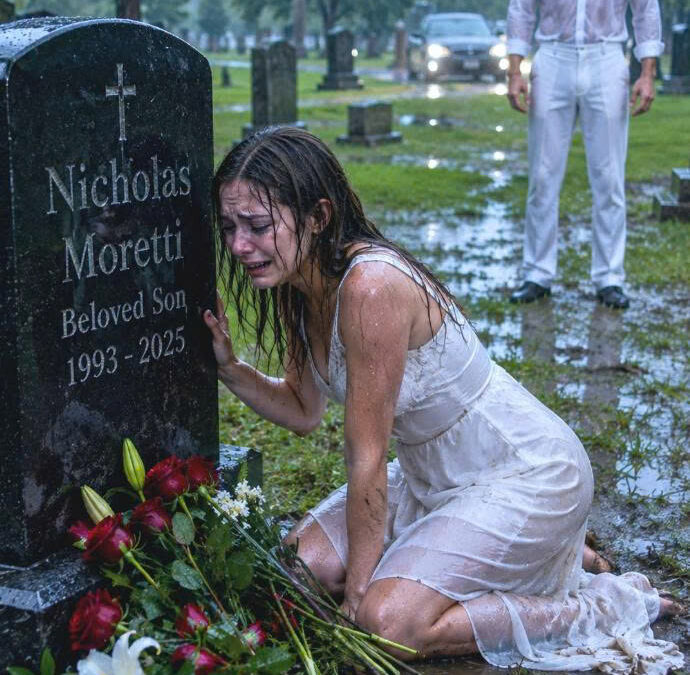
Six months after I buried my husband, I found him standing ten feet from his own grave in the rain.
Alive.
Silent.
Watching me cry over the lie he had let me believe.
For half a year, I had apologized to a dead man.
And now Nicholas Moretti was looking at me as if he had never stopped breathing at all.
For six months, every Sunday had ended the same way.
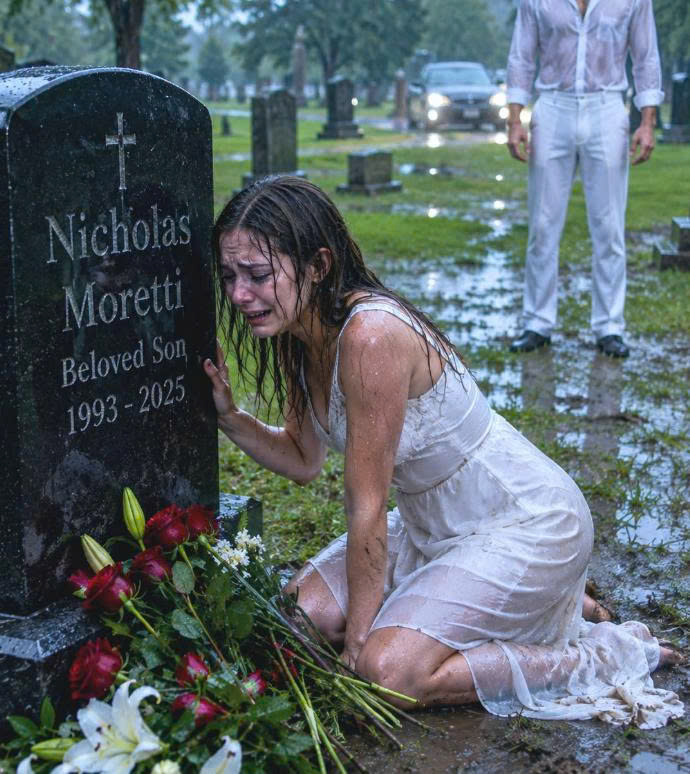
I drove to the cemetery on Chicago’s north side, knelt in the mud, and whispered things I thought my husband would never hear.
“I’m sorry.”
“I should have been there.”
“I don’t know how to do this without you.”
That afternoon, rain soaked through my coat as I traced the letters carved into the marble.
Nicholas Moretti
Beloved Son
1993–2025
Six months earlier, they said he died in an explosion at a warehouse near the river.
I saw the photographs.
Flames climbing into the night.
Black smoke swallowing the building.
His men gave me a death certificate, paperwork from his attorney, and condolences delivered in voices so careful they sounded afraid I might break.
They were right.
I did.
Nicholas Moretti had never been an ordinary husband.
Chicago newspapers called him an investor and property developer.
People who knew better called him the head of the Moretti crime family.
Mafia king.
A man judges remembered, politicians answered, and enemies learned not to underestimate.
But to me, he had been the man whose shoes stayed beside mine at the door.
The man whose cedar-and-amber cologne clung to my pillows.
The man I loved.
“I’m sorry I’m still here when you’re not,” I whispered.
Then the wind changed.
A familiar scent reached me.
Leather.
Smoke.
His cologne.
My pulse stumbled.
Grief plays tricks, I told myself.
I closed my eyes.
And suddenly I was twenty-four again, working doubles at Bellavue downtown with forty-eight dollars in my checking account and student loans hanging over me like a threat.
That was where I met Nicholas.
I had turned too quickly near the private dining room and crashed straight into him with a tray of champagne.
The glasses tilted.
My heart stopped.
Then one of his hands caught the tray while the other closed around my elbow.
“Easy,” he said.
His voice was low enough to make me look up.
Dark hair.
Sharp features.
Black eyes.
A charcoal suit that probably cost more than my car.
“I’m sorry,” I blurted. “I wasn’t looking.”
He glanced at the tray.
Then back at me.
“That makes two of us.”
Two men behind him stepped closer.
Dark suits.
Earpieces.
The kind of faces that made people move aside without being asked.
I noticed them.
I just did not understand yet what they meant.
“Are you hurt?” Nicholas asked.
“No.”
“You sure?”
I nodded.
He studied me for another second.
Then smiled slightly.
That was how it started.
A spilled drink.
A dangerous man.
A waitress who had no idea whose hand was still wrapped around her arm.
The memory shattered when gravel crunched behind me.
I opened my eyes.
Someone stood near the path.
Black coat.
Broad shoulders.
Completely still.
For one second, I thought grief had finally broken my mind.
Then lightning flashed behind the trees.
I saw his face.
The same dark eyes.
The same scar near his jaw.
The same man whose name was carved into the stone beneath my hand.
My lungs stopped working.
“Nicholas?”
His expression changed.
Barely.
But enough.
I stood so quickly my knees nearly gave out.
“You’re dead.”
He took one step toward me.
Rain ran down his face.
Then he said the one thing I had imagined hearing every night for six months.
“Come home.”
I stared at him.
Then I slapped him.
Hard.
The sound disappeared into the rain.
Nicholas did not move.
Did not raise a hand.
Did not look angry.
He only closed his eyes for one second.
When he opened them again, there was something in them I had never seen before.
Shame.
“You let me bury you.”
“I know.”
“You let me identify a body.”
“No.”
I froze.
“What?”
“The body was never shown to you.”
My chest tightened.
“You told me there was nothing left.”
“My attorney told you.”
“On whose orders?”
His silence answered.
I slapped him again.
This time my hand hurt.
“Six months.”
“Sofia—”
“Six months!”
My voice cracked across the cemetery.
“I slept on your side of the bed because it still smelled like you.”
His jaw tightened.
“I know.”
“I stopped cooking because every meal felt wrong.”
“I know.”
“I called your phone for three weeks after they disconnected it.”
His eyes dropped.
“I know.”
“You know?”
I laughed.
It came out ugly.
“How do you know?”
He looked at me.
Because he had been listening.
That realization came before he said it.
“You heard me.”
“Sofia.”
“You heard my voicemails.”
He said nothing.
I stepped back.
“You watched me grieve you.”
“I made sure you were protected.”
“That is not what I asked.”
“Yes.”
The word almost knocked me down.
He had heard me.
Every apology.
Every breakdown.
Every night I told a dead man things I had been too afraid to say while he was alive.
My hands started shaking.
“Why?”
Nicholas glanced toward the road.
“Not here.”
“I’m not going anywhere with you.”
“You’re already being watched.”
My anger stalled.
“What?”
He stepped closer.
“Do not look around.”
Of course I immediately wanted to.
His voice hardened.
“Sofia.”
That tone.
I remembered it.
The voice that had once made twenty men stop talking around a dinner table.
I hated that my body still trusted it.
“Who?”
“People who believe I am dead.”
“That seems reasonable.”
His mouth almost moved.
Not quite a smile.
“People who need me to stay dead.”
Rain slid into my eyes.
“Then why come here?”
“Because somebody found you.”
A cold feeling moved through me.
“What does that mean?”
He looked at the grave.
Then back at me.
“It means the lie stopped protecting you.”
Nicholas put me into a black sedan parked two rows from the cemetery.
I almost refused.
Then I noticed the second vehicle across the street.
Gray SUV.
Engine running.
Two men inside.
One looked away too quickly when I noticed him.
I got in.
Nicholas followed.
The driver pulled away immediately.
I sat as far from my husband as the back seat allowed.
He did not try to touch me.
Good.
Because I was not sure whether I would hit him or hold him.
Both possibilities disgusted me.
“Start talking.”
Nicholas looked toward the privacy glass.
“Six months ago, someone inside my organization sold information about a federal shipment route.”
I stared at him.
“You disappeared because of a shipment?”
“No.”
“Then keep going.”
He leaned back.
“The route was mine. The leak was designed to make it look like I sold federal protection information to an outside syndicate.”
“I don’t understand.”
“You’re not supposed to.”
“I was married to you for four years. Stop treating me like a civilian.”
His eyes shifted toward me.
That hit him.
Good.
He continued.
“If the information had been traced publicly, two things would have happened. My rivals would have moved against us, and federal investigators would have assumed I was cooperating with one side against another.”
“So you faked your death.”
“I needed whoever betrayed me to believe the Moretti structure had collapsed.”
“And me?”
His face hardened with something close to pain.
“You had to believe it too.”
“No.”
“Yes.”
“No, Nicholas. You decided I had to believe it.”
He looked out the window.
“If you knew, they would know.”
“You don’t know that.”
“I know how you look at me.”
I stopped.
He finally met my eyes.
“You cannot fake grief like that, Sofia.”
The cruelty of that sentence stunned me.
“So my suffering was useful.”
His face changed.
“I did not say that.”
“You did not have to.”
Silence filled the car.
Then I asked the question I had feared since the cemetery.
“Who betrayed you?”
Nicholas said:
“My brother.”
I stared at him.
“Luca?”
“Yes.”
Impossible.
Luca Moretti had stood beside me at Nicholas’s funeral.
Held my arm.
Made sure I ate.
Sat in my living room until midnight when I could not stop crying.
He had called me every morning for two weeks.
“He mourned you.”
“He performed.”
“No.”
Nicholas did not argue.
He reached into his coat and placed a phone between us.
On the screen was a photograph.
Luca meeting a man outside a hotel.
Then another.
Bank records.
Names.
Transfers.
Then a message.
Once Nick is gone, the widow becomes manageable.
My stomach turned.
“Widow?”
Nicholas swiped.
Another message.
She has the voting shares. We need her signature before she realizes what she owns.
I looked at Nicholas.
“What voting shares?”
And there it was.
Another secret.
He closed his eyes briefly.
“When I died, control of the legitimate Moretti holdings transferred to you.”
“How much?”
“Sofia.”
“How much?”
“Forty-one percent.”
I laughed once.
Not because it was funny.
“Forty-one percent of what?”
“Moretti Development. Moretti Shipping. Two hotel groups. Several private holdings.”
I stared at him.
“I thought I inherited the house and one investment account.”
“That was what the public paperwork showed.”
“You hid this too.”
“For your protection.”
“Stop saying that.”
His jaw tightened.
“What would you have preferred? A spreadsheet detailing every company so Luca could put a gun to your head and ask for passwords?”
“I would have preferred a husband who trusted me.”
That shut him up.
Good.
The car did not take us home.
It took us to an old brownstone near Lincoln Park.
No name on the door.
No visible security.
But I saw the cameras.
The reinforced glass.
The man inside who opened the door before Nicholas touched the bell.
“Boss.”
Nicholas nodded.
The man looked at me.
His eyes widened.
“Mrs. Moretti.”
I recognized him.
Matteo Russo.
Nicholas’s former driver.
He had cried at the funeral.
Or pretended to.
I suddenly wanted to scream.
“How many people knew?”
Matteo looked at Nicholas.
Wrong move.
I pointed at him.
“No. You answer me.”
Matteo swallowed.
“Seven.”
“Seven people knew my husband was alive while I buried him?”
“Yes.”
“Did you stand at the funeral?”
His face dropped.
“Yes.”
I turned away before I did something stupid.
Nicholas spoke quietly.
“Sofia.”
“Do not.”
I walked into the sitting room.
There were monitors on one wall.
Maps.
Photographs.
Files.
One screen showed my house.
My house.
Live.
I stopped.
“You’ve been watching me.”
Nicholas came up behind me.
“Security feed.”
“You watched me in my own home?”
“Exterior only.”
I turned.
“Do you hear yourself?”
“I needed to make sure no one approached you.”
“Luca approached me.”
Nicholas went still.
“When?”
That reaction was too immediate.
“Three nights after the funeral.”
“What did he want?”
“He brought food.”
“What else?”
“He asked whether you left instructions about the companies.”
Nicholas’s face became stone.
“I thought he was helping.”
“What did you tell him?”
“The truth. That I didn’t know anything.”
He exhaled.
That was when I understood.
My ignorance had not only made my grief believable.
It had kept me alive.
I hated that fact.
Because facts do not become kind just because they explain cruelty.
“He knew you really didn’t know,” Nicholas said.
“That is why he waited.”
“For what?”
“For you to receive the sealed estate packet.”
I remembered it.
A thick envelope delivered by Nicholas’s attorney two weeks earlier.
I had not opened it.
Could not.
It was still in the desk drawer.
Nicholas looked at Matteo.
“Get a team to the house now.”
Matteo left immediately.
I crossed my arms.
“What is in the packet?”
Nicholas answered:
“The transfer documents for the voting shares.”
I stared at him.
“And Luca knows?”
“He knows they exist.”
“Then why not take them before?”
“Because the documents require your biometric confirmation and a rotating authentication key held by the trustee.”
I shook my head.
“This is insane.”
“This is my life.”
“No.”
I looked at him.
“This was your life.”
He went quiet.
I continued.
“You made it mine when you married me and decided I did not deserve to know.”
At 6:40 that evening, Matteo returned.
The estate packet was gone.
My house had been entered through the rear service door.
Nothing else was taken.
No jewelry.
No cash.
No electronics.
Only the sealed envelope.
Nicholas did not react outwardly.
That was always when he was most dangerous.
“Luca has it,” he said.
Matteo nodded.
“Most likely.”
I looked between them.
“What happens now?”
Nicholas reached for his coat.
“We end this.”
I stood.
“No.”
He looked at me.
“What?”
“I’m coming.”
“No.”
I laughed.
Six months ago, that word might have worked.
Not anymore.
“You faked your death. Lied to me. Turned my mourning into camouflage. And now somebody is trying to steal companies I apparently own.”
“Sofia—”
“I am coming.”
“It is dangerous.”
“So was marrying you, apparently.”
Matteo looked down.
Probably hiding a smile.
Nicholas ignored him.
“You do not understand Luca.”
“No. But I understand being manipulated by Moretti men.”
That one landed deep.
He said nothing.
Then:
“You stay beside me.”
“I decide where I stand.”
He closed his eyes.
“Fine.”
It was the first honest negotiation of our marriage.
Luca had chosen one of the Moretti hotels downtown.
Top-floor private dining room.
Of course.
The same kind of room where Nicholas and I first met.
Maybe the family had a flair for circles.
We arrived after midnight.
Not dramatically.
No army.
No gunfight.
Just Nicholas.
Me.
Matteo.
And two attorneys.
That surprised me.
“Lawyers?” I whispered.
Nicholas glanced at me.
“You wanted less violence.”
“I did.”
“I listen occasionally.”
I almost smiled.
I hated that too.
Luca was already inside.
He stood by the window holding a whiskey.
When he saw Nicholas, the glass slipped from his hand.
It shattered.
For the first time in six months, I understood exactly what it meant to see a dead man walk into a room.
Luca went white.
“Nicholas.”
My husband shut the door.
“Brother.”
Luca looked at me.
Then back at Nicholas.
“You told her?”
“She found me.”
That was not exactly true.
But I let it go.
Luca began laughing.
Softly.
Then harder.
“This is unbelievable.”
Nicholas said nothing.
Luca shook his head.
“Six months. You let your wife bury you for six months just to catch me.”
I watched Nicholas.
He did not look at me.
Good.
Luca continued.
“You always did love theater.”
“You sold my routes.”
“You were suffocating the family.”
“You forged transfer orders.”
“You controlled everything.”
“You arranged the warehouse explosion.”
Silence.
There.
The real thing.
Luca’s face changed.
Barely.
But enough.
I looked at Nicholas.
“You said the explosion was staged.”
“It was.”
Luca smiled.
“Not entirely.”
Nicholas went still.
My stomach dropped.
Luca lifted his glass, remembered it was gone, and laughed again.
“You were supposed to be inside.”
The room became colder.
Nicholas stepped forward.
Matteo moved too.
I reached for Nicholas’s sleeve.
He stopped.
That surprised all of us.
Luca saw it.
And smiled.
“Look at you.”
He looked at me.
“You domesticated him.”
“No,” I said.
Luca raised his eyebrows.
“I just remind him prison is inconvenient.”
Nicholas almost smiled.
Luca’s expression hardened.
“You think this is funny?”
“No.”
I stepped forward.
“I think you spent six months waiting for a grieving widow to sign something she didn’t understand.”
His eyes narrowed.
“You don’t understand what you own.”
“Maybe.”
I looked toward the attorneys.
“But they do.”
One of them placed a folder on the table.
Luca’s face changed.
The attorney said:
“Mr. Moretti, the attempted transfer documents taken from Mrs. Moretti’s residence were reported stolen. Any use of them has been flagged with the trustee and financial institutions.”
Luca looked at Nicholas.
“You brought lawyers to threaten me?”
Nicholas said:
“No.”
I answered.
“I brought them to make you irrelevant.”
That felt good.
Maybe too good.
The attorney continued.
“Mrs. Moretti has executed replacement control documents. The original packet is void.”
Luca looked at me.
“You signed?”
“Yes.”
“You don’t know what you signed.”
I smiled.
“I spent the last six hours reading.”
Nicholas looked at me.
Surprised.
Apparently he had still underestimated me.
I enjoyed that.
Luca’s face twisted.
“You think this makes you one of them?”
“No.”
I looked around the room.
“I think it makes me the person whose name is on forty-one percent of what you tried to steal.”
Luca turned toward Nicholas.
“This is your fault.”
Nicholas almost laughed.
“My fault?”
“You gave her everything.”
“I gave my wife what was mine.”
“You gave an outsider control of the family.”
I felt Nicholas change beside me.
Danger.
Real danger.
Before he could speak, I did.
“Outsider?”
Luca looked at me.
I stepped closer.
“I was the one at his grave every Sunday while you were stealing from him.”
Silence.
“I was the one cleaning out his closet because I thought he was dead.”
Luca’s face tightened.
“I was the one apologizing to a man who was alive.”
Then I looked at Nicholas.
“And he is going to spend a very long time apologizing for that.”
Matteo coughed.
Probably covering another laugh.
“But you?”
I looked back at Luca.
“You don’t get an apology.”
The police arrived nine minutes later.
Not because Nicholas called them.
Because I had.
Before entering the hotel.
Luca stared at me when the first detective walked in.
“What did you do?”
I held up my phone.
“Something nobody in this family seems to enjoy.”
“What?”
“Used the legal system.”
Nicholas looked at me.
I could not tell if he was proud or horrified.
Probably both.
Luca was arrested on charges connected to the warehouse explosion, financial fraud, theft, conspiracy, and several things the federal investigators had apparently been building quietly for months.
Nicholas had evidence.
Lots of it.
That was the real reason he had stayed dead.
Not revenge.
Proof.
He needed Luca confident enough to move money.
Contact partners.
Expose the people working with him.
The Ghost King had not vanished.
He had become bait.
I understood it.
I still did not forgive it.
Both things could be true.
We went home at 4:30 in the morning.
Our home.
The house where I had lived alone for six months.
Nicholas stopped at the front door.
He did not enter.
I unlocked it.
Then turned.
“What are you doing?”
“Waiting.”
“For?”
“Permission.”
That surprised me.
“You own half this house.”
“I know.”
“But?”
He looked at me.
“But I am not sure I still belong inside it.”
For the first time since the cemetery, my anger loosened.
Just a little.
Not enough.
I stepped inside.
Then said:
“You can sleep in the guest room.”
He nodded.
“That seems generous.”
“It has a terrible mattress.”
“I remember.”
“Good.”
He walked in.
I closed the door.
His shoes landed beside mine for the first time in six months.
I looked at them.
And immediately started crying.
Nicholas froze.
“I’m sorry.”
“Stop.”
He did.
I covered my face.
“I hate you.”
“I know.”
“I love you.”
His eyes closed.
“I know.”
“That makes it worse.”
“I know.”
I laughed through the tears.
“Do you know anything else?”
“Yes.”
“What?”
“That I don’t deserve you to make this easy.”
That was the right answer.
The next three months were ugly.
Not dramatic.
Ugly.
Real.
Nicholas told me everything.
Not every crime.
I did not want names and bodies in my head.
But enough.
His father.
The organization.
How Nicholas took control at twenty-six.
How legitimate businesses were built around illegal ones.
How he had spent years pushing the family toward legitimate investments while Luca resented every step.
Why the Ghost King existed.
Why Nicholas wanted him gone.
I asked:
“Are you still him?”
He answered:
“Yes.”
I almost left.
Then he added:
“But I no longer want to be.”
That mattered.
Not because transformation happens in one sentence.
Because it was the first time Nicholas admitted the life he had built was not inevitable.
He began dismantling parts of it.
Not for me.
I refused to let him make me responsible for his redemption.
He did it because he chose to.
Shipping routes became legitimate freight contracts.
Cash holdings became declared assets.
Certain people disappeared from payroll.
Some men objected.
Nicholas lost power.
He gained sleep.
I watched all of it.
And every Sunday, I still went to the cemetery.
Nicholas never asked me to stop.
For a while, I hated that grave.
Then I understood I was not mourning him anymore.
I was mourning who I had been before I learned the truth.
One Sunday, three months after he returned, Nicholas came with me.
He stood beside his own headstone.
“That’s disturbing,” he said.
I laughed despite myself.
“Try kneeling in front of it every week.”
He went quiet.
Then:
“I listened to some of your cemetery visits.”
I looked at him.
“I know.”
“I stopped after the third.”
“Why?”
“Because I could not stand hearing what I was doing to you.”
“Yet you stayed dead.”
“Yes.”
“Coward.”
He nodded.
“Yes.”
That made me angrier than excuses would have.
Because he was not fighting me.
He was finally listening.
I touched the engraved name.
“Nicholas Moretti. Beloved Son.”
He looked at it.
“Terrible epitaph.”
“What would you prefer?”
He thought.
“Complicated husband.”
I almost smiled.
“Accurate.”
Then I asked:
“Did you ever think I would move on?”
His face changed.
“Yes.”
“And?”
“I told myself I wanted you to.”
“Liar.”
“Yes.”
“What would you have done?”
“Nothing.”
I looked at him.
That answer scared me because I believed it.
He continued.
“If you had found someone who made you happy, I would have stayed dead.”
Tears burned my eyes.
“That is not romantic.”
“I know.”
“It is horrible.”
“I know.”
“You don’t get to decide when I deserve the truth.”
“I know.”
I turned toward him.
“Then say what you should have said six months ago.”
Nicholas looked at me for a long time.
Then:
“I was afraid.”
That was not what I expected.
“Of Luca?”
“No.”
“Of dying?”
“No.”
“Then what?”
His voice dropped.
“Of trusting someone enough to give them the choice to stay.”
I stared at him.
There it was.
Beneath the mafia king.
Beneath the money.
Beneath the guns and men and whispered reputation.
A man who thought control was safer than being abandoned.
I said:
“You took my choice because you were afraid I might make one you didn’t like.”
“Yes.”
“That is not love.”
“No.”
“Do you understand that now?”
He nodded.
“I’m learning.”
Luca eventually pleaded guilty.
The case took over a year.
His empire inside the Moretti network collapsed.
Several of his allies went with him.
Federal authorities seized properties.
Accounts.
Businesses.
Nicholas cooperated selectively through attorneys.
Enough to survive.
Enough to change.
Not enough to become innocent.
He was never innocent.
Neither was our marriage.
But innocence was no longer what I wanted.
Truth was.
I took a seat on the board of the legitimate Moretti companies.
Not because Nicholas asked me.
Because forty-one percent really was mine.
The first meeting was almost funny.
Twelve men in expensive suits stared at me as if I had wandered into the wrong room.
One said:
“Mrs. Moretti, these matters are complicated.”
I smiled.
“So was discovering my husband faked his death. I adapted.”
Nicholas looked down at his papers to hide a smile.
By the end of the year, I knew more about the companies than Luca ever expected me to.
Nicholas did not interfere.
That mattered too.
One year after I found him at the cemetery, we returned on the anniversary of his “death.”
It was raining again.
Of course it was.
Nicholas stood beside me.
Alive.
No guards close enough to see.
No lies between us that mattered.
At least none I knew of.
I had learned not to promise perfection.
I carried a small hammer.
Nicholas looked at it.
“What is that?”
“You’ll see.”
I walked to the grave marker.
A new plaque lay beside it.
I had ordered it myself.
Nicholas read it.
Then laughed.
Really laughed.
For the first time in months.
It said:
Nicholas Moretti
1993–
Beloved Son
Difficult Husband
Still Working On It
“You added the dash.”
“You’re alive.”
“For now.”
I looked at him sharply.
“Bad joke.”
“Sorry.”
We had the cemetery staff replace the stone later that week.
The empty grave remained.
I asked Nicholas once whether there had ever been a body inside.
“No.”
“So I buried an empty coffin.”
“Yes.”
I shook my head.
“You owe me for therapy forever.”
“Fair.”
He took my hand.
I let him.
That was the difference.
I let him.
Not because he decided it was safe.
Not because he decided I needed protection.
Because I chose.
People like Nicholas believe power is having enough information to control an outcome.
For years, I think he believed love worked the same way.
Hide the danger.
Control the facts.
Protect the person.
Decide for them.
Then call it devotion.
He was wrong.
The day I found my husband alive beside his own grave, I thought the greatest betrayal was that he had faked his death.
It was not.
The betrayal was that he believed my love only mattered if he controlled what I knew.
It took him nearly dying, disappearing, losing a brother, and almost losing me to understand that.
It took me six months of grief and another year of anger to understand something too.
Loving someone dangerous does not mean becoming blind to what they are.
Forgiving someone does not mean pretending they did not break you.
And getting someone back does not mean getting your old life back.
The old life was gone.
So was the old marriage.
We built something else.
Slower.
Less beautiful from the outside.
Much more honest inside.
I never apologized to Nicholas’s grave again.
There was no dead man to apologize to.
There was only a living one.
Complicated.
Flawed.
Still dangerous.
Still learning.
And one Sunday, two years after the explosion, I stood beside him while rain darkened the grass around the empty grave.
Nicholas looked at the stone.
Then at me.
“Do you regret staying?”
I thought about it.
Then told him the truth.
“Some days.”
He nodded.
No anger.
No fear.
Just acceptance.
“And today?”
I slipped my hand into his.
“Ask me tomorrow.”
He smiled.
That was enough.
Because after everything we had survived, forever no longer meant pretending nothing could change.
It meant waking up the next day—
alive,
honest,
and choosing again.