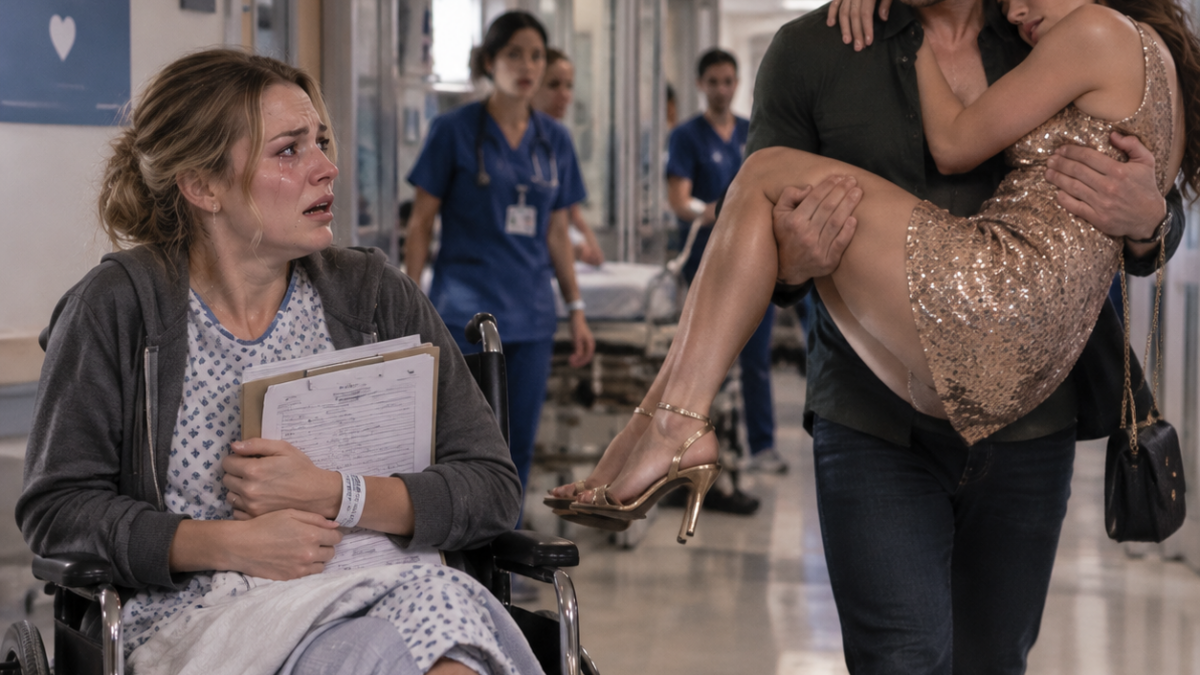
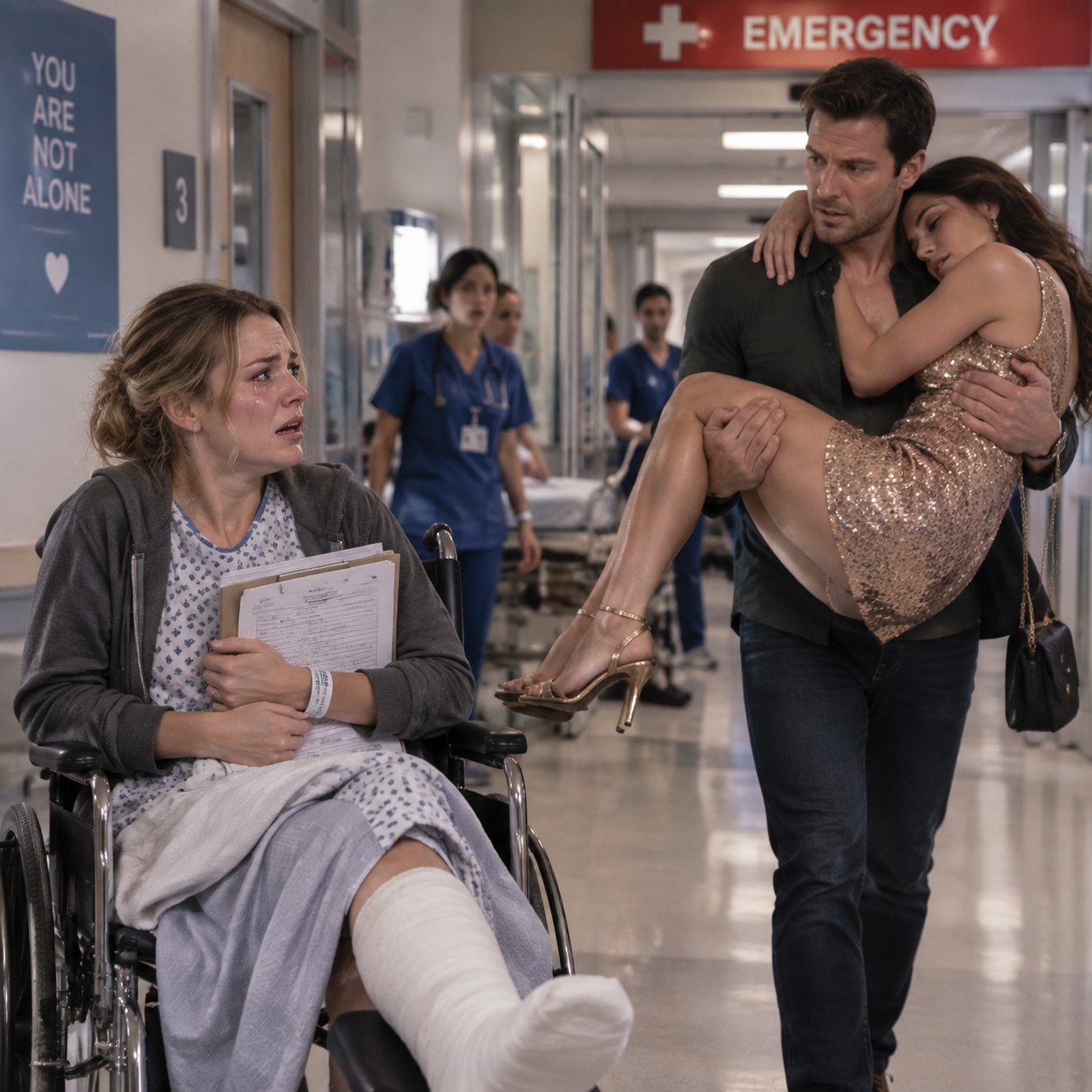
I was sitting alone in a hospital wheelchair with my left leg in a temporary cast when I saw my husband run through the emergency entrance carrying another woman in his arms.
Not helping her walk.
Not holding her elbow.
Carrying her.
Like she was precious.
Like dropping her would be the worst thing that could happen to him that night.
I had just survived a car accident.
My coat was torn at the shoulder.
There was dried blood near my hairline.
My right hand still shook every few minutes, and the nurse had warned me not to put weight on my leg until the orthopedic doctor arrived.
I had called my husband, Daniel, six times.
No answer.
I had texted him:
I’ve been in an accident. I’m at St. Matthew’s. Please come.
The message showed delivered.
Not read.
I had told myself he was driving.
That his phone was on silent.
That he was rushing to me.
Then the emergency doors opened.
And there he was.
Daniel.
My husband of seven years.
His face pale with panic.
His shirt untucked.
His hair wet from the rain.
And in his arms was a woman I knew.
Vanessa Cole.
His office manager.
The woman he had told me not to worry about.
Her head rested against his chest.
One arm hung loosely around his neck.
Her black dress had ridden up above one knee, and one of her silver heels was missing.
She smelled like alcohol even from several feet away.
Daniel kept saying:
“Stay with me, Vanessa. We’re here. You’re okay.”
My fingers tightened around the medical file resting in my lap.
The pain in my leg disappeared for a second.
Everything did.
The fluorescent lights.
The voices.
The wheels of stretchers moving over polished floors.
All of it faded behind one thought.
He came for her.
Not me.
A nurse hurried toward them.
“What happened?”
“She fell,” Daniel said. “She hit her head. She’s been drinking. She was barely conscious in the parking garage.”
His voice cracked.
I had not heard that kind of fear in his voice when I called him after my miscarriage three years ago.
I had not heard it when my father was in intensive care.
I had not even heard it when Daniel himself needed emergency surgery for appendicitis.
But for Vanessa?
He looked terrified.
The nurse directed him toward a bed.
Daniel carried her past me.
Three feet away.
Two.
One.
He did not see me.
I could have reached out and touched his sleeve.
Instead, I stayed silent.
Vanessa opened her eyes for half a second.
And she saw me.
I know she did.
Because her eyes widened.
Then she immediately closed them again.
That hurt more than seeing Daniel carry her.
Because Daniel might have been surprised.
Vanessa was not.
She knew exactly who I was.
And she knew exactly what this looked like.
“Mrs. Carter?”
I turned.
A nurse was standing beside me.
“Your husband still hasn’t arrived?”
I looked down the hallway where Daniel had disappeared.
Then I said:
“No.”
The word tasted like blood.
“No, he hasn’t.”
My name is Rachel Carter.
I was thirty-five years old when I learned that betrayal does not always announce itself with lipstick on a collar or a secret hotel receipt.
Sometimes it walks directly past you in a hospital hallway.
Sometimes it is wearing your husband’s arms.
Daniel and I had been married for seven years.
We were not one of those couples who screamed.
Maybe that should have worried me more.
We had become polite.
Organized.
Efficient.
Mortgage paid on the third.
Groceries on Sunday.
Dinner with his mother twice a month.
Vacation every August.
We were good at running a marriage.
I was no longer sure we were good at being in one.
Daniel worked as a regional sales director for a medical supply company.
Long hours.
Conferences.
Client dinners.
Emergency calls.
Vanessa had started working with him eighteen months earlier.
At first, she was just a name.
“Vanessa reorganized the quarterly schedule.”
“Vanessa booked the Denver trip.”
“Vanessa says the client moved the meeting.”
Then she became a person.
Christmas party.
Tall.
Dark hair.
Perfect smile.
She hugged Daniel when she saw him.
Too familiar.
Too natural.
When he introduced us, she held my hand for a second longer than necessary.
“I’ve heard so much about you.”
I smiled.
“Hopefully good things.”
She looked at Daniel before answering.
“Mostly.”
Everyone laughed.
I did too.
That was the first time.
There were others.
Late texts.
Inside jokes.
A dinner that “ran over.”
A Saturday meeting.
Once, I walked into Daniel’s home office and saw a message preview on his phone.
You saved me again ❤️
When I asked, he barely looked up.
“Work crisis.”
“Why the heart?”
He sighed.
“Rachel.”
Just my name.
But the way he said it made the question feel embarrassing.
So I stopped asking.
That was how Daniel handled suspicion.
He never denied enough to look defensive.
He just made you feel foolish for needing reassurance.
The orthopedic doctor finally saw me at 1:20 a.m.
Small fracture.
Severe sprain.
No surgery.
Six weeks in a boot after the swelling went down.
“Someone taking you home?” he asked.
I almost laughed.
“My husband.”
The lie came automatically.
The doctor nodded.
A nurse gave me pain medication.
By 1:45, I was back in the hallway waiting for discharge.
Daniel still had not called.
I checked my phone.
Nothing.
Then a voice came from behind me.
“Rachel?”
I looked up.
Daniel stood there.
His face went white.
For several seconds, neither of us spoke.
His eyes dropped.
Wheelchair.
Cast.
Bruised forehead.
Hospital bracelet.
Then back to my face.
“What happened?”
I stared at him.
It was such a ridiculous question that I almost admired it.
“I had a car accident.”
“What?”
“I called you.”
His hand went to his pocket.
He pulled out his phone.
The screen lit.
Six missed calls.
My text.
He stared at it.
“Oh my God.”
I watched him read the message.
Then I watched his mind work.
Not fear.
Calculation.
He looked toward the emergency room doors behind him.
Then back at me.
“Rachel, I—”
“Vanessa okay?”
His mouth stopped.
That was the moment he knew I had seen them.
“Rachel.”
“Is she?”
“She fell.”
“I heard.”
“She was drunk.”
“I could smell that.”
“She called me from the parking garage. She was alone.”
“And I called you from an ambulance.”
His face tightened.
“I didn’t see your calls.”
“You saw hers.”
“She called repeatedly.”
“So did I.”
“I was driving.”
“To her.”
He stepped closer.
“Can we not do this here?”
I laughed.
A small sound.
Painful.
“Where would you prefer? The parking garage where you found her? Your office? Maybe wherever she lost the other shoe?”
His eyes flashed.
“Nothing happened.”
There it was.
The sentence guilty people love because it covers a lot of territory without explaining any of it.
“I didn’t ask if anything happened.”
He went silent.
I looked at him.
“Why were you the person she called?”
“Because I’m her boss.”
“Do all your employees call you drunk at midnight?”
“No.”
“Do you carry all of them into hospitals?”
“She could barely stand.”
“Funny. So can’t I.”
That one hit.
He looked down at my cast again.
For the first time, guilt appeared.
“Rachel, I’m sorry. I genuinely didn’t know.”
I believed that.
That was the problem.
He did not know because he was busy saving someone else.
The nurse approached.
“Mrs. Carter? Your discharge papers.”
Then she looked at Daniel.
“Oh. Your husband finally made it.”
Daniel flinched.
I signed the papers.
The nurse explained my medication.
Elevation.
Ice.
Follow-up.
Daniel stood beside me listening like a concerned spouse.
It made me sick.
When the nurse left, he reached for the wheelchair handles.
“I’ll take you home.”
“No.”
“Rachel.”
“I said no.”
“How are you getting home?”
“I’ll figure it out.”
He lowered his voice.
“You’re on pain medication.”
“And you have Vanessa.”
His expression changed.
“She’s being monitored.”
“Then go monitor her.”
“You’re my wife.”
I looked at him.
For the first time that night, I almost cried.
“That is exactly why this hurts.”
My best friend Nora picked me up at 2:30.
She arrived wearing pajama pants, boots, and a winter coat over what I suspected was no bra.
She took one look at me and said:
“I’m going to kill him.”
“No.”
“I’ll only injure him.”
“No.”
“Fine. Emotionally.”
That almost made me smile.
In the car, she asked what happened.
I told her.
Not everything.
Just enough.
Daniel.
Vanessa.
Hospital.
Carrying her.
Nora drove in silence for a minute.
Then:
“Do you think they’re sleeping together?”
“I don’t know.”
“Do you think he loves her?”
That question hurt more.
“I don’t know.”
“What do you know?”
I looked out the window.
Rain streaked across the glass.
“I know he looked more scared for her than he looked when he saw me.”
Nora said nothing after that.
Good friends know when silence is useful.
Daniel came home at 5:12 a.m.
I was awake.
Of course I was.
Pain medication had dulled my leg, but nothing could quiet my head.
He entered the bedroom quietly.
I had moved to the guest room.
He found me there.
“Rachel.”
I looked at the clock.
“Long night?”
He closed his eyes.
“Please don’t do that.”
“Do what?”
“Turn everything into a weapon.”
I stared at him.
“You carried another woman into a hospital while your injured wife was sitting ten feet away.”
“I didn’t know you were there.”
“You keep saying that like it makes it better.”
“It matters.”
“It does.”
I nodded.
“It tells me where your attention was.”
Daniel sat on the chair beside the bed.
“Vanessa’s going through something.”
I waited.
“Her engagement ended.”
I almost laughed.
“Of course.”
“What does that mean?”
“It means every cliché apparently decided to visit my marriage at once.”
“She’s been struggling.”
“And you’ve been helping.”
“Yes.”
“How much?”
He hesitated.
Wrong answer already.
“How much, Daniel?”
“She’s called a few times.”
“At night?”
“Yes.”
“You’ve met her outside work?”
Silence.
“Daniel.”
“Coffee.”
“How many times?”
“I don’t know. Three? Four?”
“Did you tell me?”
“No.”
“Why?”
“Because you would react like this.”
I stared at him.
That sentence did something extraordinary.
It made me calm.
“So you hid it because you knew it would hurt me.”
“No. I hid it because there was nothing to tell.”
“Those are not the same thing.”
“She needed a friend.”
“Then why did she need my husband?”
He stood.
“You’re making this ugly.”
“No. I think I’m finally looking at what was already ugly.”
His jaw tightened.
“There was no affair.”
“Did you want there to be?”
He looked at me.
Long pause.
There are questions where silence is the answer.
This was one.
I turned my face away.
“Get out.”
“Rachel.”
“Get out of the room.”
“I never slept with her.”
I looked back.
“That wasn’t my question.”
He said nothing.
“Get out.”
He did.
Vanessa texted me at 8:14 the next morning.
I had never given her my number.
That alone told me Daniel had.
Rachel, I’m so sorry about last night. Nothing is going on between Daniel and me. He has only been kind to me. Please don’t blame him because I was a mess.
I read it twice.
Then a third time.
Nora, sitting at my kitchen counter, said:
“What?”
I handed her the phone.
She read it.
“Oh, absolutely not.”
“What?”
“That is not an apology.”
“I know.”
“She’s protecting him.”
“I know.”
“And herself.”
“I know.”
Nora looked at me.
“What are you going to do?”
I took the phone back.
Then I typed:
Did you know I was in the hospital when you saw me?
The reply took four minutes.
I saw you after Daniel brought me in. I didn’t know before.
I typed:
Why didn’t you tell him I was there?
This time, ten minutes.
Then:
I was intoxicated and confused.
I stared at the screen.
Bullshit is easier to recognize when it arrives in complete sentences.
I wrote:
Did you and Daniel ever kiss?
Nothing.
Five minutes.
Ten.
Twenty.
Then:
You should ask your husband about that.
Nora saw my face.
“What did she say?”
I showed her.
Nora whispered:
“Oh.”
That was all.
Because sometimes one word is enough to bury a marriage.
Daniel came home at noon.
He looked exhausted.
I was waiting in the living room.
My leg elevated.
Phone on the table.
“Did you kiss her?”
He froze.
No hello.
No warm-up.
No escape.
“Rachel—”
“Yes or no.”
He rubbed his face.
“One time.”
The room became very quiet.
“When?”
“Three weeks ago.”
“Where?”
“Her car.”
“Who kissed who?”
He looked at the floor.
“She kissed me.”
“And you?”
“I kissed her back.”
There it was.
Clean.
Simple.
Seven years reduced to one sentence.
“How long?”
“What?”
“How long before you stopped?”
“Rachel.”
“Five seconds? A minute? Ten?”
“I don’t know.”
“You know.”
“Maybe ten seconds.”
I laughed.
He looked hurt by that.
Interesting.
“Did you tell her it could never happen again?”
“Yes.”
“Did you stop seeing her alone?”
“No.”
“Did you stop answering late-night calls?”
“No.”
“Did you tell me?”
“No.”
I nodded.
“So the kiss ended. The intimacy didn’t.”
“That’s not fair.”
“It’s exactly fair.”
He sat opposite me.
“I was confused.”
“About being married?”
“No.”
“About wanting her?”
He looked away.
I waited.
Finally:
“I liked how she made me feel.”
That sentence hurt more than the kiss.
“How did she make you feel?”
“Younger.”
Of course.
“Wanted.”
I looked down.
“Important.”
There it was.
Not love.
Ego.
Sometimes that is worse.
I looked at Daniel.
“And how did I make you feel?”
He did not answer.
I did for him.
“Responsible.”
His face tightened.
“Rachel.”
“Mortgage. Laundry. Dinner. Fertility appointments. My father getting sick. Real life.”
“That’s not what I meant.”
“But that’s what happened.”
I felt tears rise.
This time I let them.
“Vanessa got the version of you that wanted to be admired. I got the version that wanted to be left alone.”
“That isn’t fair.”
“You keep saying that.”
“Because you’re acting like seven years mean nothing.”
“No.”
I shook my head.
“Seven years mean enough that I know exactly how much this costs.”
He looked scared.
“What are you saying?”
“I’m saying I need you to leave.”
His face changed.
“Leave?”
“Yes.”
“For how long?”
“I don’t know.”
“Rachel, come on.”
“No.”
“You’re injured.”
“I know.”
“You need help.”
“Nora is staying.”
His eyes flicked toward the guest room.
He realized.
“You already planned this.”
“I planned it after finding out you kissed her.”
He stood.
“Don’t throw away our marriage because of one mistake.”
I looked at him.
“The mistake was the kiss.”
Then I pointed toward his phone.
“Everything after that was a decision.”
Daniel moved into a hotel.
Vanessa resigned two days later.
Not fired.
Resigned.
Apparently, office gossip had already started after someone from the hospital recognized them together.
That embarrassed Daniel.
I wish I could say that made me feel better.
It did not.
For three weeks, he sent flowers.
Messages.
Long emails.
He started therapy.
He asked for marriage counseling.
I said no at first.
Then yes.
Not because I wanted to save the marriage.
Because I wanted to understand it.
That surprised him.
The counselor’s name was Dr. Helen Park.
On our second session, she asked Daniel:
“When did the affair begin?”
Daniel immediately said:
“It wasn’t an affair.”
Dr. Park waited.
He shifted.
“There was one kiss.”
She nodded.
“And emotional intimacy hidden from your spouse?”
He said nothing.
“Private meetings?”
“Yes.”
“Late-night communication?”
“Yes.”
“Romantic attraction?”
“Yes.”
“Secrecy?”
“Yes.”
Dr. Park folded her hands.
“You are arguing with vocabulary instead of behavior.”
I almost smiled.
Daniel did not.
That session changed something.
Not enough.
But something.
He stopped defending himself.
That mattered.
Then, six weeks after the accident, I discovered something I had not expected.
Vanessa had lied too.
Not about the kiss.
About the hospital.
A nurse called me because my insurance paperwork had been mixed with Daniel’s contact information.
During the conversation, she casually mentioned:
“Your husband’s friend was discharged around four that morning.”
I paused.
“Four?”
“Yes.”
Daniel had not come home until after five.
That gave him over an hour.
I called him.
“Where were you between four and five the night of the accident?”
Silence.
Then:
“In the parking lot.”
“With her?”
“Yes.”
My whole body went cold.
“Why?”
“She was upset.”
“She had just been discharged.”
“Yes.”
“And you sat with her.”
“Yes.”
“While knowing I was in that same hospital injured.”
“No.”
I froze.
“What?”
“I still didn’t know.”
That made no sense.
“You spoke to me in the hallway before two.”
His face must have changed on the other end.
Silence.
Then I understood.
“Daniel.”
Nothing.
“You left after seeing me.”
“Rachel.”
“You saw me injured. You knew I needed a ride home. And after I refused to let you take me, you went back to Vanessa.”
“It wasn’t like that.”
“What was it like?”
“She was crying.”
I laughed.
A broken sound.
“So was I.”
He had no answer.
That was the moment my marriage ended.
Not the kiss.
Not the late calls.
Not even the hospital entrance.
The parking lot.
Because after seeing exactly what his choices had done, Daniel still chose to comfort her first.
That was not confusion.
That was priority.
I filed for divorce two months later.
Daniel fought it for three weeks.
Then stopped.
He did not fight about the house.
Or savings.
Or furniture.
Maybe guilt.
Maybe exhaustion.
Maybe therapy had finally taught him that forcing me to stay would not make me love him again.
Vanessa contacted me once more.
A handwritten letter.
I almost threw it away.
Instead, I read it.
She apologized.
She admitted the emotional relationship had started months before the kiss.
She said Daniel never promised to leave me.
She said she told herself that made it harmless.
Then one line stayed with me:
I knew he was married, but because he complained about being lonely, I let myself believe his loneliness mattered more than your marriage.
At least it was honest.
I never replied.
My leg healed.
Slowly.
Six weeks in a boot.
Physical therapy.
Then a cane.
Then nothing.
The first day I walked around the block without pain, Nora came with me.
“You know what’s funny?” she said.
“What?”
“The accident probably saved you.”
I looked at her.
“That is a terrible thing to say.”
“You know what I mean.”
I did.
If I had not crashed that night, Daniel might have continued.
Maybe no physical affair.
Maybe eventually.
Maybe years of small lies.
Maybe I would have kept telling myself I was suspicious.
Difficult.
Insecure.
Instead, the universe put us all in one fluorescent hallway.
No excuses.
No deleted texts.
No interpretation.
Just my husband carrying another woman past his injured wife.
Sometimes the truth is cruel enough to be kind.
A year after the accident, I went back to St. Matthew’s.
Not because I was sick.
Nora had surgery there, and I brought her flowers.
While walking through the lobby, I passed the exact hallway.
For a second, I could see myself.
Wheelchair.
Cast.
Medical folder crushed in my hand.
Waiting for a husband who was already inside the building.
Just not there for me.
I expected anger.
Instead, I felt sad for that woman.
She thought the worst thing happening to her was a broken leg.
She had no idea that in the next five minutes, her entire life would split open.
But she also did not know something else.
She was going to survive it.
Not gracefully every day.
Not bravely every day.
But completely.
Daniel remarried three years later.
Not Vanessa.
They stopped speaking within months of our divorce.
I heard that from mutual friends.
It did not satisfy me the way people assumed it would.
By then, Vanessa was no longer the villain in my story.
Daniel was not either.
They were simply two people who made choices.
And I was the person who finally stopped making excuses for those choices.
I did not remarry quickly.
I learned how to be alone without calling it lonely.
I traveled.
Changed jobs.
Bought a ridiculous yellow couch Daniel would have hated.
I learned pottery badly.
Then less badly.
I stopped checking my phone when someone came home late because nobody owed me an arrival anymore.
And strangely, that felt peaceful.
Two years after my divorce, I met someone.
His name was Aaron.
The first time I had a terrible migraine during dinner, he canceled his plans and sat beside me in urgent care.
Nothing dramatic.
No speeches.
No roses.
He simply stayed.
At one point, I woke from a nap and saw him reading in the plastic chair.
I stared at him.
“What?”
“Nothing.”
He smiled.
“Okay.”
I looked away before he could see my eyes fill.
Because sometimes healing is discovering that the thing you once begged for was never extraordinary.
It was basic.
Presence.
Care.
Being chosen when it is inconvenient.
I still think about that hospital night.
Daniel running through the doors.
Vanessa in his arms.
The panic on his face.
The way he passed me without seeing me.
For a long time, that was the memory that hurt most.
Now?
It is the memory that taught me the most.
People reveal themselves in emergencies.
Not always because they become different.
Because emergencies remove the time they normally use to manage appearances.
Daniel did not have time to think about what carrying Vanessa would look like.
He did not have time to construct the correct story.
He simply ran toward the person who mattered most to him in that moment.
And I finally believed what his actions had been telling me for months.
I was sitting in a hospital wheelchair after a car accident when my husband carried another woman through the emergency doors.
At the time, I thought that was the worst night of my life.
It wasn’t.
It was the night I stopped competing for a place I should never have had to earn.
And the strangest part is this:
My leg healed long before my heart did.
But eventually—
both did.