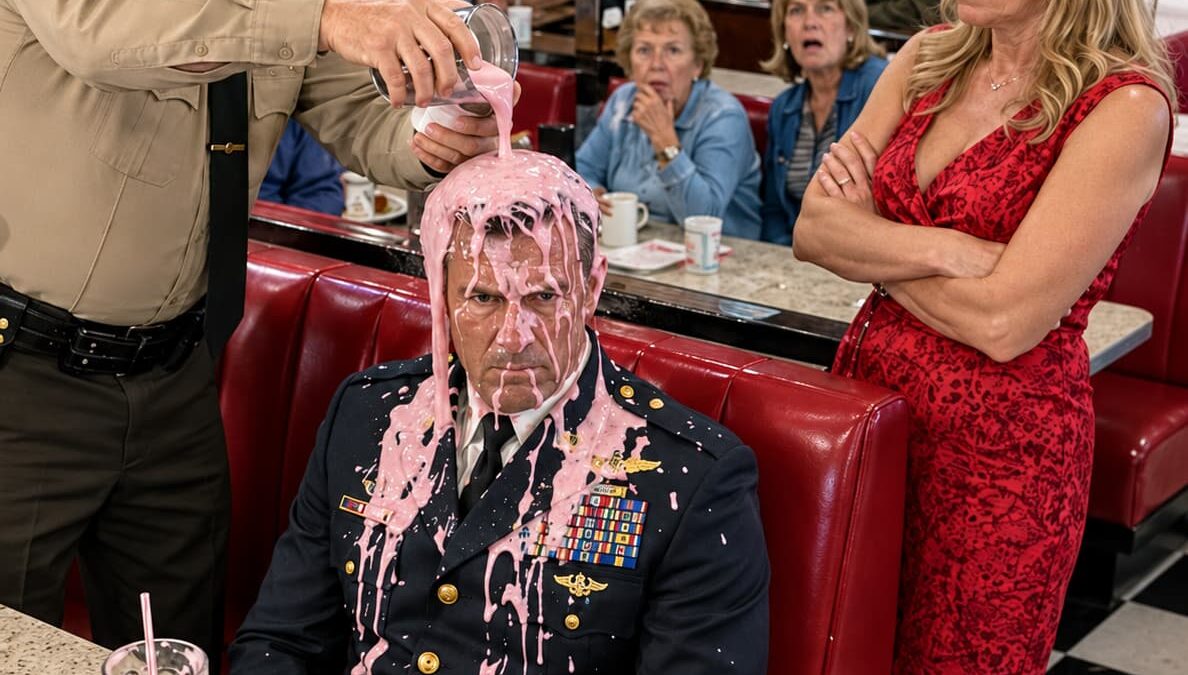
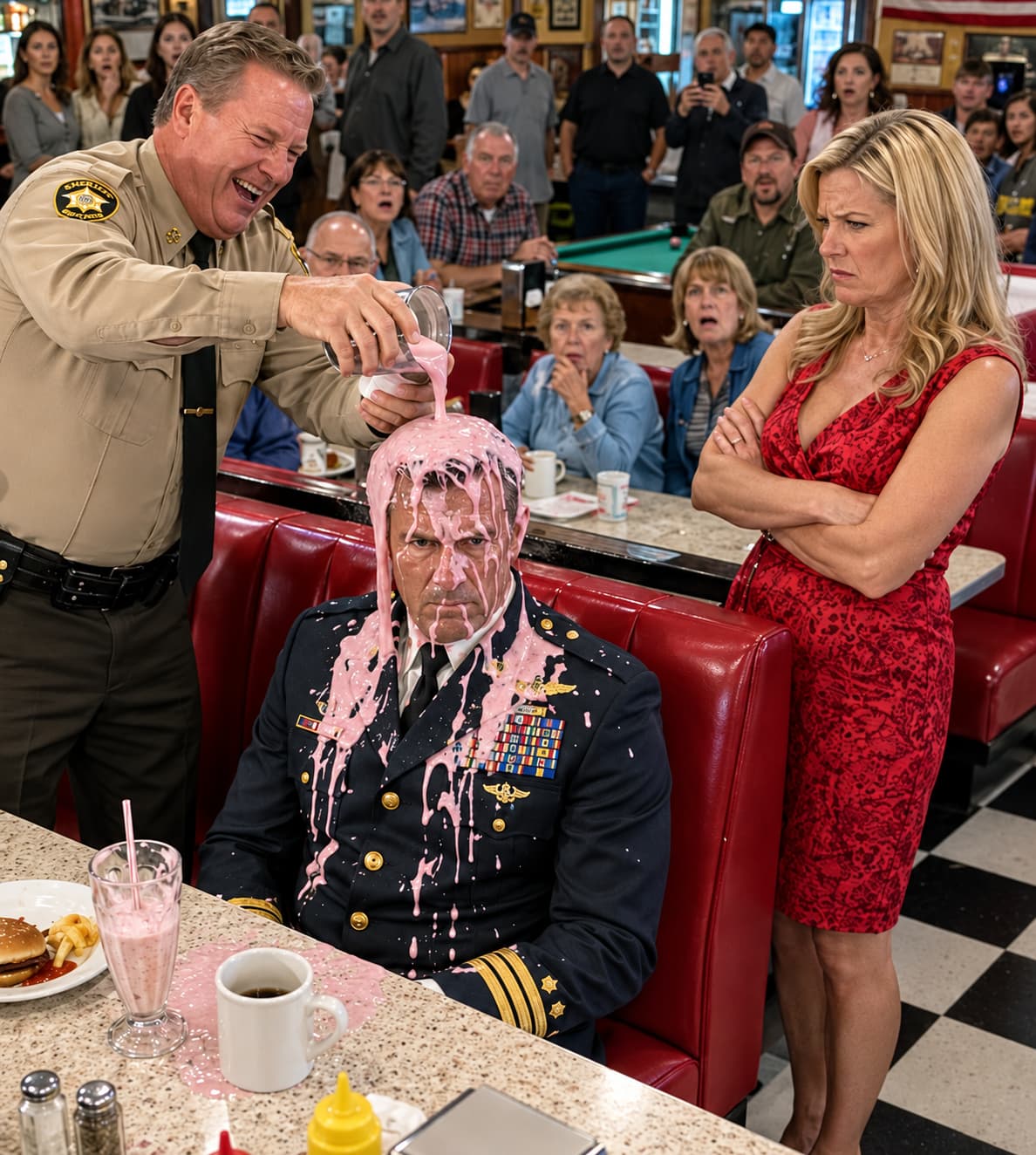
The strawberry milkshake hit me before I saw Sheriff Travis Cole lift the glass.
Cold exploded across my face.
Pink syrup ran into my eyebrows, down my nose, and beneath the collar of my flannel shirt. A chunk of melting ice slid past my jaw and dropped onto the cracked tile floor of the Rusty Spur Diner.
For half a second, nobody moved.
Forks stopped halfway to mouths.
The waitress behind the counter froze with a coffee pot in her hand.
Even the old ceiling fan seemed suddenly too loud.
Then Travis laughed.
“Look at the town ghost.”
A few people chuckled nervously.
Nobody wanted to be the first person in town to tell Sheriff Cole that something wasn’t funny.
I had learned that much during my three years in Red Creek, Montana.
I stayed in my chair.
Across from me, my wife Rachel stared at the table.
That bothered me more than the milkshake.
“Ethan,” she whispered. “Please. Don’t make a scene.”
I looked at her.
Not at Travis.
At her.
My wife of eleven years wouldn’t meet my eyes.
Travis stepped closer.
He was forty-six, broad through the shoulders, with the kind of body that came from being naturally large rather than disciplined. His badge sat high on his chest. His right hand rested close to his belt.
Whiskey rode on his breath.
“You got something to say, mechanic?”
Fourteen years of special operations training taught me how quickly violence can begin.
It also taught me something more important.
How not to begin it.
I noticed the way Travis favored his left knee.
The delay in his right shoulder.
The position of his sidearm.
The distance between us.
I could have put him on the floor before half the diner understood I had moved.
But then what?
I’d become exactly what he needed me to become.
A violent former soldier attacking the county sheriff in front of twenty witnesses.
So I picked up a napkin.
I wiped strawberry syrup from my eyebrow.
“No,” I said. “I’m done eating.”
His smile widened.
Rachel stood.
“I’ll wait in the truck.”
Then she added quietly:
“Try not to embarrass me any more than you already have.”
That sentence hit harder than the milkshake.
She walked toward the door.
Travis moved aside to let her pass.
And then it happened.
A tiny movement.
Almost nothing.
Travis gave Rachel a slight nod.
Rachel lowered her eyes.
Immediately.
Not in confusion.
In recognition.
I had seen signals like that before.
Not that exact signal.
But the relationship between two people communicating without wanting anyone else to notice.
My mind began rebuilding the previous six months.
Rachel’s late nights.
Her sudden interest in county planning meetings.
The phone she always kept face down.
The argument two months earlier when I’d walked into the kitchen and she’d snapped her laptop shut.
The way Travis had started appearing at places where Rachel and I happened to be.
The fundraiser.
The hardware store.
The gas station.
Once outside my garage.
I’d called it coincidence because marriage sometimes requires you to resist your worst suspicions.
Now I wasn’t sure it had been coincidence at all.
I stood.
Travis looked pleased with himself.
He thought he had humiliated me.
What he had actually done was make me pay attention.
Rachel was already sitting in the passenger seat when I climbed into my truck.
She was scrolling through her phone.
“You could have defended me,” I said.
“Against what?”
I stared at her.
She finally looked up.
“Ethan, Travis is an idiot. Everybody knows that.”
“He threw a drink in my face.”
“And you’re fine.”
“That isn’t the point.”
She sighed.
“Can we please just go home?”
I didn’t start the engine.
Instead, I opened the center console.
Inside was an old satellite phone.
I kept it for trips into areas where cell service disappeared.
Rachel’s face changed the moment she saw it.
“Who are you calling?”
“Someone who knows what questions I should ask.”
Her voice sharpened.
“About a milkshake?”
“No.”
I looked at her.
“About why my wife and the sheriff just exchanged a signal after he deliberately tried to provoke me into hitting him.”
The color left her face.
That was answer enough.
I called a former Navy JAG attorney I trusted from my years in service.
His name was Commander Owen Barrett when I knew him. He had since retired and gone into federal compliance work.
He answered after four rings.
“Hayes?”
“It’s me.”
“Been a while.”
“I need advice.”
His tone changed.
“What happened?”
“I think a county sheriff just tried to provoke me into assaulting him.”
Silence.
“And I think my wife knew it was going to happen.”
That got his attention.
I explained what I had seen.
I also told him about something I had not told Rachel.
Three weeks earlier, a man named Peter Walsh had brought his Ford F-350 into my repair shop.
Peter owned a small excavation company.
While I was checking his transmission, he asked whether I knew anything about encrypted storage.
I told him enough to make him trust me.
He came back the next afternoon carrying a flash drive.
Peter claimed the sheriff’s office had been pressuring local contractors to use a specific hauling company for county projects. Businesses that refused suddenly encountered inspections, permit problems, or traffic stops.
He thought public money was being redirected.
I had told him to take his concerns to an attorney or appropriate investigators.
Four days later, Peter disappeared.
The sheriff’s office said he had probably left town because of debts.
His truck was found near the state line.
The flash drive was still in my gun safe.
I hadn’t opened it.
Now Owen went quiet.
“Ethan, do not access that drive.”
“I haven’t.”
“Good. Preserve it exactly as received. Write down when and how you got it. Don’t confront anybody. If there’s genuine evidence of public corruption, you take it through counsel to the appropriate state or federal authorities. Your old rank does not give you jurisdiction here.”
“I know.”
“And Ethan?”
“Yeah?”
“If someone knows Walsh gave you something, the diner may not have been about your pride.”
I looked at Rachel.
She was staring straight ahead.
“It may have been about creating a reason to arrest you.”
I drove home without another word.
Rachel went upstairs.
I went to my workshop.
The safe was behind a steel cabinet bolted into concrete.
I opened it.
The flash drive was there.
So was the envelope Peter had put it in.
I photographed everything without removing the drive from the envelope.
Then I wrote down exactly what Peter had told me.
At 4:18 that afternoon, Owen connected me with an attorney in Helena who had experience handling whistleblower and public-corruption matters.
By evening, the drive was no longer in my house.
It was transferred through counsel for proper preservation and review.
That decision probably saved me.
Because at 10:37 that night, Sheriff Travis Cole arrived with three deputies.
I watched their headlights sweep across my workshop.
Rachel came downstairs in pajamas.
“What’s happening?”
I looked at her.
“You tell me.”
Someone pounded on the door.
“Sheriff’s department!”
I opened it only after confirming what they wanted.
Travis held up paperwork authorizing a search relating to property allegedly stolen from Peter Walsh’s excavation company.
They were looking for company records, electronic storage devices, and equipment.
Travis smiled.
“Funny how trouble follows some people.”
I stepped aside after my attorney confirmed I should comply with the lawful search while documenting what happened.
For nearly two hours, deputies searched my workshop.
They found nothing from Peter’s company.
Because the one thing Peter had given me was already with counsel.
Travis became visibly frustrated.
He walked close enough that only I could hear him.
“Where is it?”
There it was.
Not What did Peter give you?
Where is it?
I looked at him.
“Where is what, Sheriff?”
His jaw tightened.
Then I knew.
He knew about the drive.
After they left, I found Rachel sitting at the kitchen table.
She was crying.
I remained standing.
“How long?”
She covered her face.
“Ethan—”
“How long have you been involved with him?”
“Four months.”
The words should have destroyed me.
Instead, they clarified everything.
“Was the diner planned?”
She didn’t answer.
“Rachel.”
“Yes.”
I sat down slowly.
“Why?”
“He wanted you to hit him.”
“I know that now.”
“He said you were dangerous.”
I almost laughed.
“And throwing a drink at me was supposed to prove it?”
“He said if you attacked a sheriff in public, he could arrest you and search the property.”
“He already found another route to a search warrant.”
“I didn’t know about that.”
“What did you tell him about Peter?”
Her head snapped up.
That was the moment I saw real fear.
“I didn’t know his name.”
“What did you tell Travis?”
She began crying harder.
“A man came to the garage after closing. I saw you talking. You put something in the safe.”
I closed my eyes.
“You told him.”
“He kept asking whether anyone had given you files.”
“How did he know to ask?”
“I don’t know.”
“Rachel.”
“I don’t know everything, Ethan.”
That sentence mattered.
Not nothing.
Not everything.
“What do you know?”
She hesitated.
Then told me.
The affair had begun after a county fundraiser.
At first, according to Rachel, it had been exactly what it looked like: betrayal.
No coercion.
No innocent explanation.
She had been lonely. I had become withdrawn after leaving the service. I spent too much time at the garage. We had stopped talking.
Those things explained the cracks in our marriage.
They did not excuse what she had done.
Rachel knew that.
But after the affair began, Travis started using her.
He asked questions about my military background.
My finances.
My safe.
My contacts.
Whether I owned weapons.
Whether I still spoke to federal employees.
Then, two weeks earlier, he told Rachel I was “interfering in things I didn’t understand.”
That was when she should have warned me.
She didn’t.
“Why?”
“I was scared.”
“Of him?”
“And of you finding out about us.”
I stared at her.
“So you helped him set me up because you were afraid I’d discover you were sleeping with him.”
Her face collapsed.
“Yes.”
I stood.
“I need you to leave.”
“Ethan—”
“Tonight.”
“I can help.”
“You had six months to help by telling me the truth.”
“I have messages.”
I stopped.
“What?”
“From Travis.”
She unlocked her phone.
“He told me what to do at the diner.”
She showed me.
The messages were still there.
Keep Ethan seated near the window.
If he starts something, stay back.
And then one sent twenty minutes before the milkshake hit me:
Today we find out whether your hero is as controlled as you claim.
There were others.
Some were personal.
Some were sexual.
Some discussed Peter.
One was worse.
If Hayes has Walsh’s material, I need him separated from it before anybody outside the county sees it.
I looked at Rachel.
“Do not delete anything.”
The flash drive changed the case.
It didn’t contain a magical confession.
Real corruption rarely comes packaged that neatly.
Instead, Peter had collected fragments.
Invoices.
County bid records.
Photographs of trucks.
Copies of messages.
Payments between companies.
Dates of inspections.
A spreadsheet comparing which contractors supported certain county projects and which ones later faced enforcement problems.
Individually, some of it could have been explained.
Together, it justified deeper scrutiny.
Rachel’s messages added something Peter’s files lacked:
a direct connection to Travis.
My attorney turned the material over through proper channels.
State investigators became involved.
Then federal investigators joined after questions arose about federal infrastructure funds used in some county projects.
I gave a statement.
So did Rachel.
The diner had security cameras.
Travis had apparently forgotten that.
The footage showed him approaching our table with the milkshake already in his hand.
It showed Rachel looking toward him seconds before he threw it.
It showed him leaning toward me afterward.
And it showed me doing absolutely nothing violent.
His attempt to manufacture an image of an unstable former SEAL had produced evidence of the opposite.
I had sat there.
Wiped my face.
And walked away.
Three weeks later, Peter Walsh was found alive.
That surprised everyone.
He had not been murdered.
He had fled.
Peter later explained through his attorney that after receiving threats and noticing vehicles following him, he panicked. He left Montana without telling his employees where he was going.
His disappearance had frightened me.
But his return helped investigators enormously.
He could authenticate the records he had collected.
He could explain why he had given me the drive.
And he could describe the pressure he said he had experienced.
The case expanded.
Several county contracts came under review.
A hauling company partly controlled through an associate of Travis became a focus.
Investigators examined whether confidential law-enforcement information had been used to intimidate businesses.
They also reviewed whether traffic enforcement and permit pressure had been selectively used against certain contractors.
Not every allegation survived scrutiny.
Some things Peter suspected turned out to have innocent explanations.
Others did not.
That mattered to me.
I didn’t want Travis destroyed by rumors.
I wanted the truth established by evidence.
Rachel moved into an apartment in Helena.
I filed for divorce.
She asked me twice whether there was any chance of saving our marriage.
Both times, I gave her the same answer.
“I can understand why our marriage became lonely. I can even accept my part in that.”
Then I looked at her.
“But loneliness didn’t make you betray me. And fear didn’t force you to help another man provoke me into committing a crime.”
She cried.
I did too.
Eleven years does not disappear just because someone deserves consequences.
That was one of the hardest lessons of my life.
You can love someone and still know they no longer belong beside you.
Rachel eventually cooperated fully with investigators.
I was grateful for that.
I did not confuse it with reconciliation.
Travis was placed on administrative leave while the investigations proceeded.
Months later, prosecutors brought charges arising from specific conduct supported by the evidence. Other people connected to the contracting scheme were investigated separately.
The process took more than a year.
There was no dramatic moment where fifty federal agents stormed the diner because I had once been a SEAL.
My former military career did not make me above the law.
It did not give me secret authority over a Montana sheriff.
What it gave me was discipline.
The instinct to preserve evidence.
The patience not to act before I understood the situation.
And friends who knew enough to tell me which lawful door to knock on.
That was more valuable than revenge.
At one court hearing, Travis and I saw each other for the first time since the investigation began.
He looked smaller without the uniform.
Not physically.
Something else.
For years, the badge had been part of his personality.
People laughed when he laughed.
Moved when he told them to move.
Looked away when looking became inconvenient.
Now he was sitting beside his attorney like everyone else.
He stared at me as I passed.
“You think you won?” he muttered.
I stopped.
My attorney touched my elbow.
I looked at Travis.
“No.”
He seemed surprised.
“Peter lost his business for months. My marriage is over. People were intimidated. A town stopped trusting its sheriff.”
I shook my head.
“Nobody won.”
Then I walked away.
The divorce became final fourteen months after the diner incident.
Rachel received her fair share of our marital property under the settlement.
I kept the garage.
She never asked for forgiveness again.
That actually made it easier to eventually give her a small amount of it.
Not enough to take her back.
Enough to stop carrying her choices around inside me every day.
The last time we spoke in person, she handed me a cardboard box.
Inside was my old Navy shadow box.
Trident.
Ribbons.
Photographs.
A folded flag from one of my retirement ceremonies.
I had packed it away when we moved to Montana.
Rachel ran her fingers across the lid.
“I think I hated this box for a while.”
“Why?”
“Because everybody who knew you before Montana looked at you like you were somebody important.”
I said nothing.
“And I started looking at you like you were just the man who came home smelling like motor oil.”
“That man was still me.”
“I know.”
Her eyes filled.
“I figured that out too late.”
I closed the box.
“You didn’t need to respect what I used to do.”
She looked at me.
“You just needed to respect me.”
She nodded.
“Yes.”
That was the closest thing to closure we ever got.
Two years later, I still owned Hayes Auto & Diesel.
Most mornings I opened at seven.
I fixed transmissions.
Changed brakes.
Argued with suppliers.
Drank terrible coffee.
People occasionally came into the shop expecting to meet some legendary retired operator because the story had spread.
They were usually disappointed.
They found a man under a pickup truck swearing at a rusted bolt.
That suited me.
One autumn afternoon, I went back to the Rusty Spur.
I had avoided the place for almost two years.
The same waitress was working.
Her name was June.
When she saw me, she stopped pouring coffee.
“Ethan.”
“Hey, June.”
She looked nervous.
Then she walked behind the counter and returned with a strawberry milkshake.
I stared at it.
She immediately raised both hands.
“Too soon?”
For the first time in a long while, I laughed.
“Probably.”
She put it on the table anyway.
“On the house.”
I took a sip.
It tasted exactly like I remembered.
Strawberries.
Vanilla.
And for half a second, humiliation.
Then that feeling passed.
Because Travis had misunderstood me that day.
So had Rachel.
They thought my silence meant weakness.
They thought the mechanic sitting quietly in a diner had forgotten how to fight.
They were wrong.
But not because I was a former SEAL.
Not because I could have dropped Travis before his empty glass hit the table.
Not because I knew military lawyers or people who understood federal investigations.
They were wrong because they misunderstood what fourteen years of service had taught me.
Anyone can react.
Control is harder.
Travis needed me angry.
So I stayed calm.
He needed me violent.
So I walked away.
He needed me isolated.
So I called people who understood the law.
He needed the evidence hidden.
So I preserved it.
And he needed everyone to believe the battle began when he threw that milkshake.
It didn’t.
That was the moment he lost control of it.
I looked out the diner window at the mountains beyond Red Creek.
For years, I had believed moving to Montana would give me peace.
I had been wrong about that too.
Peace isn’t a place where nothing bad happens.
It isn’t a quiet town.
A good marriage.
A locked workshop.
Or a uniform hanging in a closet.
Peace is knowing that when someone tries to drag you into becoming the worst version of yourself, you still get to choose who you are.
Travis Cole risked his badge, his freedom, and the trust of an entire town because he believed power meant nobody could tell him no.
Rachel risked an eleven-year marriage because she believed betrayal could remain hidden if she helped control the man she had betrayed.
And me?
That afternoon in the Rusty Spur, I risked something too.
I risked becoming exactly the man Travis wanted everyone to believe I was.
All it would have taken was one punch.
One second of rage.
One bad decision.
Instead, I picked up a napkin.
I wiped the strawberry milkshake from my face.
And I walked away.
It was the least dramatic thing I could have done.
It was also the move that changed everything.