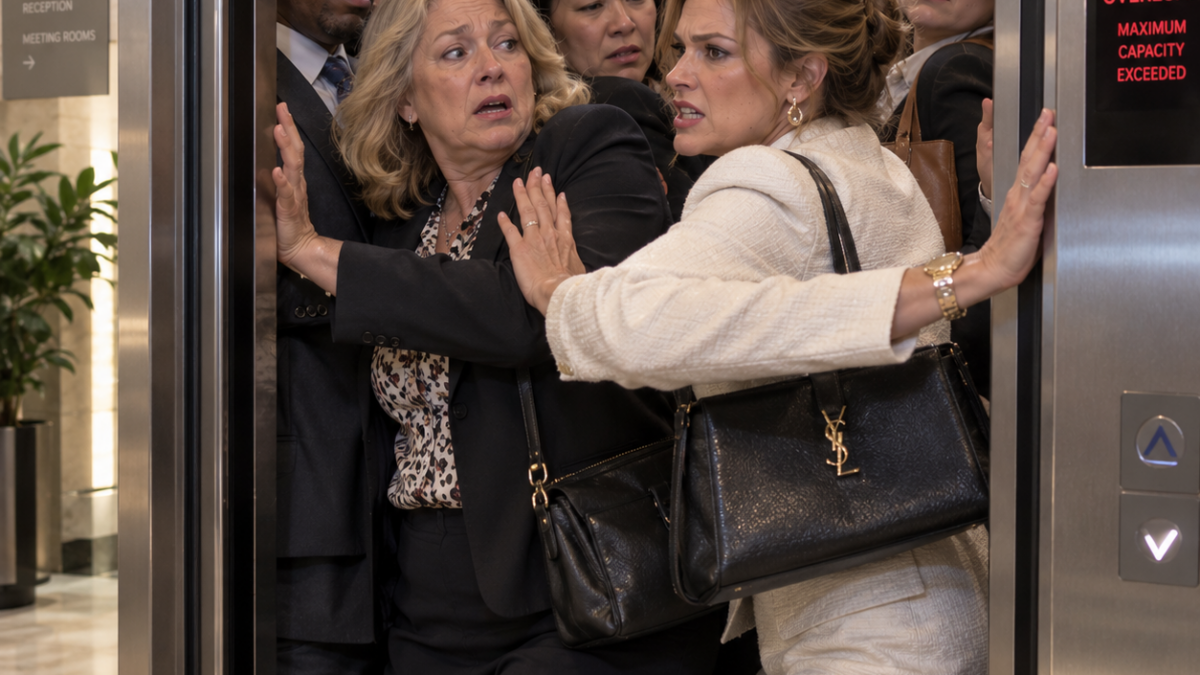
“Move in a little.”
Nobody moved.
Brenda stood outside the elevator with one hand holding the door open.
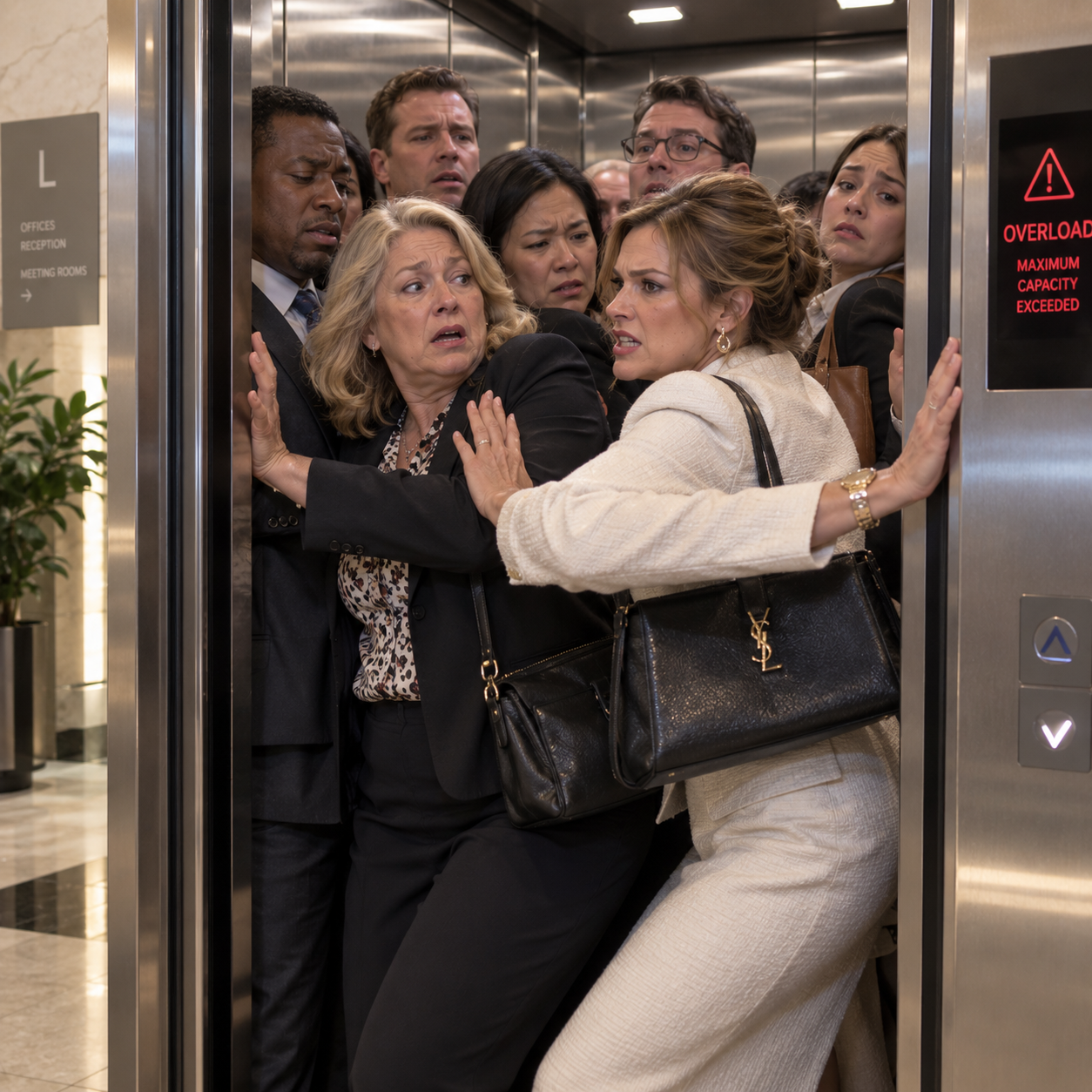
Inside, six people were already packed shoulder to shoulder.
A man carrying a briefcase was pressed against the back wall.
A young woman held two coffee cups against her chest.
An elderly gentleman had flattened himself beside the control panel.
And closest to the door stood Linda, a fifty-five-year-old woman holding a brown leather folder.
Linda looked at Brenda.
“It’s full. Please take the next one.”
Brenda glanced at her watch.
8:52 a.m.
“No.”
Linda frowned.
“No?”
“I have a meeting.”
“So do the rest of us.”
Brenda rolled her eyes.
She pushed her large designer handbag through the opening.
“There’s plenty of room.”
“There really isn’t.”
“Just move back.”
Linda looked behind her.
There was nowhere to move.
“Ma’am, please wait for the next elevator.”
Brenda sighed dramatically.
“Oh, for God’s sake.”
Then she stepped forward.
Linda was forced backward.
The young woman with the coffee gasped as Brenda’s handbag struck her arm.
Coffee splashed onto the lid.
“Careful!”
Brenda barely looked at her.
“You’re fine.”
Then she pulled her suitcase-sized handbag fully inside.
The elevator doors tried to close.
They stopped.
Opened.
Tried again.
Brenda pressed the button repeatedly.
“Come on.”
Linda stared at her.
“Pressing it ten times won’t make the elevator larger.”
Brenda ignored her.
The doors began closing again.
Then—
BEEP. BEEP. BEEP.
A red light flashed above the panel.
OVERLOAD.
Nobody spoke.
Brenda stared at the display.
Then at everyone inside.
The young woman holding the coffee looked down to hide a smile.
The man with the briefcase didn’t bother.
Linda simply said:
“Someone needs to get out.”
Brenda crossed her arms.
“Well, who got in last?”
Silence.
Linda raised an eyebrow.
Brenda’s face reddened.
“I mean, maybe somebody isn’t going very far.”
A man at the back laughed.
“You’re the one who just forced your way in.”
Brenda looked at him.
“I have an important meeting.”
“So do I.”
The alarm continued.
BEEP. BEEP. BEEP.
Brenda pressed the close button again.
Nothing happened.
Linda calmly pointed toward the lobby.
“The next elevator will probably be here in thirty seconds.”
Brenda looked at her.
“You could get out.”
Linda almost smiled.
“Why would I?”
“You’re standing closest to the door.”
“I was also standing here before you arrived.”
Brenda’s jaw tightened.
The alarm kept sounding.
People in the lobby had begun staring.
Finally, Brenda stepped out.
Instantly—
the alarm stopped.
The doors began closing.
Brenda’s face burned.
Then Linda reached out and held the door for one second.
Brenda thought she was being invited back in.
Instead, Linda smiled.
“See? Problem solved.”
The doors closed.
Brenda stood alone in the lobby.
“Unbelievable.”
She checked her watch.
8:54.
Her meeting started at nine.
She pressed the elevator button repeatedly.
Nothing.
“Come on!”
A security guard at the desk looked over.
“Ma’am, another one is coming.”
“I can see that.”
He returned to his computer.
Brenda pulled out her phone.
Three messages were waiting.
Where are you?
Everyone’s upstairs.
Then one from her boss:
Do NOT be late. Northbridge has arrived.
Brenda’s stomach tightened.
This wasn’t an ordinary meeting.
For eight months, her company had been pursuing Northbridge Health Systems, a national healthcare network preparing to outsource its customer-experience training.
The contract was worth more than six million dollars.
Brenda was director of client strategy.
If she closed this account, she had been told privately that she would likely become senior vice president.
She looked at the elevator display.
Floor 7.
“Come on.”
Finally, the second elevator arrived.
Empty.
Brenda stepped inside.
As the doors closed, she muttered:
“Some people have absolutely no consideration for anyone else’s time.”
At 9:03, Brenda rushed into the twenty-second-floor conference room.
Her boss, Michael, immediately looked at his watch.
Brenda forced a smile.
“Sorry. Elevator issue.”
Michael wasn’t amused.
Around the table sat several executives.
Brenda recognized most of them.
Then she noticed one empty chair at the head of the table.
She placed her laptop down.
“Has Northbridge’s representative arrived?”
Michael frowned.
“She was here before me.”
“Where is she?”
“Taking a call.”
Brenda opened her presentation.
“Okay. Great.”
Michael lowered his voice.
“This meeting matters.”
“I know.”
“They’ve already rejected two competitors.”
“I know.”
“Their board chair is personally involved in the selection.”
“I know, Michael.”
He stared at her.
“Then act like it.”
Brenda forced another smile.
“I’ve got this.”
The door opened.
Everyone stood.
Brenda turned.
Her smile disappeared.
Linda walked into the room.
Brown leather folder in hand.
For one second, neither woman moved.
Michael smiled.
“Brenda, I’d like you to meet Linda Marshall.”
Brenda couldn’t speak.
Michael continued.
“Chair of Northbridge Health Systems’ patient experience committee.”
Linda extended her hand.
“Good morning.”
Brenda stared at it.
Then slowly shook it.
“We’ve met.”
Linda smiled politely.
“Yes.”
“In the elevator.”
Michael looked between them.
“Oh?”
Linda sat down.
“Briefly.”
Brenda’s heart began pounding.
For the first twenty minutes, Linda said nothing about the elevator.
That was somehow worse.
Brenda delivered her presentation.
She spoke about customer satisfaction.
Empathy.
Respect.
Accessibility.
Human-centered service.
She had rehearsed every sentence.
Normally, she was excellent.
But every time she said the word “respect,” she remembered pushing Linda backward.
Every time she said “patience,” she heard the overload alarm.
Then Brenda reached a slide titled:
NO CUSTOMER SHOULD EVER FEEL LIKE AN INCONVENIENCE.
Linda looked at it for several seconds.
Then raised her hand.
“May I ask a question?”
“Of course.”
“What happens when your employees are under pressure?”
Brenda relaxed slightly.
She knew this answer.
“We train them to maintain professionalism regardless of stress.”
Linda nodded.
“What if they’re late?”
Brenda froze.
Michael glanced at Linda.
She continued.
“What if they’re frustrated?”
“Professional standards still apply.”
“What if they believe their needs are more important than the person standing in front of them?”
Brenda’s mouth went dry.
Linda looked directly at her.
“Do the standards still apply?”
Silence.
“Yes.”
“Why?”
Brenda could have given the prepared answer.
Instead, she closed the presentation remote.
“Because pressure doesn’t create respect.”
She paused.
“It reveals whether you actually practice it.”
Linda’s expression changed slightly.
Brenda swallowed.
Then she said:
“And this morning, I didn’t.”
Michael frowned.
“What happened?”
Brenda looked at him.
Then at everyone else.
She wanted to disappear.
But she knew there was no way around it.
“The elevator was full.”
Michael waited.
“I forced my way in anyway.”
One executive looked down.
Brenda continued.
“Mrs. Marshall asked me to wait for the next one.”
“And?”
“I told everyone to move.”
Michael closed his eyes.
Brenda’s face burned.
“Then the overload alarm went off.”
Someone coughed to hide a laugh.
Linda didn’t.
Brenda continued.
“I suggested someone else should get out.”
Michael stared at her.
“You did what?”
“I was late.”
“That isn’t an explanation.”
“I know.”
Linda finally spoke.
“Why didn’t you wait?”
Brenda looked at her.
“Because I thought this meeting was more important than whatever everyone else was doing.”
Linda nodded.
“At least that’s honest.”
Brenda sat down.
“I apologize.”
“To me?”
“To everyone in that elevator.”
She paused.
“And especially the woman whose coffee I nearly spilled and then told she was ‘fine’ without even asking.”
Linda studied her.
“Good.”
Brenda looked surprised.
“Good?”
“Now continue the presentation.”
The meeting lasted two more hours.
Brenda recovered.
But something had changed.
She stopped performing.
When Linda challenged one of the company’s training proposals, Brenda listened instead of immediately defending it.
When another executive questioned the staffing model, she admitted where the plan was weak.
At the end, Linda closed her folder.
“We’ll be in touch.”
That was all.
In the hallway, Michael turned to Brenda.
“What were you thinking?”
“I wasn’t.”
“You nearly lost a six-million-dollar contract because you couldn’t wait thirty seconds.”
“I know.”
Michael shook his head.
“No.”
He looked at her.
“That’s not the real problem.”
Brenda frowned.
“The contract?”
“The contract is secondary.”
He pointed toward the conference room.
“You just spent two hours telling a healthcare organization that your company teaches people patience and dignity.”
Brenda looked down.
Michael continued.
“And when you thought Linda was just another woman in an elevator, you couldn’t show either.”
That sentence stayed with her.
Not because Linda was powerful.
Because Brenda hadn’t known she was powerful.
If she’d recognized Linda as the Northbridge chair, Brenda knew exactly how she would have behaved.
She would have smiled.
Held the door.
Probably offered to wait for the next elevator herself.
That realization made her feel worse than the embarrassment.
Northbridge didn’t sign the contract that week.
Instead, Linda requested something unusual.
She wanted to observe Brenda’s company before making a decision.
Not the executives.
The frontline employees.
Receptionists.
Support staff.
Call-center representatives.
Building personnel.
Michael agreed.
For the next month, Brenda joined the review.
At first, she treated it like another project.
Then she began noticing things.
A receptionist who stayed calm while a furious customer shouted at her.
A janitor who stopped cleaning to help an elderly visitor find the correct office.
A call-center employee who spent twenty extra minutes helping a confused patient understand a bill.
None of them had impressive titles.
None of them knew Linda was evaluating the company.
They were simply doing their jobs.
One afternoon, Brenda asked the receptionist:
“How do you stay patient when people are rude?”
The young woman smiled.
“My mother used to tell me everyone is carrying somewhere they need to be.”
Brenda frowned.
“What does that mean?”
“You’re not the only person who’s late.”
Brenda went silent.
The elevator returned to her mind.
Six weeks later, Northbridge approved the contract.
But Brenda didn’t receive the promotion.
Michael gave it to another director.
Brenda was devastated.
She sat in his office.
“Was it because of the elevator?”
Michael shook his head.
“No.”
“Then why?”
“Because you’re excellent at winning rooms.”
Brenda frowned.
“But?”
“You still need to learn how to share them.”
She looked away.
Michael continued.
“I want you to lead the Northbridge implementation.”
“Without the promotion?”
“Yes.”
“For how long?”
“A year.”
Brenda almost refused.
Then she remembered Linda.
The receptionist.
The elevator.
“Okay.”
Michael looked surprised.
“Okay?”
“Yes.”
“I’ll do it.”
Eleven months later, Brenda entered the lobby on a rainy Monday morning.
She was carrying a laptop bag and two coffees.
The elevator doors opened.
Almost full.
There was enough room for one more person.
Brenda stepped toward it.
Then she noticed an elderly man walking slowly toward the elevator with a cane.
The doors began closing.
Brenda put out her hand.
“Hold on.”
The doors reopened.
The man smiled.
“Thank you.”
Brenda stepped aside.
“You go ahead.”
He entered.
Then looked at her.
“Aren’t you coming?”
Brenda looked inside.
It would be tight.
She smiled.
“I’ll take the next one.”
The doors closed.
A voice behind her said:
“Well.”
Brenda turned.
Linda was standing near the lobby entrance.
Brenda laughed.
“Were you watching me?”
“No.”
Linda approached.
“But apparently I have excellent timing around elevators.”
Brenda smiled.
“Please don’t tell me that was another test.”
Linda shook her head.
“No test.”
They waited together.
Thirty seconds later, another elevator arrived.
Empty.
They stepped inside.
Linda pressed twenty-two.
Brenda pressed eighteen.
Then Linda said:
“I heard you’re getting promoted.”
Brenda looked surprised.
“How did you know?”
“Michael called me for a reference.”
Brenda laughed.
“Of course he did.”
Linda looked at her.
“I gave you a good one.”
“Even after the elevator?”
“Especially after the elevator.”
Brenda frowned.
“Why?”
“Because I wasn’t interested in whether you made a mistake.”
Linda smiled.
“I wanted to know whether embarrassment would make you defensive or make you different.”
The doors opened at eighteen.
Brenda stepped out.
Then turned.
“Linda?”
“Yes?”
“Can I ask you something?”
“Of course.”
“If you’d known that morning that I was presenting to you, would you still have made me get out?”
Linda laughed.
“Absolutely.”
The doors began closing.
Then she added:
“The elevator was overloaded, Brenda. Physics doesn’t care about your promotion.”
The doors closed.
Brenda burst out laughing.
A year later, Brenda became senior vice president.
On her first morning with the new title, she entered the same building.
She was early.
The lobby was crowded.
The elevator opened.
People rushed toward it.
Brenda stayed back.
A young man behind her looked irritated.
“Aren’t you getting in?”
“It’s full.”
“There’s room.”
He squeezed forward.
Brenda smiled.
“Good luck.”
He forced himself inside.
The doors tried to close.
Then—
BEEP. BEEP. BEEP.
Brenda covered her mouth to hide a laugh.
Inside, everyone looked at the young man.
His face reddened.
He reluctantly stepped out.
The doors closed.
Now he was standing beside Brenda.
Embarrassed.
He muttered:
“Stupid elevator.”
Brenda looked at him.
“No.”
He frowned.
“What?”
She smiled.
“Actually, that alarm taught me one of the most useful lessons of my career.”
The man stared at her.
“An overload alarm?”
“Yes.”
“How?”
The next elevator arrived.
Brenda stepped inside.
Then held the door for him.
“Because I used to think getting ahead meant never waiting when I could force my way forward.”
He entered.
“And?”
Brenda pressed her floor.
“And eventually I learned that getting somewhere first isn’t impressive if you have to push everyone else backward to do it.”
The doors closed.
Years earlier, Brenda had thought the most humiliating moment of that morning was the sound of an elevator announcing to an entire lobby that one person needed to get out.
It wasn’t.
The real humiliation came later.
It was realizing she had treated Linda differently when she thought Linda was nobody important.
And that became the lesson Brenda carried long after the embarrassment disappeared:
Respect that depends on someone’s title isn’t respect.
Patience isn’t something you practice only when you have time.
And sometimes waiting thirty seconds for the next elevator doesn’t make you fall behind.
Sometimes—
it’s the first sign that you’re finally learning how to move forward.