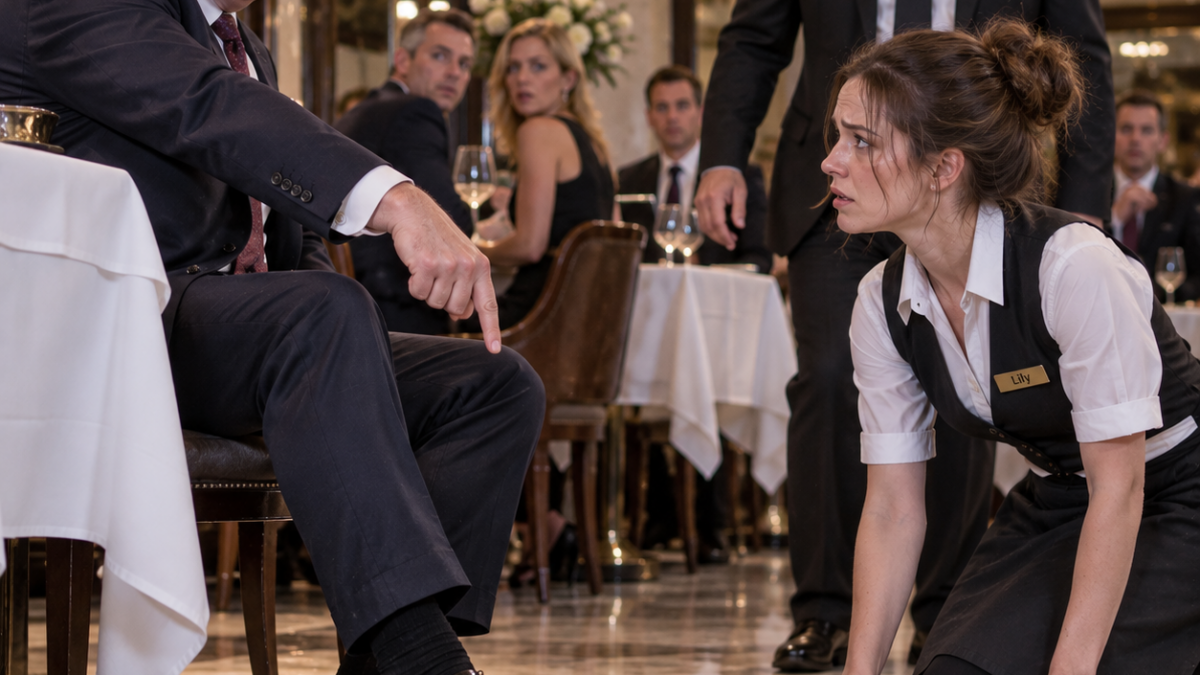
“Kneel down and clean my shoes.”
Lily thought she had misheard him.
The young waitress stood beside table twelve, holding a tray against her chest.
Across from her sat William Carter.
Forty-five years old.
Expensive suit.
Gold watch.
A bottle of wine on the table that cost more than Lily earned in a week.
William pointed toward his shoes.
A few drops of dirty water covered the polished leather.
“I’m sorry, sir?”
William smiled.
“You heard me.”
Several nearby diners turned to look.
Lily glanced toward the floor.
A small puddle of water had formed near the table after another server accidentally spilled a glass.
Only moments earlier, Lily had seen William deliberately step into it.
At first, she hadn’t understood why.
Now she did.
He wanted entertainment.
At someone else’s expense.
“My shoes are dirty.”
Lily remained calm.
“I can bring you a clean towel, sir.”
William laughed.
“I don’t want a towel.”
He pointed at her.
“I want you to clean them.”
Lily’s face tightened.
“Sir, I’m happy to clean the floor or replace anything at your table, but cleaning a customer’s shoes isn’t part of my job.”
William leaned back.
“Your job is whatever the customer paying the bill tells you it is.”
Lily looked around.
More people were watching now.
Some looked uncomfortable.
Others simply stared.
Nobody said anything.
William picked up his cloth napkin.
Then deliberately dropped it onto the floor.
It landed beside his shoe.
“Here.”
Lily stared at it.
William pointed down.
“Kneel.”
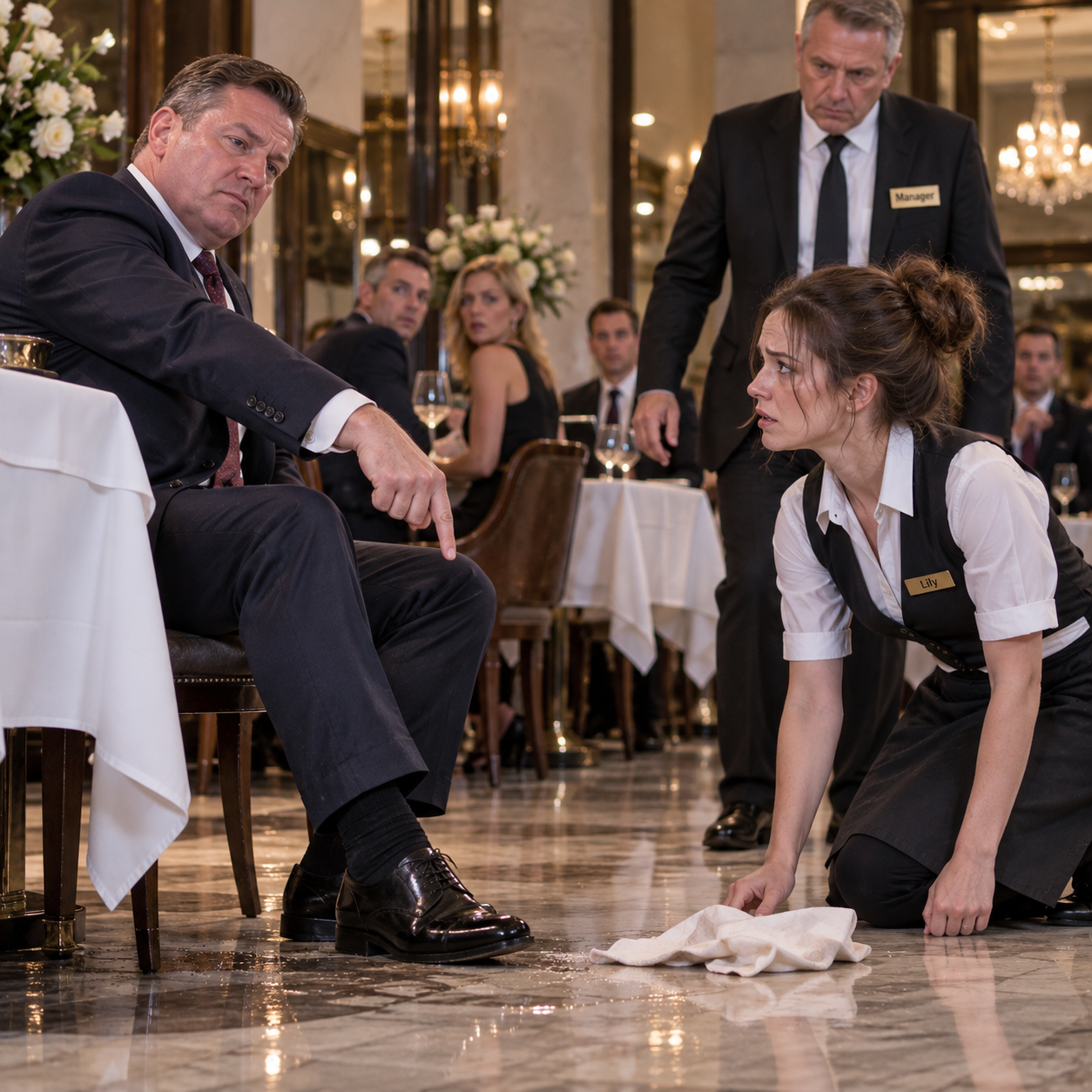
The restaurant went quiet.
Lily could feel her heart pounding.
She needed this job.
More than William could possibly understand.
Her rent was eight days overdue.
Her younger brother’s college tuition payment was due at the end of the month.
And there were medical bills from her mother’s final months that Lily was still paying two years after her death.
Losing her job wasn’t an option.
But neither was this.
William smiled.
“What’s wrong?”
Lily didn’t answer.
“You’re a waitress.”
He gestured toward the floor.
“So serve.”
Lily slowly bent down.
William’s smile widened.
But she didn’t kneel.
She picked up the napkin.
Stood straight again.
Folded it carefully.
Then placed it on his table.
She looked directly into his eyes.
“No.”
William’s smile disappeared.
“What did you say?”
“I said no.”
His dinner companion shifted uncomfortably.
William leaned forward.
“Do you know who I am?”
Lily’s voice remained calm.
“No, sir.”
His expression darkened.
“And I don’t think knowing would change my answer.”
A few people nearby exchanged looks.
William laughed bitterly.
“You’re about to lose your job.”
“Maybe.”
“And you think that’s funny?”
“No.”
Lily swallowed.
“I really need this job.”
For the first time, William looked slightly surprised.
Lily continued.
“But needing a paycheck doesn’t mean I sold you my dignity.”
Someone at another table quietly said:
“Good for her.”
William heard it.
His face reddened.
He raised his hand.
“MANAGER!”
Lily closed her eyes for half a second.
Here it came.
Footsteps approached from behind.
A man in his fifties hurried toward the table.
His name was Henry.
He had managed the restaurant for almost twenty years.
“What seems to be the problem?”
William pointed at Lily.
“Fire her.”
Henry looked at Lily.
Then at William.
“Why?”
“She refused to serve me.”
Lily opened her mouth.
William interrupted.
“I asked her to clean my shoes.”
Henry stared at him.
“You asked one of our servers to clean your shoes?”
William smiled.
“Yes.”
“And she refused.”
“Yes.”
William leaned back confidently.
“I come here three times a month. You know how much money I spend.”
“I do.”
“Then we’re not going to have a problem, are we?”
Henry looked at Lily.
Her hands were trembling.
“Lily.”
“Yes?”
“Did you refuse?”
She nodded.
“Yes.”
Henry was silent.
William smiled.
Then Henry said:
“Good.”
William’s smile vanished.
“What?”
Henry turned toward him.
“Our employees serve food.”
His voice became firm.
“They do not kneel at customers’ feet.”
William stared at him.
“You’re taking her side?”
“I’m not taking sides.”
Henry pointed toward the puddle.
“I watched you deliberately step into that water.”
William froze.
“I was standing near the kitchen.”
Henry continued.
“You stepped into it, called Lily over, and threw a napkin at her.”
William’s dinner companion slowly looked away.
Henry’s expression hardened.
“So I’m going to ask you to leave.”
William laughed.
“You’re throwing me out?”
“Yes.”
“Do you have any idea how much I’ve spent here?”
Henry nodded.
“Enough to know you can afford manners.”
Someone laughed.
William turned.
Several diners were now openly watching.
His humiliation was becoming public.
He stood.
“You’ll regret this.”
Henry said nothing.
William grabbed his jacket.
Then he pointed at Lily.
“You.”
She looked at him.
“You’ll be serving tables for the rest of your life.”
Lily’s expression changed slightly.
But before she could answer, Henry said:
“Actually, Mr. Carter…”
William stopped.
Henry hesitated.
Then looked at Lily.
“Maybe it’s time.”
Lily immediately shook her head.
“Henry.”
William frowned.
“Time for what?”
Henry looked at her.
“You can’t hide forever.”
The room became quiet again.
Lily whispered:
“Please don’t.”
But Henry walked toward a wall near the entrance.
Several framed photographs hung there.
Pictures of the restaurant over the decades.
Henry removed one.
Then brought it to the table.
He placed it in front of William.
It showed a smiling middle-aged woman standing outside the restaurant twenty-seven years earlier.
Beside her was a much younger Henry.
Above them was the restaurant’s original sign.
William frowned.
“So?”
Henry pointed at the woman.
“Do you know who this is?”
“No.”
“This is Margaret Evans.”
William shrugged.
“Should that mean something to me?”
Henry looked at Lily.
“It’s her mother.”
William glanced at Lily.
Then back at the photograph.
“I don’t care.”
“You should let me finish.”
Henry pointed around the restaurant.
“Margaret founded this place.”
William went silent.
Lily looked down.
Henry continued.
“She started with eight tables, a borrowed stove, and almost no money.”
William frowned.
“If her mother owned the restaurant, why is she waiting tables?”
Henry looked at Lily.
“Because her mother is dead.”
The room became still.
Lily’s eyes lowered.
Henry continued softly.
“Two years ago, Margaret died from cancer.”
William said nothing.
“She left the restaurant to Lily and her younger brother.”
William stared at her.
Then he laughed.
“So the waitress owns the restaurant?”
Lily finally spoke.
“Part of it.”
“How much?”
Henry answered.
“Fifty-one percent.”
William’s face changed.
Lily immediately looked at Henry.
“You didn’t need to tell him that.”
“Yes,” Henry replied.
“I think I did.”
William stared at Lily’s simple uniform.
“You own this place?”
Lily nodded.
“Then why are you carrying plates?”
It was the question everyone was wondering.
Lily looked around the dining room.
“My mother worked the floor until six months before she died.”
She looked toward the old photograph.
“She used to say that if you own a restaurant but don’t know how it feels to carry six hot plates while someone snaps their fingers at you…”
Lily paused.
“…then eventually you’ll stop seeing employees as people.”
Henry smiled.
Lily continued.
“So after she died, I kept working shifts.”
William stared at her.
“That’s ridiculous.”
“Maybe.”
“You could hire someone.”
“I did.”
“Then why work?”
Lily’s expression softened.
“Because someday my brother and I will run this place without Henry.”
She smiled at the manager.
“And before that happens, I want to understand every job I’m asking someone else to do.”
Henry looked proud.
William said nothing.
Then Lily added:
“And because I need the salary.”
William laughed.
“You own half a luxury restaurant and need a waitress’s salary?”
“Ownership doesn’t mean cash.”
Lily’s smile disappeared.
“My mother left behind medical debt.”
The room became silent again.
“I refused to take money out of the restaurant to make my life easier while employees depended on it for their paychecks.”
William looked away.
Lily continued.
“So yes.”
“I wait tables.”
“I live in a small apartment.”
“I take the bus most mornings.”
“And sometimes I worry about bills.”
She looked directly at him.
“But none of that makes me less worthy of respect.”
William’s face reddened.
“I didn’t know who you were.”
Lily nodded.
“That’s the problem.”
He frowned.
“What?”
“You think you should have treated me better because you know who I am now.”
William opened his mouth.
Lily continued.
“But five minutes ago, you thought I was just a waitress.”
She paused.
“And you thought that meant I deserved less.”
Nobody spoke.
William looked around the restaurant.
People were staring at him.
He grabbed his coat.
“This place has lost my business.”
Henry nodded.
“We’ll survive.”
William turned toward the door.
Then Lily spoke.
“Mr. Carter.”
He stopped.
She picked up the napkin.
For a moment, William seemed to think she might apologize.
Instead, Lily handed it to him.
“You dropped this.”
A few diners laughed.
William snatched it from her hand.
Then walked out.
Three weeks passed.
Lily assumed she would never see him again.
She was wrong.
One rainy Tuesday afternoon, William walked back into the restaurant.
No expensive dinner party.
No arrogance.
No demand for a table.
He asked for Henry.
Lily happened to be near the entrance.
When she saw him, her expression hardened.
“Can I help you?”
William looked uncomfortable.
“I came to apologize.”
Lily stared at him.
“To the owner?”
He shook his head.
“To the waitress.”
That surprised her.
William reached into his coat.
He pulled out an envelope.
“I’ve been thinking about what you said.”
Lily didn’t take it.
“What is that?”
“A check.”
Her expression immediately changed.
“No.”
“You haven’t even seen the amount.”
“I don’t care.”
“It’s not for you.”
“Then who?”
William looked toward the kitchen.
“For your staff.”
Lily remained silent.
“I was wrong.”
He swallowed.
“And I thought money was the easiest way to make it right.”
Lily almost smiled.
“Money is probably how you make most things right.”
William nodded.
“That’s what my daughter said.”
Lily frowned.
“Your daughter?”
William looked embarrassed.
“She saw the video.”
Lily froze.
“What video?”
Apparently, one of the diners had recorded part of the confrontation.
It had circulated online.
William’s daughter had seen it.
“She called me,” he said.
“What did she say?”
William gave a sad laugh.
“She asked me if that’s how I would want someone to treat her.”
Lily said nothing.
“I told her no.”
He looked down.
“Then she asked why someone else’s daughter deserved less.”
Lily’s expression softened.
William folded the check.
“My daughter hasn’t spoken to me in two weeks.”
“I’m sorry.”
“Don’t be.”
He shook his head.
“She needed to say it.”
Then he looked at Lily.
“So did you.”
He put the check back into his pocket.
“I understand if you don’t want this.”
Lily thought for a moment.
Then she said:
“I don’t.”
William nodded.
He turned to leave.
“But…”
He stopped.
Lily pointed toward the dining room.
“We’re short a dishwasher tonight.”
William stared at her.
She smiled slightly.
“You want to make a gesture?”
He looked toward the kitchen.
“You’re serious?”
“Completely.”
William looked at his expensive suit.
Then at Lily.
“How long is the shift?”
“Four hours.”
He hesitated.
Then took off his jacket.
“Where’s the kitchen?”
For four hours, the wealthy businessman who had once ordered a waitress to kneel at his feet stood over a sink.
He washed plates.
Scrubbed pans.
Took out garbage.
And for the first time in years, nobody cared how much money he had.
At the end of the night, his back hurt.
His hands were wrinkled from water.
His shirt was stained.
Lily walked into the kitchen.
“How was it?”
William looked exhausted.
“Terrible.”
She laughed.
He did too.
Then he looked toward the servers cleaning the dining room.
“I never noticed how hard everyone works.”
Lily nodded.
“Most people don’t.”
William dried his hands.
“Does this mean you forgive me?”
“No.”
His smile disappeared.
Lily continued.
“But it means I believe your apology more than I did four hours ago.”
William nodded.
That was enough.
He put on his jacket.
As he reached the kitchen door, Lily called after him.
“Mr. Carter.”
He turned.
She tossed him a clean napkin.
He caught it.
William looked at the cloth.
Then at her.
Lily smiled.
“For your shoes.”
William laughed.
And for the first time, the napkin wasn’t an instrument of humiliation.
It was a reminder.
A wealthy man had entered the restaurant believing money placed him above the people serving him.
He left understanding something his money had never taught him:
A person’s job may tell you what they do.
It never tells you what they’re worth.