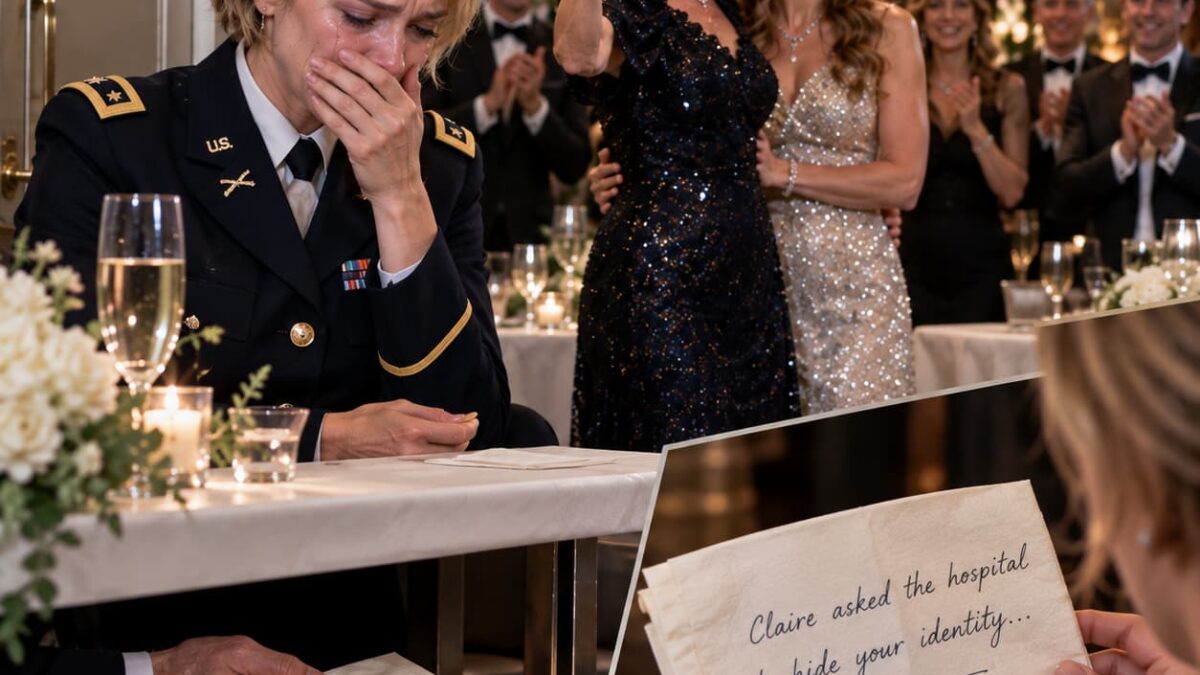
The second line on the napkin began with my mother’s name.
Claire.
I stared at it until the letters blurred.
Then I read the rest.
“Claire contacted the transplant office before your surgery. She asked them to keep your identity out of all foundation communications and told staff Natalie was the family spokesperson. There is more. Do not confront her here. I have copies. Meet me in the library at 8:15.”
My fingers went cold.
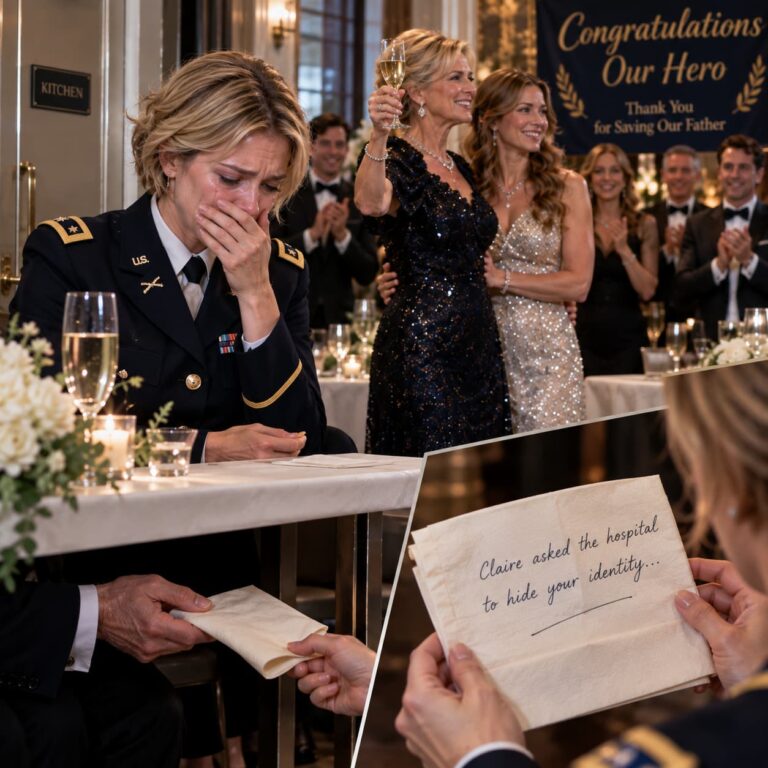
Across Ashford Hall, my mother was still standing beneath the chandelier with a champagne glass raised toward Natalie.
My sister smiled while twenty-two people applauded her.
And my father—
the man carrying my kidney inside his body—
had just told me that my disappearance from the story had not happened accidentally.
It had been arranged.
I folded the napkin.
Then I sat back down.
For once in my life, I did exactly what my mother would never have expected.
I stayed quiet because I chose to.
My name is Captain Olivia Reed.
I was thirty-one years old when I donated my left kidney to my father, Kenneth Reed.
Nine weeks later, I sat at Table 18 near the kitchen doors while my mother publicly praised my older sister, Natalie, as “the one who saved him.”
The irony was almost impressive.
Natalie had organized a fundraiser.
I had undergone major surgery.
Apparently only one of those things photographed well.
But after reading Dad’s note, my anger changed.
Until then, I had believed my mother was simply doing what she had done my entire life—favoring Natalie.
Now I understood there might be something more deliberate behind it.
I looked toward Dad.
He had returned to the head table.
He didn’t look at me.
Claire touched his arm while speaking to a donor.
Dad smiled weakly.
Anyone watching would have seen a recovering businessman beside his devoted wife.
I saw a frightened man waiting for 8:15.
At 8:11, I left the ballroom.
Ashford Hall was an old estate outside Chicago that Reed Medical used for donor dinners, board retreats and holiday events.
The library was upstairs behind a pair of dark wooden doors.
Dad was already inside.
He stood near the fireplace.
“You shouldn’t be standing this long,” I said.
He almost smiled.
“You sound like my nurse.”
“Your nurse probably has better judgment.”
His smile disappeared.
Then he looked at me.
“I’m sorry.”
I hated those words immediately.
“For what?”
“For all of it.”
“Dad, what did Mom do?”
He pointed toward a leather portfolio on the desk.
“Sit down.”
“No.”
“Olivia.”
“I spent nine weeks being told not to lift ten pounds. I think I can survive a conversation standing up.”
He nodded.
Then he opened the portfolio.
Inside were printed emails.
Hospital letters.
Copies of foundation communications.
And a memorandum from the hospital’s transplant ethics office.
My stomach tightened.
“Am I in trouble?”
Dad looked horrified.
“No.”
“Then what is this?”
“The hospital received a complaint.”
“From whom?”
“A nurse.”
I stared at him.
“One of mine?”
He nodded.
“She became concerned about how the family foundation was describing the transplant publicly.”
That sounded strange.
“Why would the hospital care about our Thanksgiving speeches?”
“It wasn’t only Thanksgiving.”
Dad slid a printed page toward me.
It was from the Reed Family Foundation website.
There was a photograph of Natalie beside Dad in the hospital.
The headline read:
A Daughter’s Mission to Save Her Father Inspires New Kidney Health Campaign.
I had seen it before.
I had assumed it referred to her fundraiser.
Then I read the text more carefully.
It never explicitly said Natalie donated a kidney.
But it came dangerously close.
Phrases like:
“Natalie stood at the center of her father’s lifesaving journey.”
“Her extraordinary personal sacrifice inspired the campaign.”
“The Reed family credits Natalie with giving Kenneth a second chance.”
It was written so readers could reach the wrong conclusion without the foundation technically stating it.
“That was intentional,” I whispered.
Dad nodded.
Then he showed me an email.
It was from Claire to the foundation’s communications director six days after surgery.
Do not identify Olivia as donor in any public-facing material. She values privacy and does not want attention. Natalie will represent the family story.
I looked at Dad.
“I never said that.”
“I know.”
“I signed medical privacy forms. I never authorized Mom to speak for me.”
“I know.”
My voice rose.
“Then why didn’t you correct it?”
Dad closed his eyes.
And there it was.
The question underneath every question I had ever asked him.
Why didn’t you stop her?
Why didn’t you defend me?
Why did you let Mom decide which daughter mattered?
Why did you call me from parking lots instead of loving me where she could see?
Dad lowered himself into a chair.
“Because I’ve been a coward.”
I said nothing.
He continued.
“Not because I didn’t love you.”
“That doesn’t make it better.”
“I know.”
“Stop saying you know.”
He flinched.
Good.
For once, I wanted my words to hurt enough to be heard.
Dad told me the hospital issue began when one of the transplant nurses saw a Reed Foundation campaign shared online.
She remembered me.
Apparently she also remembered that Natalie had spent less than a minute in my room on surgery morning.
The hospital contacted its internal teams because transplant programs are extremely careful about donor confidentiality, informed consent, and public representations involving donation.
The review did not accuse Natalie of stealing my kidney or anything ridiculous.
It focused on communications and whether hospital staff or records had been improperly involved in creating a misleading public narrative.
That distinction mattered.
Then Dad showed me another email.
Claire had contacted someone in hospital development asking whether photographs from Dad’s recovery could be provided for a Reed Foundation campaign.
She had specifically requested that Natalie be included.
When asked whether the donor would participate, Claire answered:
The donor is a private family matter. Please coordinate through me.
The donor.
Not Olivia.
Not my daughter.
The donor.
I felt physically sick.
“Why?” I asked.
Dad looked toward the fire.
“Reed Medical was preparing for a leadership transition.”
I knew that.
Dad planned to step back within two years.
Natalie was vice president of community partnerships and had been positioning herself for a larger executive role.
“She wanted the board to see Natalie as the future of the company,” Dad said.
“She?”
He hesitated.
“Your mother.”
Of course.
Dad continued.
“The kidney campaign became very successful. Donations increased. Media interest increased. Natalie became the public face.”
“And Mom decided the actual donor was inconvenient.”
His silence answered.
I laughed.
It sounded awful.
“So she erased me because I didn’t fit the brand?”
“Olivia—”
“No. Say it.”
Dad looked at me.
“Yes.”
That one word hurt more than the Thanksgiving toast.
Then he told me something worse.
He had known.
Not everything.
But enough.
Two weeks after surgery, Dad saw the first campaign materials.
He asked Claire why I wasn’t mentioned.
Claire told him I wanted privacy.
He believed her.
“For how long?”
“Three days.”
I stared at him.
“What happened after three days?”
“I called you.”
I remembered.
Dad had called while I was lying on my couch trying to decide whether I had enough energy to shower.
He asked how I was feeling.
I said:
“Like somebody removed an organ.”
He laughed weakly.
Then he asked whether I wanted people knowing I was the donor.
I had answered:
“I don’t care who knows. I just don’t want a circus.”
Dad had known then that Claire lied.
“And you still said nothing.”
“Yes.”
“Why?”
His eyes filled.
“Because Claire told me correcting the campaign would humiliate Natalie, confuse donors and create questions about why you weren’t involved with the foundation.”
“So?”
“She said it would become a family scandal.”
I stared at him.
“And you chose the easier daughter to disappoint.”
He began crying.
I had never seen my father cry.
It didn’t make me forgive him.
But it stopped me from shouting.
“Yes,” he whispered.
“I did.”
Then Dad pushed another folder toward me.
“This is why I asked you here.”
Inside was a draft memorandum prepared for Reed Medical’s board.
The foundation’s communications issue had triggered questions inside the company because some fundraising events had used company resources and personnel.
Nothing yet proved a massive fraud.
There was no secret $50 million theft.
But there were governance problems.
Expenses needed review.
Representations to donors needed review.
And the board wanted to understand whether Natalie had knowingly participated in misleading communications.
“Did she?” I asked.
Dad shook his head.
“I don’t know.”
That surprised me.
“You’re defending her?”
“No. I’m refusing to accuse my daughter of something before I know.”
I looked at him.
“Interesting time to develop that principle.”
He accepted the blow.
“I deserve that.”
At 8:27, the library door opened.
Natalie walked in.
She saw me.
Then Dad.
Then the documents.
Her face changed.
“What is this?”
Dad stood.
“Close the door.”
She did.
“Mom said you weren’t feeling well.”
“Sit down, Natalie.”
She looked at me.
“What’s going on?”
I asked the question.
“Did you know Mom told the hospital and foundation that I wanted my identity hidden?”
Natalie froze.
Not long.
Half a second.
But I saw it.
“You knew.”
“No.”
“Natalie.”
“I knew Mom wanted me to handle the campaign.”
“That isn’t what I asked.”
She looked at Dad.
He didn’t rescue her.
Finally she said:
“I knew you weren’t going to be publicly involved.”
“Why?”
“Because Mom said you didn’t want to be.”
“Did you believe her?”
“At first.”
There it was again.
At first.
“How long?”
Natalie’s eyes filled.
“Olivia…”
“How long?”
“Until I called you after surgery.”
I remembered that call too.
She had asked whether I needed anything.
I told her I needed groceries and help collecting a prescription.
She said she had a donor luncheon.
She sent flowers instead.
“What did I say?”
Natalie looked down.
“You said nobody had even asked whether you wanted to be involved.”
The room became very quiet.
“So you knew.”
“Yes.”
I expected rage.
Instead, I felt tired.
“Why didn’t you correct it?”
Natalie began crying.
“Because for once Mom was proud of me.”
I stared at her.
“You’re joking.”
“No.”
“You were always her favorite.”
“You think being displayed is the same as being loved?”
That stopped me.
Natalie wiped her face.
“She managed everything. My clothes. My job. My friends. Which events I attended. Which men were acceptable. You left.”
“I enlisted because I couldn’t breathe in that house.”
“I know.”
Her voice cracked.
“But you got out.”
For the first time in my life, I looked at my sister and didn’t see the golden child.
I saw another daughter Claire had shaped differently.
That did not excuse what Natalie had done.
But it complicated it.
Natalie continued.
“When Dad got sick, Mom said the foundation campaign could prove I was ready for more responsibility. The first interviews were about fundraising. Then reporters started using words like ‘saved’ and ‘sacrifice.’”
“And you let them.”
“Yes.”
“Did you ever explicitly tell anyone you donated?”
“No.”
Dad spoke.
“That’s consistent with what we’ve found.”
I looked at Natalie.
“But you knew people thought it.”
She nodded.
“Yes.”
“And you enjoyed it.”
Another pause.
“Yes.”
At least she finally stopped lying.
Then the door opened again.
Claire entered.
She looked at all three of us.
Her eyes landed on the documents.
“What are you doing?”
Dad straightened.
“Sit down.”
Claire ignored him.
She looked at me.
“This is a family matter.”
I almost laughed.
“I donated the kidney, Claire. I think that qualifies me.”
Her face hardened.
“Don’t call me Claire.”
“Then act like my mother.”
Silence.
Natalie whispered:
“Mom, she knows.”
Claire looked at her.
“Knows what?”
“The campaign.”
For a moment, my mother looked almost bored.
Then Dad placed the ethics memorandum on the desk.
Her expression changed.
Claire’s first instinct was not apology.
It was strategy.
“This is being exaggerated.”
Dad said nothing.
“The foundation never stated Natalie was the donor.”
“No,” I said. “You just made sure everyone assumed it.”
“That was not the intention.”
“Then why did you tell them I requested privacy?”
“Because you hate publicity.”
“That isn’t consent.”
Claire looked at Dad.
“Kenneth, you need rest.”
He didn’t move.
She tried again.
“This conversation can wait.”
“No,” Dad said.
It was the first time I had ever heard my father use that tone with her.
Claire noticed too.
Dad continued.
“For thirty-six years, I’ve let conversations wait because you didn’t like where they were going.”
My mother’s face went still.
“No more.”
What followed wasn’t dramatic in the way movies make family confrontations dramatic.
Nobody overturned a table.
Nobody revealed that Natalie wasn’t Dad’s daughter.
Nobody discovered a secret second family.
The truth was ordinary.
Which made it worse.
Claire admitted she had deliberately positioned Natalie as the public face of Dad’s recovery.
She insisted it was good for the foundation.
Good for Reed Medical.
Good for Natalie.
When I asked why she excluded me, she said:
“Because you always leave.”
I stared at her.
“I was deployed.”
“You chose the Army.”
“Yes.”
“You chose a life away from us.”
“Because you made home feel like a place I had to earn.”
She shook her head.
“You were difficult.”
“I was twelve.”
Claire stopped.
I continued.
“You removed me from Christmas photographs when I was twelve.”
“You refused the dress I bought you.”
“So you took the family picture without me.”
“You were making a scene.”
“I was a child.”
For the first time, Dad interrupted.
“She was a child, Claire.”
My mother turned toward him.
And I watched thirty years of marital habit collide with one sentence.
The board review took almost five months.
It was not a criminal conspiracy.
The hospital did not announce that my mother had “stolen” my transplant story.
The findings were more specific.
Some public materials were misleading and needed correction.
The foundation had failed to clearly distinguish between Natalie’s fundraising role and my role as the living donor.
Communications had been shaped around a narrative that senior family members knew could be misunderstood.
Hospital privacy and development interactions were reviewed, and procedures were tightened.
Reed Medical’s board also reviewed the use of company resources in foundation activities.
Natalie was not fired.
But she did not receive the promotion Claire had been preparing her for.
The board chose an outside executive for the role.
Natalie remained employed in a narrower position after accepting responsibility for allowing misleading publicity to continue.
Claire resigned from two foundation committees.
Dad supported both decisions.
That cost him dearly at home.
For once, he paid the price instead of asking me to.
The public correction was simple.
No humiliating press conference.
No revenge interview.
The foundation updated its website.
It explained that Natalie had led a kidney-health fundraising campaign after Kenneth Reed’s illness.
And that Captain Olivia Reed had been Kenneth’s living kidney donor.
My photograph wasn’t included.
That was my choice.
The truth was enough.
Within days, people started contacting me.
Cousins.
Aunts.
Employees.
Even strangers.
I ignored most of them.
I didn’t donate an organ to become famous.
I simply refused to remain erased.
Then came the part nobody in my family had expected.
The bills.
Living donors are often told that many direct donation-related medical costs may be handled through recipient insurance or transplant arrangements, but real life still brings travel, lost time, medications, follow-up needs and other expenses.
My situation had been complicated.
I had returned to my apartment alone.
I had paid for help twice when I couldn’t manage basic tasks.
I had used leave.
I had struggled with expenses while Claire’s foundation was raising money under a story built partly around Dad’s transplant.
Dad found out.
He was furious.
Not at the hospital.
At himself.
“You should’ve told me.”
I looked at him.
“When?”
He stopped.
“While you were in the private suite with Mom and Natalie?”
His face collapsed.
That was cruel.
It was also true.
Dad personally reimbursed certain documented expenses I had carried, after we checked what could appropriately be covered and how.
I almost refused.
Then I realized refusing would only let him feel forgiven without doing anything.
So I accepted what was appropriate.
Accountability is sometimes less dramatic than punishment.
Sometimes it looks like paying a bill you should have noticed months earlier.
Dad and Mom separated the following spring.
Not because of me.
I made that very clear.
Their marriage had problems older than my scar.
Dad told me he had spent decades avoiding conflict.
Claire controlled social life, family presentation and increasingly his relationships with his daughters.
He allowed it because challenging her exhausted him.
That was his explanation.
Not an excuse.
They went to counseling.
Eventually, they chose to live separately.
I stayed out of it.
I had spent enough of my life inside their marriage without being married to either of them.
Natalie and I took longer.
For almost a year, we barely spoke.
Then, one evening, she came to my apartment carrying two grocery bags.
I opened the door.
“What is this?”
“Groceries.”
“I can see that.”
She swallowed.
“I should’ve brought them nine weeks after surgery.”
That almost broke me.
She put them on the counter.
Then she handed me something.
A printed photograph.
The one she had taken in my hospital room before surgery.
She had cropped herself out.
All that remained was me.
Hospital gown.
IV pole.
Terrified smile.
On the back, Natalie had written:
I spent my whole life standing where Mom placed me. That doesn’t excuse standing in your place too. I’m sorry.
I sat down.
For several minutes, neither of us spoke.
Then I asked:
“Why did you let them call you the one who saved Dad?”
She cried.
“Because I wanted to believe I’d finally done something that made me important.”
I looked at her.
“You were already important.”
“So were you.”
That was the first real conversation we’d had as sisters in years.
We did not become inseparable afterward.
Healing is not a montage.
We argued.
We stopped talking twice.
We tried again.
Natalie eventually left Reed Medical voluntarily and joined another healthcare nonprofit.
She said she needed to discover whether she was good at her work without our mother’s name opening every door.
She was.
I was proud of her.
It took me a long time to admit that.
My relationship with Claire was different.
She apologized eventually.
But even her apology initially sounded like a defense.
“I was trying to protect the family.”
I answered:
“From what?”
She couldn’t answer.
Months later, she tried again.
This time she said:
“I decided what kind of daughter you were when you were young, and then I spent years interpreting everything you did as proof I was right.”
That was more honest.
She looked at me.
“When you left for the Army, I told everyone you didn’t need us.”
“I did need you.”
“I know.”
“No. You know now.”
She nodded.
“Yes.”
We never became close.
But we became truthful.
For me, that was enough.
Dad recovered well.
My kidney apparently liked him.
I joked that it had always preferred quieter houses.
He laughed harder than the joke deserved.
Two years after the transplant, Dad retired from Reed Medical.
At his final company dinner, he gave a speech.
I almost didn’t attend.
Then he asked me personally.
Not through Mom.
Not through Natalie.
Not through an assistant.
So I went.
I wore my Army dress uniform.
Natalie sat beside me.
Claire sat several tables away.
Near the end of his speech, Dad stopped.
“I need to correct something I allowed to remain unclear for too long.”
My stomach tightened.
He looked directly at me.
“When my kidneys failed, many people helped save my life. Doctors. Nurses. Colleagues. My daughter Natalie raised funds that later supported kidney-health initiatives.”
Then he paused.
“But the person who gave me the kidney inside my body is my daughter, Captain Olivia Reed.”
The room became silent.
Dad’s voice shook.
“She gave me an organ.”
He swallowed.
“And afterward, I failed to give her something much easier.”
I knew what was coming.
“Recognition.”
My eyes filled.
“And protection.”
He looked down for a moment.
“I cannot undo that. I can only stop participating in the silence.”
Then he said:
“Olivia, thank you for saving my life. And I’m sorry I made you wonder whether you had a place in it.”
Nobody applauded immediately.
I’m grateful for that.
For a few seconds, the room simply held the truth.
Then I stood.
I walked to my father.
And hugged him.
Not because everything was fixed.
Because he had finally said my name where everyone could hear it.
Three years have passed since that Thanksgiving.
The scar beneath my left ribs has faded.
I can still feel it sometimes when I stretch.
I don’t hate it.
It reminds me of what I chose to give.
That’s important.
Claire didn’t take my kidney.
Natalie didn’t take it.
My father didn’t force me.
I chose to donate it because I loved him.
What happened afterward does not get to rewrite that choice.
I am still in the Army.
Natalie and I speak every week now.
Dad calls openly.
No more parking lots.
No more lowered voice when Claire enters a room.
And every Thanksgiving, Dad places a folded linen napkin beside my plate.
The first year he did it, I stared at him.
“Seriously?”
He smiled.
“Tradition.”
I opened it.
Nothing was written inside.
“Very funny.”
He laughed.
Then Natalie leaned across the table.
“At least check the other side.”
I did.
Dad had written four words:
I see you now, Liv.
I kept that napkin.
Not the one from Ashford Hall.
That one belonged to the night the lie began collapsing.
I kept the second one because it reminded me of something harder.
Being seen after years of invisibility does not erase the years.
An apology doesn’t restore a childhood.
Truth does not remove a surgical scar.
But sometimes accountability begins with something painfully small:
A father finally speaking.
A sister finally admitting she enjoyed praise that wasn’t hers.
A mother finally recognizing that control is not the same as love.
And a daughter finally understanding that she does not need to keep disappearing just because disappearing makes her family more comfortable.
I gave my father my left kidney.
For nine weeks, I recovered believing my family had forgotten what I had done.
Then, at Thanksgiving, my father slipped a folded napkin beneath the table and showed me the truth.
He hadn’t forgotten.
He had been afraid.
For most of my life, his fear had protected my mother’s behavior instead of protecting me.
That night was the first time he chose differently.
And years later, when people ask me what the transplant cost me, I never say a kidney.
I can live beautifully with one.
The greater cost was finally seeing my family exactly as they were.
But that truth gave something back too.
Because once I stopped waiting for my mother to decide that I deserved a place at the table—
I realized I had never needed her permission to take one.