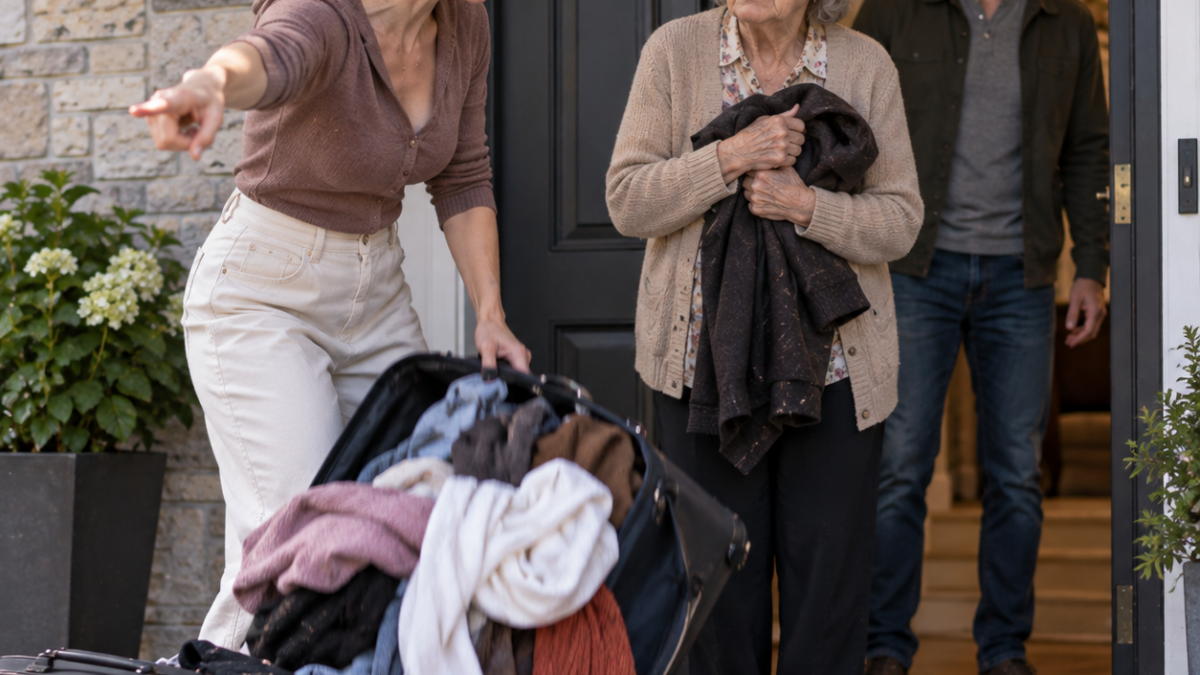
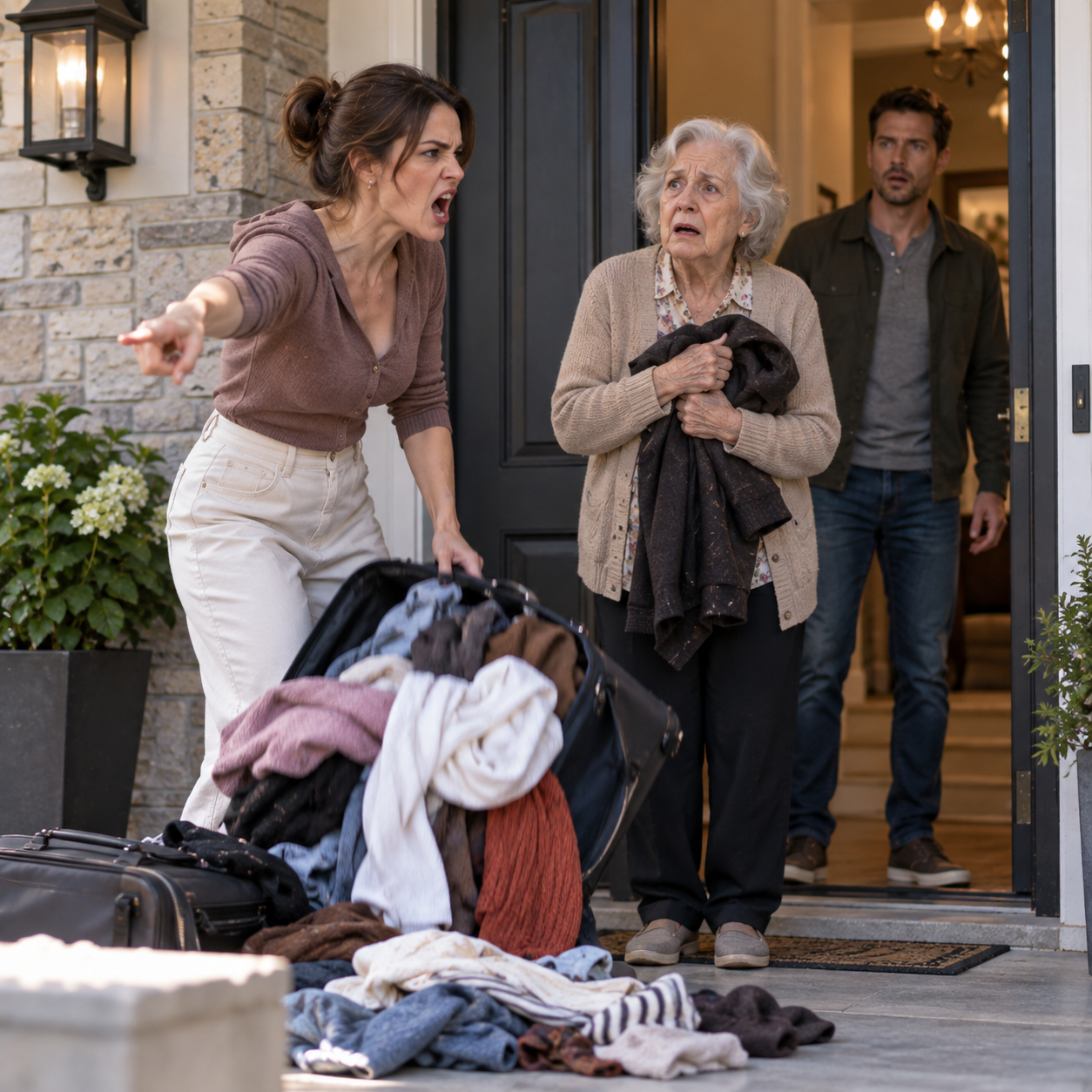
The old canvas bag hit the porch floor and burst open.
Sweaters, socks, a faded floral dress, and a handful of personal belongings scattered across the front steps.
Vanessa stood in the doorway, her jaw tight with anger.
“You need to leave.”
Dorothy didn’t move.
The seventy-year-old woman clutched an old coat against her chest and stared at her clothes on the ground as if she still couldn’t understand what had just happened.
“Vanessa…” she said quietly. “Caleb told me I could stay until my leg was better.”
“Caleb isn’t the one who has to live with you all day.”
Vanessa bent down, grabbed another sweater caught in the doorway, and tossed it outside.
“You’ve been here almost four months.”
Dorothy swallowed.
“I’ve tried to help.”
“Help?”
Vanessa let out a bitter laugh.
“You leave your medicine all over the kitchen. You move so slowly that I have to wait for everything. And every night you ask Caleb why he’s coming home late.”
Dorothy lowered her eyes.
“I’m only worried about him.”
“That’s exactly the problem.”
Vanessa pointed toward the yard.
“You are always interfering in our life.”
Dorothy looked at her daughter-in-law.
For months, she had tried to convince herself that Vanessa was simply tired.
That work was stressful.
That the house was too small for three adults.
That if Dorothy spoke less, moved more quietly, and made herself almost invisible, things would eventually get better.
But now there was no excuse left.
“I’ll call Caleb.”
Dorothy reached for the phone in her coat pocket.
Vanessa snatched it from her hand.
“No.”
Dorothy froze.
“Give me my phone.”
“You don’t need to call him.”
Vanessa placed the phone on a small table inside.
“He’s working. I’ll tell him later.”
“But I don’t have anywhere to go.”
Dorothy’s voice was barely louder than the wind.
Vanessa stared at her.
There was no sympathy in her expression.
“There are hotels.”
“My pension won’t cover a hotel for long.”
“Then call your friends.”
“My closest friends live hours away.”
Vanessa crossed her arms.
“That’s not my problem.”
At that exact moment, the sound of suitcase wheels scraping against the driveway came from behind them.
Vanessa turned.
The cold expression disappeared from her face.
Caleb stood at the gate.
A small suitcase rested beside him.
His shirt was wrinkled from traveling.
He said nothing.
His eyes moved from his mother’s face…
to the clothes scattered across the porch…
and finally to Vanessa.
“Mom?”
Dorothy turned around.
“Caleb…”
Vanessa immediately stepped forward.
“You’re home early.”
Caleb didn’t answer.
He bent down and picked up his mother’s sweater.
Then the dress.
Then the socks lying beside the steps.
One item at a time.
Nobody spoke.
Dorothy tried to bend down to help, but Caleb stopped her.
“Mom, don’t.”
His voice was calm.
Almost too calm.
When everything was back inside the bag, he stood.
“What’s going on?”
Vanessa took a breath.
“Don’t make this bigger than it is.”
“I asked what’s going on.”
“I just think it’s time your mother found somewhere else to stay.”
Caleb stared at her.
“You threw my mother’s clothes outside?”
“I’ve talked to her about this before.”
Dorothy quickly interrupted.
“It’s all right, sweetheart.”
Caleb turned to her.
“Mom. Stop.”
Dorothy fell silent.
He had heard her say those words his entire life.
It’s all right.
It was all right when she worked two jobs after his father left.
It was all right when she wore the same winter coat for six years so she could save money for Caleb’s education.
It was all right when she sold her wedding ring to cover his last semester of college.
It was all right when she drove three hours to help him move into his first apartment.
Dorothy always said it was all right.
Even when nothing was.
Caleb turned back to Vanessa.
“I want to hear everything.”
Vanessa exhaled sharply.
“Fine.”
She pointed at Dorothy.
“I can’t live like this anymore.”
“Like what?”
“She’s here all day.”
“She had hip surgery.”
“That doesn’t mean she has to live with us forever.”
“She’s been here fourteen weeks.”
“Fourteen weeks is long enough.”
Caleb looked at his mother.
Dorothy avoided his eyes.
He immediately understood.
“Something else happened, didn’t it?”
“Caleb…”
“What has Vanessa been saying to you?”
“Nothing.”
Vanessa stepped in.
“See? She does this. She acts like she’s the victim.”
Caleb turned sharply toward his wife.
“You just threw a seventy-year-old woman’s belongings outside.”
“This is our house!”
Vanessa shouted.
The words made Caleb go still.
Dorothy looked up too.
Vanessa gestured around the house.
“I live here too. I have a right to decide who stays here.”
Caleb stared at her for a long moment.
Then he asked quietly,
“What did you just say?”
Vanessa hesitated.
“I said this is our house.”
“No.”
Caleb set his mother’s bag down.
“You said you have the right to decide who stays here.”
“Yes.”
“Then maybe I made a very big mistake.”
Vanessa frowned.
“What are you talking about?”
Caleb pulled out his phone.
He opened a folder.
Then held the screen toward her.
“This house cost $480,000 when I bought it.”
“I know.”
“How much was the down payment?”
Vanessa said nothing.
“Caleb…”
“How much?”
“I don’t remember.”
“I do.”
Caleb turned toward Dorothy.
“Mom gave me $80,000.”
Vanessa immediately replied,
“She gave you the money. It was a gift.”
Dorothy spoke softly.
“Not exactly.”
Vanessa looked at her.
Dorothy slowly stepped closer.
“After my husband died, I sold my old house. Caleb needed money for the down payment, so I gave him most of my savings.”
Vanessa shrugged.
“So?”
Caleb looked at his wife.
“And because Mom’s attorney wanted to protect her investment, her name was added to the ownership agreement.”
Vanessa’s expression changed.
“What?”
“Mom owns thirty percent of this house.”
The porch fell completely silent.
Vanessa stared at Dorothy.
Then at Caleb.
“You never told me.”
“I didn’t think I had to.”
“I’m your wife!”
“And she’s my mother.”
Caleb pointed toward the bag of clothes.
“One of the owners of this house—the woman you just threw outside.”
Vanessa stepped back.
“I… I didn’t know.”
Dorothy looked at her.
Her voice remained calm.
“But if you had known, would you have treated me differently?”
Vanessa froze.
Dorothy continued.
“If my name wasn’t on any paperwork, would what you did suddenly be acceptable?”
Vanessa opened her mouth.
Nothing came out.
Caleb turned to his mother.
“Mom, go inside.”
Dorothy shook her head.
“No.”
“Mom?”
She pulled the old coat tighter around herself.
“I think I should leave today.”
Caleb stared at her.
“After this, you still want to leave?”
“Not because Vanessa told me to.”
Dorothy looked at the house behind him.
“But because I don’t want to live in a home where my presence turns the two of you into this.”
“Mom, you didn’t do anything wrong.”
“Maybe not.”
Dorothy gave him a sad smile.
“But sometimes leaving doesn’t mean losing.”
She bent down to pick up the bag.
Caleb took it before she could.
“I’m taking you somewhere.”
Vanessa suddenly panicked.
“Caleb, we need to talk.”
He turned around.
“We will.”
“I was angry. I didn’t mean—”
“You took my mother’s phone.”
Vanessa went silent.
Dorothy looked up.
Caleb continued.
“I heard you.”
“But you just got here.”
“I stood by the gate for almost two minutes.”
The color drained from Vanessa’s face.
Caleb had heard almost everything.
“I didn’t want her calling you and making me look like the bad person.”
“She didn’t have to do that.”
Caleb looked directly at her.
“You did that yourself.”
He led his mother toward the car.
Vanessa followed them.
“Caleb!”
He opened the passenger door for Dorothy.
“Mom, get in.”
Dorothy sat down.
Vanessa grabbed Caleb’s arm.
“You’re really leaving?”
Caleb gently removed her hand.
“I’m taking my mother somewhere safe.”
“What about me?”
Caleb looked at her.
For the first time, Vanessa realized there wasn’t just anger in his eyes.
There was disappointment.
“You’re standing inside a warm house.”
He said quietly.
“The woman you just threw out isn’t.”
Then he closed the car door.
Dorothy stayed at a hotel for two nights.
Caleb paid for everything.
On the third day, he rented her a small apartment near her physical therapy center.
Dorothy protested.
Caleb refused to listen.
But there was something Dorothy didn’t know.
While she was unpacking her clothes in the new apartment, Caleb returned home to speak with Vanessa.
She was sitting in the living room.
Her eyes were red.
A small suitcase stood beside the couch.
“I’m sorry.”
Those were the first words Vanessa said.
Caleb sat across from her.
“What are you sorry for?”
“For losing my temper.”
“That’s all?”
Vanessa lowered her head.
“I’ve been under a lot of pressure.”
“I know.”
“My job might be cut. We still have the mortgage. You travel all the time. I feel like I’m handling everything alone.”
Caleb remained silent.
“And then your mother moved in.”
Vanessa continued.
“The house became crowded. I didn’t have any space anymore.”
“Then why didn’t you talk to me?”
“I did.”
“You told me you were uncomfortable. You never told me you wanted my mother out on the street.”
Vanessa began to cry.
“I didn’t really want that.”
“But you did it.”
Silence filled the room.
Finally, Caleb placed an envelope on the table.
Vanessa looked at it.
“What’s that?”
“A copy of the property agreement.”
She didn’t touch it.
“What are you going to do?”
“I don’t know yet.”
“You want a divorce?”
Caleb looked toward the window.
“Last night, I remembered something.”
He turned back to her.
“When I was twelve, my mother worked at a diner during the day and cleaned offices at night.”
Vanessa said nothing.
“One winter, the heating system in our apartment broke. She didn’t have enough money to fix it immediately.”
Caleb gave a faint, humorless smile.
“She told me her bedroom was warmer, so she put the only space heater in my room.”
He paused.
“I found out years later that her room had no heat at all.”
Vanessa wiped her eyes.
“You never told me that.”
“There are a lot of things I never told you.”
Caleb looked at the envelope.
“Maybe because I thought when you married me, respecting my mother wouldn’t require an explanation.”
Vanessa lowered her head.
“I know I was wrong.”
Caleb spoke slowly.
“What I don’t know is whether you regret hurting her…”
He paused.
“…or whether you regret that I saw it.”
Vanessa couldn’t answer.
And Caleb knew he couldn’t simply return to normal.
Three weeks passed.
Vanessa didn’t see Dorothy.
She sent two apology messages.
Dorothy answered both with the same short response.
“Thank you.”
Nothing more.
One Saturday afternoon, Vanessa drove to Dorothy’s apartment.
She didn’t tell Caleb.
Dorothy was sitting on her small balcony, carefully watering a few plants.
She looked surprised when Vanessa appeared.
“Caleb doesn’t know I’m here.”
Vanessa said.
Dorothy put down the watering can.
“Would you like to come in?”
The apartment had only one bedroom.
The furniture was simple.
Photographs of Caleb as a child covered one wall.
Vanessa stopped in front of one picture.
Caleb was about eight years old, missing his two front teeth and holding a crooked birthday cake.
Dorothy smiled.
“That year I couldn’t afford to buy one, so I made it myself.”
Vanessa turned toward her.
“Do you hate me?”
Dorothy thought for a moment.
“No.”
“Why not?”
“Hating someone is exhausting.”
Dorothy sat down.
“At my age, I don’t want to spend my time doing that.”
Vanessa lowered her eyes.
“I did something terrible.”
“Yes.”
Vanessa looked up, surprised by the blunt answer.
Dorothy continued.
“But one terrible action doesn’t always define an entire person.”
Vanessa looked at her.
“Does that mean you forgive me?”
Dorothy shook her head.
“Forgiveness isn’t the same as pretending something never happened.”
She met Vanessa’s eyes.
“Trust takes longer than an apology.”
Vanessa nodded.
For the first time, she didn’t make excuses.
She didn’t mention stress.
She didn’t mention work.
She didn’t blame the small house.
She simply said,
“I understand.”
Before leaving, Vanessa placed something on the table.
Dorothy’s old phone.
“I kept it that day.”
Dorothy looked at the phone.
“I should have returned it sooner.”
Vanessa stopped at the door.
“And… there’s something else I want to say.”
Dorothy waited.
“Even if you didn’t own any part of the house…”
Vanessa took a breath.
“…I still had no right to treat you that way.”
Dorothy studied her for a long moment.
Then she gave a small nod.
It wasn’t forgiveness.
But it was a beginning.
Six months later, Dorothy never moved back in with Caleb and Vanessa.
She liked her small apartment.
She became friends with two neighbors.
She attended physical therapy three times a week.
She grew tomatoes on the balcony.
Caleb came over for dinner sometimes.
Vanessa occasionally came with him.
Their relationship never returned to what it had been before.
Maybe that was a good thing.
Because before, Dorothy always stayed silent to keep the peace.
Vanessa held in her resentment until it became anger.
And Caleb assumed the two most important women in his life would somehow figure everything out.
After the day Dorothy’s belongings were thrown onto the porch, none of them could pretend anymore.
One Sunday evening after dinner, Caleb helped his mother wash the dishes.
Dorothy looked at him.
“Are you happy?”
Caleb paused.
“I think we’re trying.”
“That’s not what I asked.”
He looked at her.
“Do you want me to leave Vanessa?”
Dorothy shook her head.
“I don’t want to make decisions about your life.”
She placed a plate into the cabinet.
“I just don’t want you to make the mistake I made.”
“What mistake?”
“Using the word ‘family’ as a reason to tolerate things that should never be tolerated.”
Caleb went quiet.
Dorothy smiled gently.
“Family isn’t a place where someone gets permission to hurt another person simply because they believe they’ll always be forgiven.”
Outside on the balcony, the tomato plants moved softly in the wind.
Caleb looked at his mother.
Six months earlier, he had thought the worst part was seeing her clothes scattered across the porch.
But now he understood that wasn’t what hurt the most.
What hurt was the expression on her face.
She hadn’t been angry.
She hadn’t fought back.
She had simply accepted it.
As if, after a lifetime of sacrificing for everyone else, she still believed she needed permission to stay.
Caleb stepped forward and hugged her.
Dorothy laughed softly.
“What are you doing?”
“Nothing.”
He hugged her tighter.
“I just want you to know something.”
“What?”
Caleb looked at her.
“The next time someone makes you feel like you’re not welcome…”
He gave a small smile.
“…don’t stand outside the door waiting for them to change their mind.”
Dorothy nodded.
She looked around her little apartment.
At the photographs on the wall.
At the plants on the balcony.
At the chair beside the window.
And for the first time in months, she didn’t feel like a guest in anyone else’s life.
She had a place of her own.
Not because someone allowed her to stay.
But because she finally understood something.
A home is not defined by whose name appears on the paperwork.
It is defined by the place where you are treated as if your presence matters.