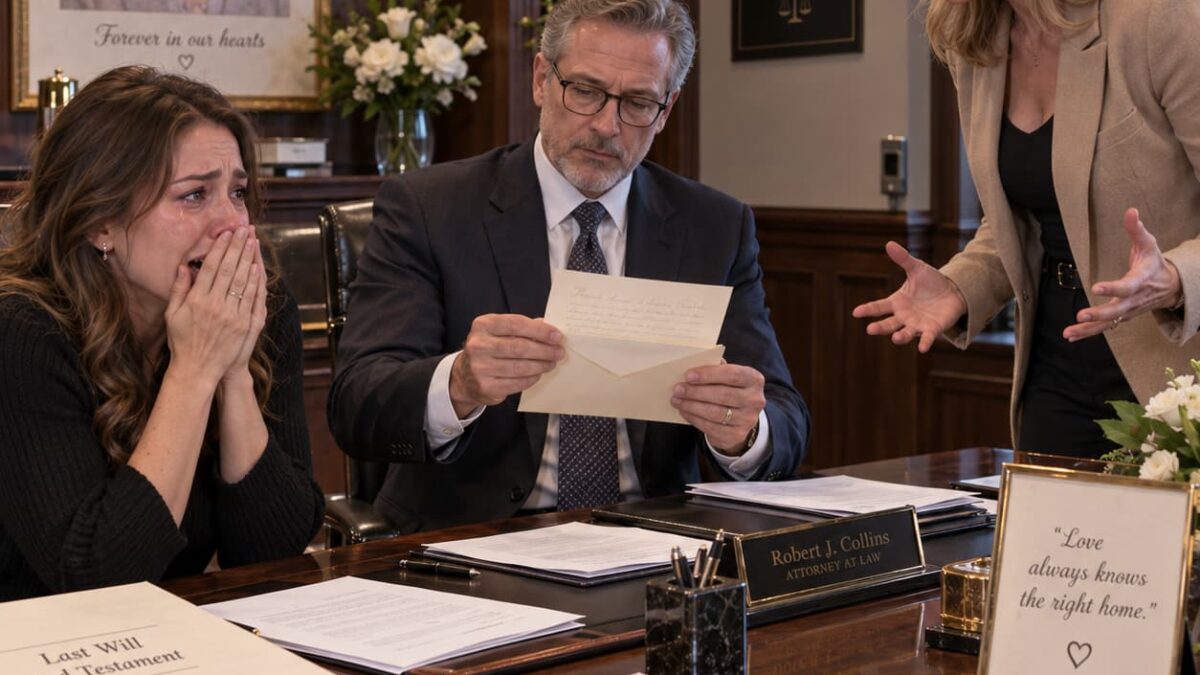
My mother had been dead less than three hours when my sister told me I did not belong in the family.
We were standing in the reception hall behind St. Matthew’s Church.
People were still arriving with flowers.
Aunt Evelyn was crying into a handkerchief near the coffee table.
My mother’s neighbors had filled one corner of the room with casseroles nobody was touching.
Someone had placed a large framed photograph of Mom beside the guest book.
She was smiling in it.
That hurt more than seeing the casket had.
Because the woman in that photograph looked alive enough to walk through the door and ask why everyone was making such a fuss.
I had barely slept in two days.
My hands were still shaking from signing forms at the funeral home.
I had spent the morning greeting people, accepting condolences, answering questions about the burial, and trying to keep myself from falling apart every time someone said, “Your mother was such a wonderful woman.”
Then Melissa walked up beside me.
My older sister.
Biologically, Mom’s daughter.
Emotionally, at that moment, I hardly recognized her.
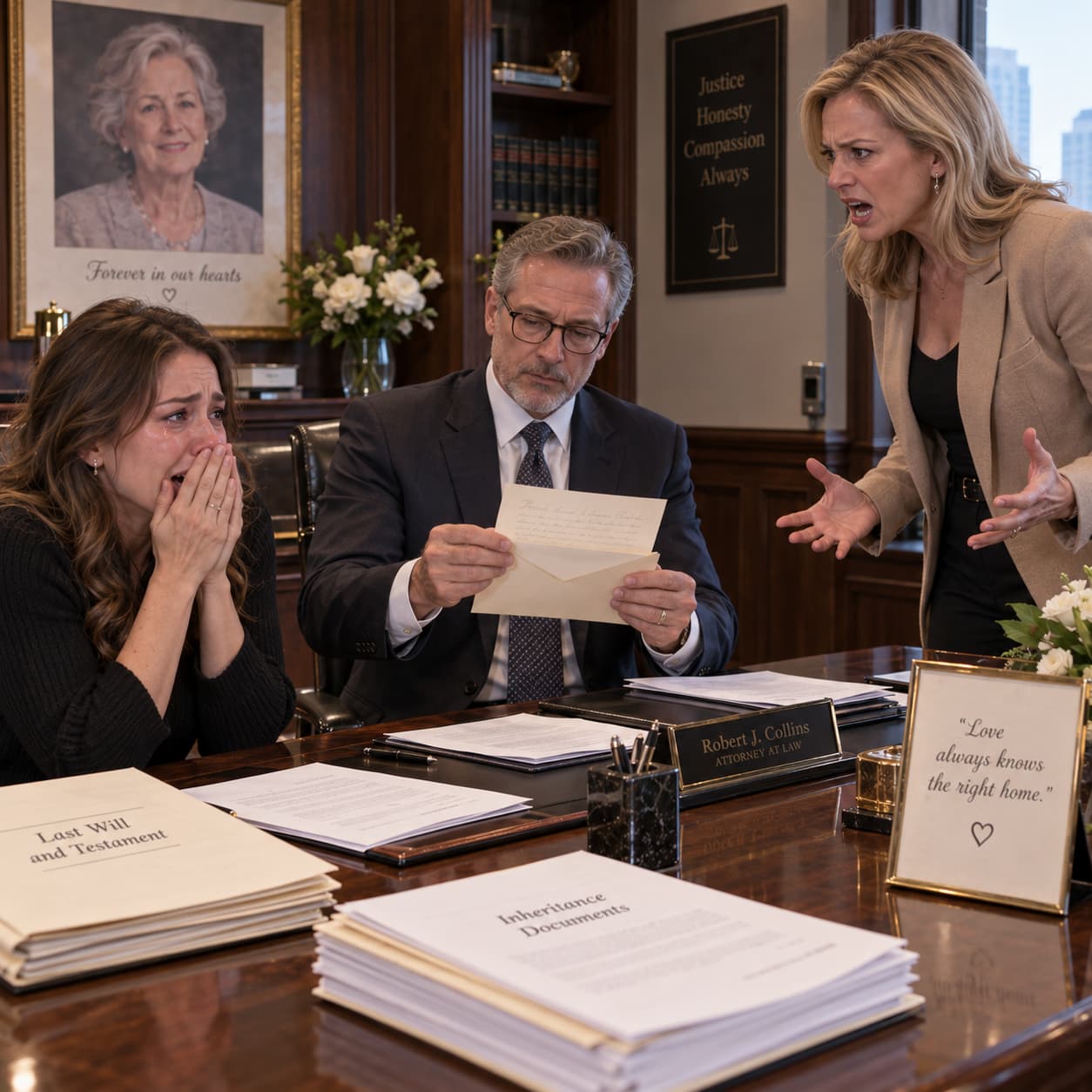
She was holding a glass of white wine even though the reception had only been going for twenty minutes.
Her black dress looked perfect.
Her makeup had survived the entire service.
I probably looked terrible.
I did not care.
Melissa stared across the room at the photograph of our childhood home sitting on a memorial display.
Then she said, quietly enough that only I could hear:
“You know the house really belongs to blood family.”
For a moment, I thought grief had made me misunderstand her.
I turned.
“What?”
She took a sip.
“The house.”
I just stared at her.
“Mom isn’t even buried yet.”
Melissa shrugged.
“I’m not trying to be cruel.”
“You chose an interesting way to show that.”
She sighed as if I were making things difficult.
“I’m just saying we should be realistic before lawyers get involved.”
“Realistic about what?”
“The estate.”
I could not believe we were having this conversation.
Not here.
Not now.
Not while our mother’s friends were ten feet away discussing where to send flowers.
I lowered my voice.
“Melissa, stop.”
“You know I’m right.”
“About what?”
She glanced toward the room, making sure no one was listening.
Then she said it.
“You were adopted.”
I felt the words like a slap.
Not because I had forgotten.
I had known I was adopted since I was old enough to understand what the word meant.
Mom never hid it.
Dad never hid it either.
They had adopted me when I was nine months old.
There were photographs of the day they brought me home.
Mom holding me in a yellow blanket.
Dad standing beside her looking terrified.
Melissa, four years old, reaching toward me from the couch.
For most of my childhood, adoption was simply one fact among many.
Melissa had brown eyes.
I had green ones.
Melissa hated peas.
I loved them.
Melissa was born into the family.
I was chosen into it.
Mom never made that distinction feel important.
Melissa sometimes did.
When we were children, she used it during arguments.
“You’re not even my real sister.”
Mom heard her once.
She made Melissa apologize before dinner.
Then Mom sat both of us down and said something I never forgot.
“There are no temporary daughters in this house.”
Melissa cried.
I cried.
We hugged.
For years afterward, she never said it again.
At least not directly.
Until the funeral.
I looked at her.
“You really want to do this right now?”
“I’m trying to avoid confusion.”
“There is no confusion.”
“There will be when the estate is divided.”
I laughed once, but there was no humor in it.
“What exactly do you think is going to happen?”
Melissa straightened.
“The house should stay in the family.”
“It is in the family.”
She gave me a look.
That look said everything.
Not your family.
Ours.
Before I could respond, our cousin Rebecca walked toward us.
Melissa immediately smiled.
“Rebecca.”
The transformation was instant.
One second she was telling me I had less right to our mother.
The next she was hugging relatives and thanking them for coming.
I stood there in silence.
That was when I realized something.
Mom was gone.
And without her there, Melissa no longer felt obligated to pretend.
The burial happened forty-five minutes later.
I stood beside the grave as the casket was lowered.
The wind was cold.
Melissa stood on the other side.
Neither of us looked at each other.
When the service ended, people gradually left.
I remained behind.
I waited until almost everyone was gone.
Then I walked closer to the grave.
“Mom,” I whispered.
My throat closed.
For the first time all day, I cried properly.
Not the polite tears that come during hymns.
Not the controlled grief you allow in front of guests.
I bent forward and cried so hard I could barely breathe.
Because Melissa’s words had opened something ugly inside me.
A fear I thought I had outgrown decades earlier.
What if blood did matter more?
What if Mom had always known other people saw me differently?
What if I had only belonged because she was there to insist that I did?
I hated myself for thinking it.
Then I remembered the last three years.
Mom’s illness had started slowly.
At first, it was fatigue.
Then forgotten appointments.
Then falls.
Then a diagnosis that changed everything.
She became weaker.
I moved back into the house.
Not because anyone asked me to.
Because it was obvious someone needed to.
Melissa lived only forty minutes away.
I lived two states over.
But when the neurologist said Mom should no longer live alone, I packed my apartment within two weeks.
I transferred my job to remote work.
I took the smaller bedroom upstairs because Mom wanted to remain in the master bedroom she had shared with Dad.
I handled medications.
Doctor appointments.
Groceries.
Insurance calls.
Physical therapy.
Nighttime emergencies.
Falls.
Confusion.
Fear.
The first year, Melissa visited often.
The second year, less.
The third year, sometimes a month passed without her coming.
She had reasons.
Work.
Her children.
Her husband.
Vacations.
A kitchen remodel.
A conference.
A migraine.
A school function.
I never judged her out loud.
I knew everyone had responsibilities.
But there were nights when Mom woke at two in the morning calling for Dad, who had been dead for eleven years.
There were mornings when she could not remember how to button her blouse.
There was one terrible afternoon when she fell beside the bed and I sat on the floor holding her for twenty minutes until the paramedics arrived.
Melissa was in Cabo that week.
Mom knew.
She never complained.
That made it worse.
The week after the funeral, I received a call from Mom’s attorney.
His name was Daniel Foster.
He had handled my parents’ legal affairs for more than twenty years.
“Claire,” he said, “I’d like you and Melissa to come into the office together.”
My stomach tightened.
“When?”
“Friday morning.”
I knew what it meant.
The will.
I almost told him I didn’t care.
At that point, I truly thought I didn’t.
I wanted my mother back.
I would have signed away the house, money, jewelry, everything if someone could have given me one more Sunday morning drinking coffee with her.
But grief does not stop paperwork.
So Friday morning, I drove to Daniel’s office.
Melissa was already there.
She wore a cream coat and carried a leather folder.
That annoyed me.
Not because there was anything wrong with a folder.
Because it made the meeting feel like a business negotiation to her.
She had come prepared.
I sat across from her.
Daniel entered a few minutes later.
He looked tired.
“First,” he said, “I’m sorry for your loss.”
We both thanked him.
Then he began.
There were several smaller distributions.
Mom left money to the church.
A donation to the local hospice.
A small amount to each grandchild for education.
Dad’s watch went to Melissa’s son.
Mom’s sapphire earrings went to Melissa.
Her wedding ring came to me.
Melissa’s mouth tightened slightly, but she said nothing.
Then Daniel reached the house.
He adjusted his glasses.
“The property at 18 Willow Ridge Road, including the residence and remaining furnishings not otherwise designated, is left solely to Claire Bennett.”
Silence.
Melissa blinked.
I thought I had heard wrong.
She leaned forward.
“What?”
Daniel looked at her.
“The house is left to Claire.”
“No.”
Her voice was sharp.
Daniel stayed calm.
“Yes.”
“No, that’s not possible.”
“It is.”
Melissa looked at me.
I said nothing.
She looked back at him.
“I’m her daughter.”
“So is Claire.”
“You know what I mean.”
Daniel’s expression changed slightly.
“I believe I do.”
Melissa stood.
“This is insane.”
“Melissa, please sit down.”
“No. I want to know when this was changed.”
Daniel opened the file.
“Fourteen months ago.”
Melissa stared at him.
“That was when she was already sick.”
My entire body went cold.
I knew what she was implying.
Daniel clearly did too.
“She was evaluated for capacity at the time.”
Melissa laughed bitterly.
“By whom?”
“Her physician, and I met with her privately on two separate occasions.”
“Privately?”
“Yes.”
“Without Claire?”
“Yes.”
Melissa looked at me again.
Her suspicion was obvious.
I felt sick.
“You think I made her do this?”
“I didn’t say that.”
“You didn’t have to.”
Daniel raised one hand.
“There is more.”
Melissa sat down slowly.
He took out a second envelope.
It had Mom’s handwriting on the front.
To My Daughters.
My chest tightened.
Daniel opened it.
He looked at both of us.
“Your mother asked that I read this if either of you questioned the division of the estate.”
Melissa crossed her arms.
Of course she did.
Daniel unfolded the letter.
Then he began reading.
“My dear Melissa and Claire,
If you are hearing this, then I am gone, and at least one of you is probably upset.”
Despite everything, I almost smiled.
That sounded exactly like Mom.
Daniel continued.
“I know both of my daughters well enough to know that silence rarely lasts long in this family.”
Melissa looked away.
Then came the line that changed the room.
“Melissa, if you are hearing this and you are angry that Claire received the house, ask yourself one question:
Who lived in it with me during the years I needed help?”
Melissa’s face froze.
Daniel kept reading.
“Claire did not move home because I promised her anything. I did not promise her the house. I did not promise her money.
She moved because I was frightened.
She moved because I was falling.
She moved because I was forgetting things and pretending I wasn’t.
She changed her life so I could remain in mine.”
I stared at the floor.
My vision blurred.
Daniel continued.
“She cleaned me when I was sick.
She sat beside me in emergency rooms.
She slept with her bedroom door open because I was afraid to be alone at night.
She learned every medication I took.
She cooked foods I could swallow when eating became difficult.
She stayed.”
Melissa’s breathing changed.
I could hear it.
“I love both of you.
But fairness does not always mean dividing everything in half.
Sometimes fairness means recognizing what each person gave.”
Melissa suddenly spoke.
“I have children.”
Daniel stopped.
“What?”
“I have children. I had responsibilities.”
I looked at her.
No one had accused her of anything.
Not yet.