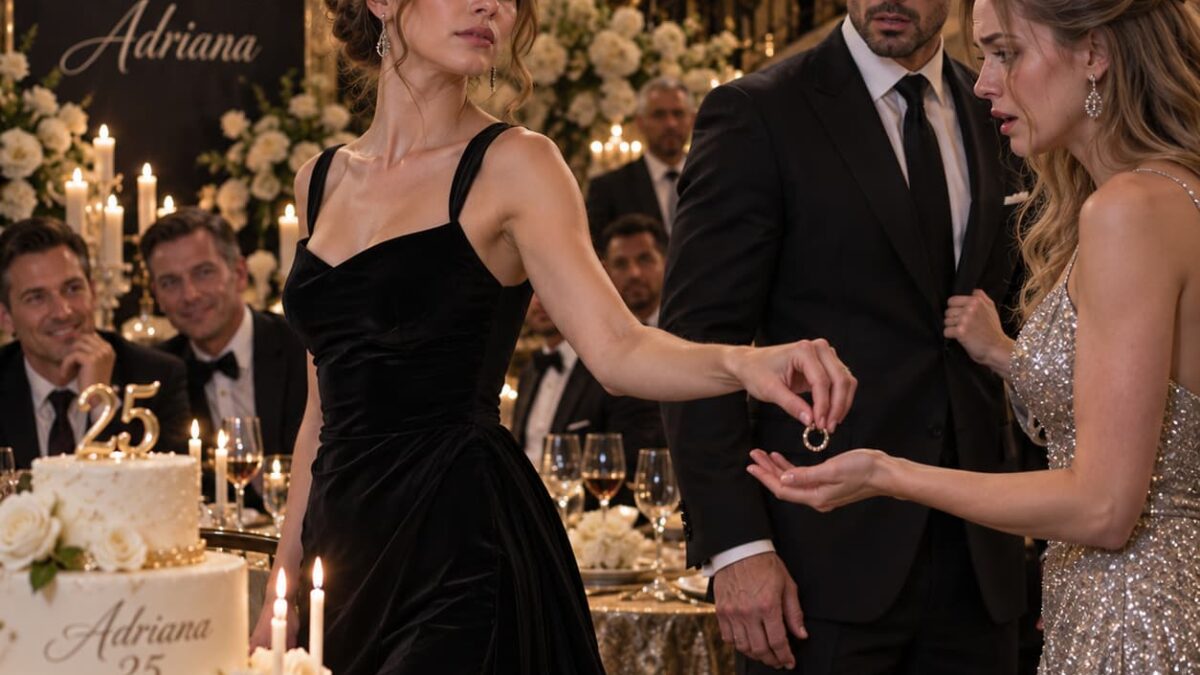
When my husband walked into my birthday dinner with another woman on his arm, the room went so quiet I could hear the candles burning.
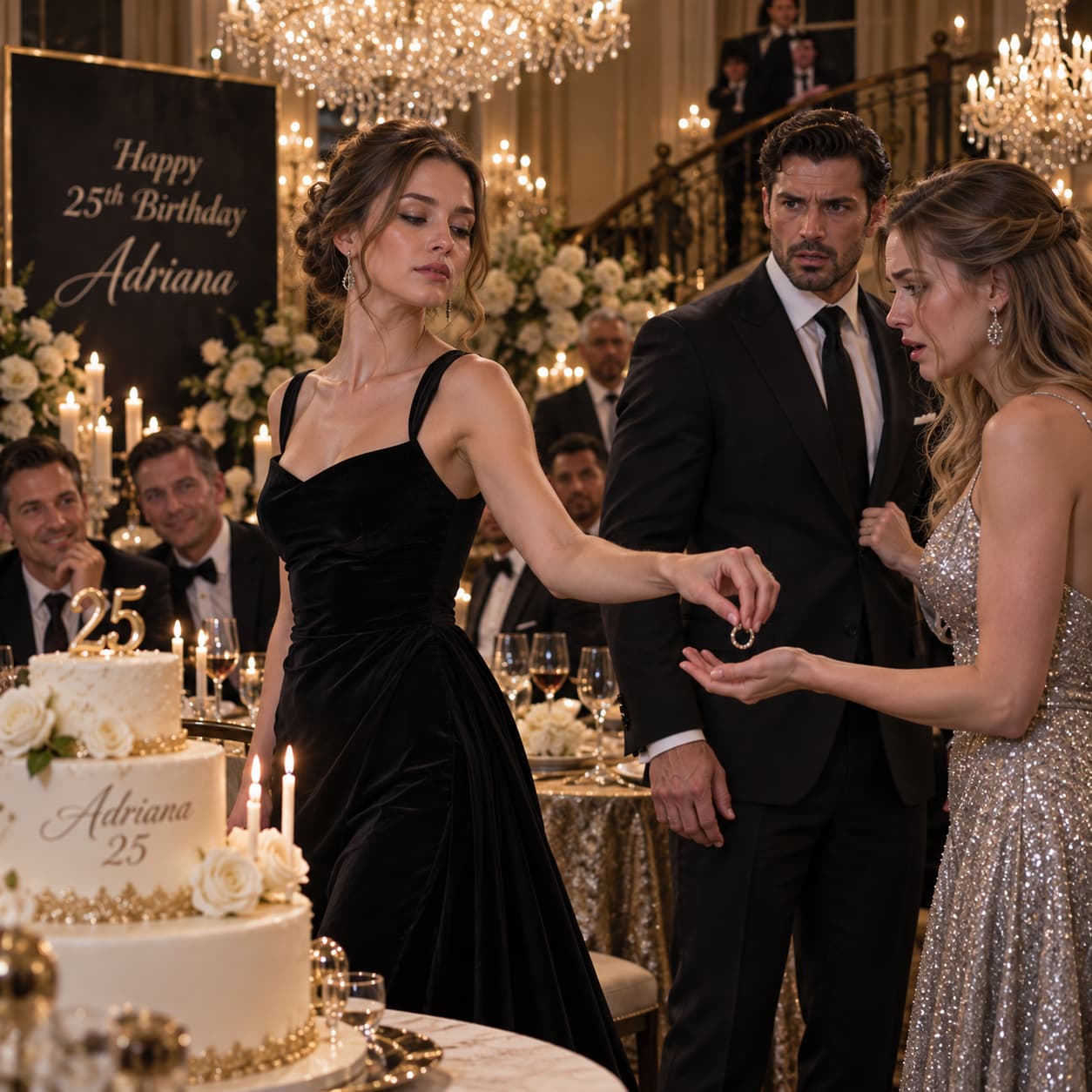
Twenty-five candles leaned over my white-and-gold cake, their flames trembling beneath the chandelier.
Then Alessandro Romano entered.
He wore black, as always.
His dark hair was combed back, his expression unreadable, and one hand rested against the lower back of the woman beside him.
She was young, dark-haired, and dressed in silver satin.
Later, I would learn her name was Camila Marino.
At that moment, all I knew was that my husband had brought another woman to my birthday.
In front of his family.
In front of his captains.
In front of everyone who mattered in the Romano world.
Ruggero Romano, Alessandro’s father’s cousin and one of the oldest men in the organization, lifted his wineglass.
He smiled.
That smile told me everything.
This wasn’t an accident.
It was a performance.
And everyone was waiting to see what I would do.
Alessandro looked directly at me.
“Happy birthday, Adriana.”
I stood.
They expected screaming.
Perhaps a slap.
Perhaps tears.
Instead, I walked toward the woman.
Up close, I noticed something I hadn’t seen from across the room.
There was a bruise beneath the makeup on Camila’s wrist.
She wasn’t smiling.
She wasn’t proud.
She was terrified.
I reached for her hand.
She flinched.
“It’s all right,” I whispered.
Then I removed my wedding ring.
I placed it in her palm and closed her trembling fingers around it.
“He’s yours.”
Nobody moved.
Camila stared at the ring.
Ruggero laughed.
“Well,” he said, “that’s certainly one way to cut the cake.”
Alessandro didn’t laugh.
His eyes stayed on me.
“Adriana.”
I smiled.
“Enjoy the party.”
Then I walked away.
I spent that night above Bellini Jewel Restoration, the small Chicago workshop that had belonged to my father.
I had grown up there surrounded by gold dust, broken watches, antique rings, and tiny tools designed to repair things most people would have thrown away.
My father used to say:
“Anything can be repaired, Adriana. The question is whether it should be.”
That night, I finally understood him.
At eight the next morning, someone knocked.
I opened the door holding jeweler’s shears.
Maso Greco stood outside carrying coffee and pastries.
Behind him was Dr. Leah Ferraro, one of the few people connected to the Romano family whom I trusted.
Maso raised the pastry box.
“Peace offering.”
“From Alessandro?”
“Absolutely not. If Alessandro had sent it, I would have poisoned it myself out of principle.”
Leah pushed past him.
“Did Alessandro hurt you?”
“No.”
“Did Camila?”
“No.”
Leah and Maso exchanged a look.
I noticed.
“What?”
Neither answered.
“Maso.”
He sighed.
“Camila isn’t Alessandro’s mistress.”
I laughed.
It wasn’t a happy sound.
“Then perhaps somebody should explain why she entered my birthday party attached to my husband’s arm.”
“Because Ruggero was watching.”
That stopped me.
Maso put down his coffee.
“Three months ago, Camila’s brother disappeared.”
“Who is her brother?”
“Mateo Marino. Accountant.”
“For whom?”
Maso hesitated.
“The Romanos.”
I felt the room change.
Mateo Marino wasn’t simply an accountant.
He handled financial records for several companies tied to Alessandro’s organization.
If he had disappeared, it meant one of two things.
He had stolen something.
Or he had discovered something.
“What did Mateo find?”
Leah answered.
“Evidence that someone inside the organization has been moving money.”
“How much?”
“Millions.”
“And Alessandro thinks Ruggero is responsible.”
Maso nodded.
I remembered Ruggero’s smile at my birthday.
Suddenly it looked different.
“Why Camila?”
“Mateo sent her something before he disappeared.”
“What?”
“We don’t know.”
“Does Ruggero?”
“He knows she has something.”
I stared at them.
“And Alessandro’s brilliant plan was to parade her into my birthday pretending she was sleeping with him?”
Maso winced.
“When you say it like that—”
“How else would you say it?”
Leah interrupted.
“Ruggero had people watching Camila. Alessandro needed a reason to keep her physically close without revealing that she was a protected witness.”
I couldn’t believe what I was hearing.
“He could have told me.”
Silence.
That was the real wound.
Not Camila.
Not the party.
Not even the ring.
He could have trusted me.
But he hadn’t.
Alessandro arrived that afternoon.
Alone.
He stood inside my father’s workshop looking impossibly out of place among polishing wheels and velvet trays.
His eyes went immediately to my bare hand.
“Where is the ring?”
I stared at him.
“You were there.”
“Camila gave it back to me.”
He placed it on the workbench.
I didn’t touch it.
“Tell me everything.”
And for once, Alessandro did.
Mateo Marino had discovered that Ruggero was quietly siphoning money from Romano-controlled businesses.
But money was only part of it.
Ruggero had also been secretly communicating with a rival organization.
He intended to weaken Alessandro financially, provoke conflict between several crews, and eventually remove him.
Mateo copied records.
Then he vanished.
Before disappearing, he sent Camila a key.
Nobody knew what it opened.
Ruggero believed Camila possessed evidence.
Alessandro moved her into a protected apartment.
But when Ruggero’s men began following her, Alessandro created the mistress story.
A mistress could remain close to him without raising questions.
“What about the bruise?” I asked.
Alessandro’s jaw tightened.
“Ruggero’s men grabbed her two nights ago.”
My anger shifted.
Not disappeared.
Shifted.
“You should have told me.”
“I couldn’t.”
“You chose not to.”
“I was protecting you.”
I laughed.
“Men like you use that sentence whenever you want women to forgive being lied to.”
His face hardened.
“If Ruggero believed you knew anything, you would become leverage.”
“I already am leverage. I’m your wife.”
He had no answer.
I pointed toward the ring.
“You humiliated me in a room full of people because your plan required me to look stupid.”
“I knew you would survive it.”
That sentence nearly ended us.
I stared at him.
“Surviving what someone does to you is not the same as consenting to it.”
For once, Alessandro Romano looked ashamed.
Three days later, Camila came to see me.
Without Alessandro.
She stood in my father’s shop wearing jeans and an oversized sweater.
She looked younger without the silver dress.
“I’m sorry,” she said.
“You didn’t make the decision.”
“I agreed to it.”
“Because your brother was missing.”
She nodded.
Then she reached inside her purse.
“I think I know what the key opens.”
She placed a tiny brass key on the counter.
I examined it.
And something about it felt familiar.
Not the shape.
The engraving.
There was a small symbol near the base.
A bell surrounded by three stars.
My stomach tightened.
Bellini.
My father’s mark.
“Where did Mateo get this?”
“I don’t know.”
I picked up my jeweler’s loupe.
Under magnification, I saw a sequence of tiny numbers scratched into the metal.
A repair number.
My father’s repair number.
I pulled open an old filing cabinet.
It took nearly an hour.
Then I found the receipt.
Six years earlier, my father had repaired an antique Swiss music box belonging to—
Ruggero Romano.
The music box was still in Ruggero’s private office.
Getting it was the dangerous part.
Alessandro wanted to handle it.
I refused.
“You didn’t trust me with the first plan,” I told him. “You don’t get to lock me outside the second.”
Eventually, he agreed.
Ruggero was invited to dinner at the Romano house under the pretense of discussing territory.
While he was away, Maso and I entered his office.
The music box sat behind glass.
I recognized my father’s restoration work immediately.
The key fit.
But it didn’t wind the mechanism.
It opened a hidden compartment beneath it.
Inside was a flash drive.
And a handwritten note.
Mateo’s handwriting.
If something happens to me, follow the transfers. R.R. knows.
The flash drive contained copies of financial records, messages, account numbers, and dates.
Enough to prove Ruggero had betrayed Alessandro.
But there was something else.
A photograph.
Mateo.
Alive.
Standing beside a motel sign in Wisconsin.
The photograph had been taken four days earlier.
“He isn’t dead,” Camila whispered.
Ruggero had been holding Mateo.
He intended to force him to reveal whether additional copies of the evidence existed.
But Mateo had escaped during a transfer and contacted a federal attorney through someone he trusted.
Within days, everything accelerated.
Lawyers became involved.
Investigators became involved.
Businesses were frozen and examined.
Men who had spent decades believing they were untouchable suddenly discovered that bank records were less loyal than soldiers.
Ruggero realized Alessandro knew.
He tried to leave Chicago.
He didn’t get far.
I won’t pretend the Romano world became clean overnight.
It didn’t.
Alessandro wasn’t suddenly an innocent businessman because somebody worse betrayed him.
But Ruggero’s network collapsed.
Several associates were arrested on financial and conspiracy charges.
Mateo entered protective custody while cooperating with investigators.
Camila left Chicago.
Before leaving, she visited me once more.
“I still have something of yours.”
She handed me a small velvet box.
My wedding ring.
“Alessandro gave it to you,” I said.
“I told him it wasn’t mine to return.”
I looked at her.
“Neither is he.”
For the first time, Camila smiled.
“Good.”
Then she hugged me.
Alessandro and I remained separated.
That surprised everyone.
Apparently the Romano men understood betrayal, murder, loyalty, and revenge better than they understood boundaries.
Alessandro came to the jewelry shop every Sunday.
Sometimes he brought coffee.
Sometimes dinner.
Sometimes he simply sat while I worked.
He never asked me to put the ring back on.
That mattered.
Months passed.
Then one evening, I asked him:
“Why did you marry me?”
He looked genuinely surprised.
“Because I love you.”
“No. Why did you marry me?”
He understood the difference.
After a long silence, he said:
“Because you were the only person who looked at me and didn’t seem impressed or afraid.”
“That’s a terrible reason.”
“I know.”
“What do you love about me now?”
He looked around my father’s workshop.
“That you left.”
I stopped polishing the bracelet in my hand.
He continued.
“You walked out of a house full of men who expected you to accept humiliation because you were my wife.”
His voice lowered.
“And you reminded me that being my wife does not mean belonging to me.”
That was the first apology I believed.
Not because he said he was sorry.
Because he finally understood what he’d done.
It took almost a year before I returned to the Romano house.
Not to live there.
For dinner.
Teresa nearly cried when she saw me.
Maso actually did, though he claimed there was pepper in the air.
Leah called him pathetic.
Alessandro stood beside the dining table.
The same table where I had removed my ring.
There were no captains.
No audience.
No performance.
Only dinner.
Afterward, Alessandro walked me outside.
At the car, he took something from his pocket.
My ring.
He held it between two fingers.
“I’ve kept this long enough.”
I looked at it.
“Are you asking me to wear it?”
“No.”
He placed it in my palm.
“I’m giving it back because it belongs to you.”
That distinction mattered.
I closed my fingers around it.
Then I kissed him.
But I didn’t put the ring on.
Not yet.
Two years after my twenty-fifth birthday, Bellini Jewel Restoration reopened downstairs with my name on the window.
ADRIANA BELLINI — RESTORATION & DESIGN
I no longer lived inside Alessandro’s world.
If he wanted me in his life, he had to enter mine too.
Sometimes he came to the shop after closing.
He learned how to make coffee properly.
He learned not to touch tools without asking.
He even learned that “I’m protecting you” was not an acceptable substitute for a conversation.
We rebuilt slowly.
Not the marriage we had.
Something different.
Something chosen.
Eventually, one winter evening, I opened the safe behind my workbench.
My wedding ring was inside.
I had repaired hundreds of rings in my life.
Broken prongs.
Cracked bands.
Missing stones.
Engravings worn smooth by decades of skin.
But I hadn’t altered mine.
Until that night.
On the inside of the band, I engraved four words:
I belong to myself.
Then I slipped it onto my finger.
Alessandro noticed immediately.
He didn’t smile.
He didn’t reach for me.
He simply looked at the ring and then at my face.
“Are you sure?”
“Yes.”
Only then did he kiss me.
People still tell the story of my twenty-fifth birthday.
Depending on who tells it, I either humiliated the most dangerous man in Chicago, abandoned a criminal empire, or handed my husband to his mistress in front of half the city.
None of those versions is quite right.
Camila was never really the other woman.
Ruggero was never really fighting over a marriage.
And the ring was never really about Alessandro.
It was about me.
For years, I had mistaken being protected for being respected.
They are not the same.
Protection without truth is another kind of cage.
Love without choice is possession dressed beautifully enough that you might mistake it for devotion.
My husband brought another woman to my birthday because he believed humiliating me was an acceptable price for keeping me safe.
I handed her my wedding ring because, for the first time, I understood that being someone’s wife did not require me to accept whatever decisions he made in the name of love.
Camila gave the ring back.
Alessandro eventually gave me the truth.
But neither of them gave me my life back.
I did that myself.
My father once told me anything could be repaired.
He was almost right.
Some things should be repaired.
Some things should be rebuilt differently.
And some things should remain broken long enough to teach you why they broke in the first place.
That night, when I placed my wedding ring in Camila’s trembling hand and said, “He’s yours,” I thought I was giving away my marriage.
I wasn’t.